5 Signs Your Child Is a Visual Learner
Unlocking the secret to how your child's brain processes information can transform frustration into academic triumph. Here is how to spot a visual learner.
Have you ever felt like you and your child are speaking two entirely different languages when it comes to homework? You explain a math concept slowly and clearly, using your best teacher voice, but they just stare at you blankly. Yet, the moment you draw a quick picture of the problem on a scrap of paper, their eyes light up with sudden understanding. If this scenario sounds familiar, you might be raising a visual learner.
Educational psychologists have long recognized that children process information in different ways, often categorized by the VARK model: Visual, Auditory, Reading/Writing, and Kinesthetic. While most children use a mix of these modalities, many have a dominant learning style that dictates how they best absorb, retain, and understand new information.
Visual learners are those who need to see the world to understand it. They thrive on images, colors, spatial layouts, charts, and demonstrations. Unfortunately, traditional schooling often leans heavily on auditory lectures and dense text, which can leave a brilliant visual learner feeling lost or inadequate. By identifying these traits early, you can advocate for your child and provide them with the visual tools they need to succeed. Here are the five most common signs that your child is a visual learner.
They Have Vivid Imaginations and Think in Pictures
One of the most profound indicators that you are raising a visual learner is the way they conceptualize the world inside their own minds. While auditory learners might process thoughts as an ongoing internal monologue or a series of spoken conversations, visual learners quite literally 'see' their thoughts. If you ask them to describe an event from their school day or a dream they had the night before, pay close attention to the language they use. They will often paint a picture with their words, focusing heavily on colors, spatial arrangements, and specific visual details rather than what was said.
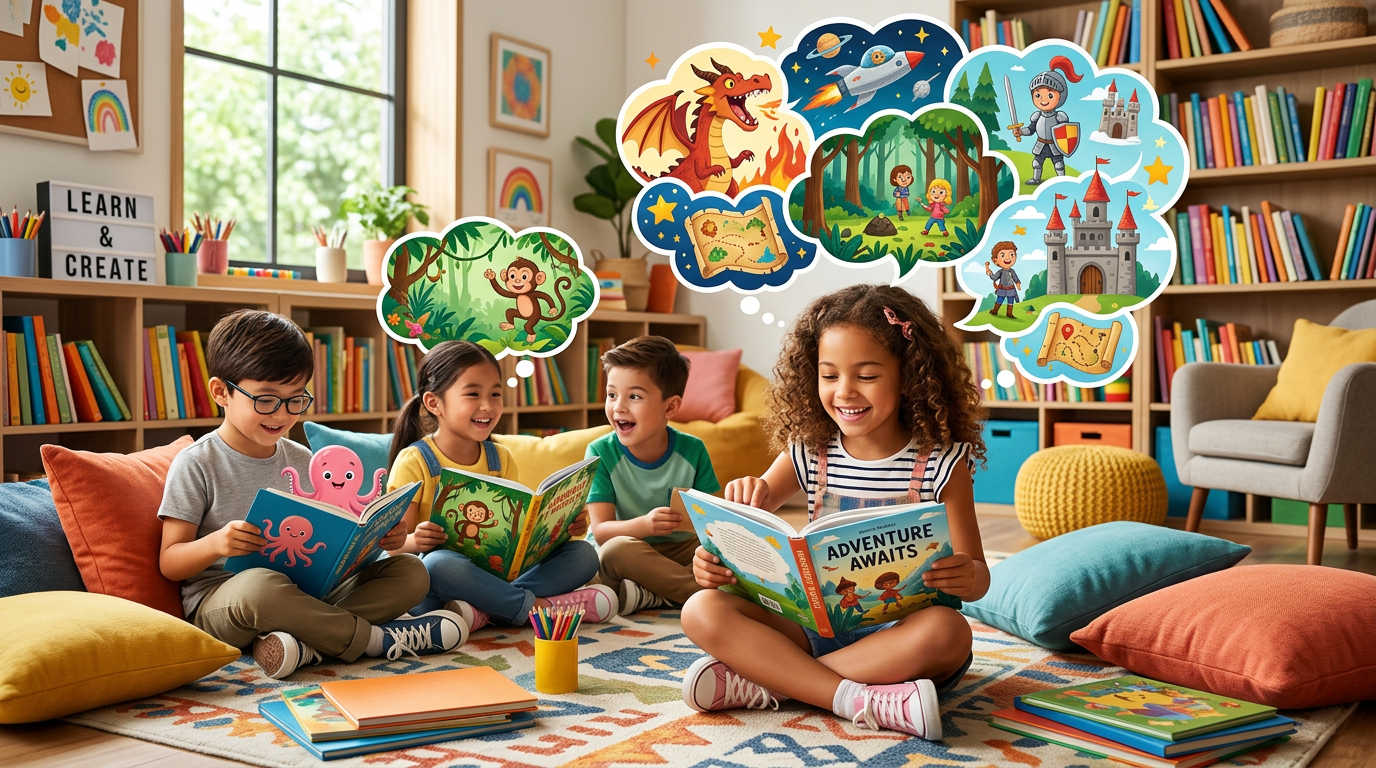
This incredible capacity for visualization means they often have incredibly vivid imaginations. When reading a story or listening to an audiobook, a visual learner is directing a full-length, high-definition movie inside their head. They can effortlessly picture the sprawling fantastical landscapes, the exact shade of the dragon's scales, and the layout of the hero's castle. However, this also means that if a concept is presented entirely in abstract terms without any visual anchors, they may struggle to grasp it. They need a mental image to attach the new information to.
Because their internal world is so visually rich, you might also notice them staring off into space or daydreaming frequently. They aren't necessarily ignoring you or losing focus; they are often deep in the process of building, rotating, and examining mental imagery. Recognizing this trait is the first step in shifting your educational approach from a text-heavy or lecture-based style to one that embraces charts, diagrams, and visual storytelling.
Visual thinkers often see the solution to a problem as a complete picture before they can even articulate the steps to get there. It's a hallmark of incredible creative and spatial intelligence.
Encouraging a child who thinks in pictures requires providing them with the tools to get those pictures out of their heads and onto paper. Here is how you can support this unique cognitive style:
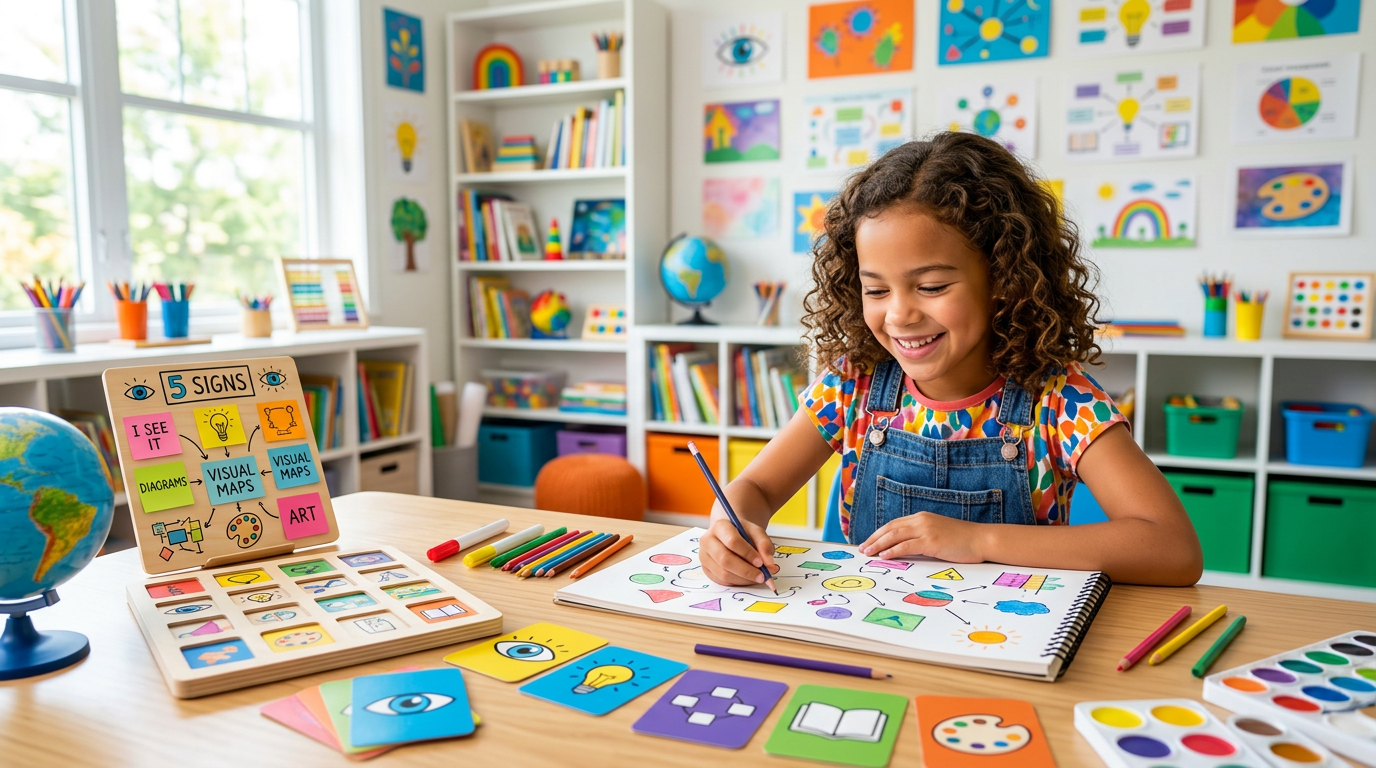
• Introduce Mind Mapping: When your child is tackling a complex topic for school, such as a history lesson or a science concept, ditch the traditional bulleted outlines. Instead, teach them how to create mind maps. Use a large piece of paper, put the main idea in the center, and draw branching lines to sub-topics. Encourage them to use different colored markers and small doodles for each branch.
• Ask Visual Questions: Change the way you ask about their day. Instead of 'What did you do today?', ask 'What was the most colorful thing you saw today?' or 'Can you draw a picture of the best part of recess?'
• Use Graphic Organizers: Whether they are writing a story or planning a science project, provide graphic organizers like Venn diagrams, flowcharts, or storyboards. This aligns perfectly with how their brain naturally categorizes information.
• Encourage 'Sketch-Noting': If they are listening to a lecture or a story, allow them to doodle. Sketch-noting (drawing small icons and pictures to represent concepts) actually increases focus and retention for visual learners, even if it looks to an outsider like they aren't paying attention.
They Are Drawn to Colorful, Illustrated Books Over Text-Heavy Pages
If your child actively avoids chapter books that feature wall-to-wall text but will happily spend hours pouring over graphic novels, encyclopedias, comic books, or heavily illustrated guides, you are almost certainly looking at a visual learner. Many parents worry when their older child resists transitioning to traditional, text-only chapter books, fearing it indicates a reading delay or a lack of interest in literature. In reality, it is often simply a strong preference for visual input.
For a visual learner, illustrations are not just decorative fluff; they are vital context clues that anchor the narrative and deepen comprehension. When a page is nothing but a solid block of black-and-white text, it can feel visually exhausting and mentally unstimulating to a child whose brain craves color, shape, and spatial design. Graphic novels, on the other hand, perfectly marry text with sequential art, allowing the visual learner to process the story at lightning speed while maintaining deep engagement with the plot and character development.
Furthermore, these learners often use the physical layout of a page to remember information. They might not remember the exact sentence that explained photosynthesis, but they will remember that the information was located in the bottom left corner of the page, right next to the diagram of the green leaf with the yellow sun arrows. This spatial-visual memory is a powerful tool that should be embraced rather than discouraged.
Graphic novels and heavily illustrated books are not 'lesser' forms of reading. For visual learners, they are the necessary bridge between abstract text and deep, meaningful comprehension.
You can cultivate a deep love of reading in your visual learner by filling their library with formats that cater to their strengths. Consider these strategies:
• Embrace Graphic Novels: Stock up on high-quality graphic novels. These books require complex inferencing skills, as the reader must synthesize the text with the facial expressions, background details, and action sequences depicted in the art.
• Invest in Visual Encyclopedias: Books published by companies like DK (Dorling Kindersley) or National Geographic Kids are absolute goldmines. The combination of bite-sized text boxes, vibrant photographs, cutaway diagrams, and timelines perfectly suits their learning style.
• Try 'Seek and Find' Books: Books like 'Where's Waldo?' or the 'I Spy' series are fantastic for honing their already strong visual acuity and focus.
• Create a Visual Reading Log: Instead of just writing down the title and author of a book they finished, have them design a 'movie poster' or a new book cover for the story. This allows them to process and summarize the book using their strongest modality.
They Notice Tiny Visual Details That Others Completely Miss
Visual learners are the ultimate observers. From a very young age, you might have noticed your child pointing out the tiniest speck of dirt on a pristine floor, noticing a slight change in a teacher's hairstyle, or immediately zeroing in on a missing toy in a cluttered playroom. Their brains are highly attuned to their visual environment, constantly scanning, categorizing, and noticing discrepancies.
This acute observational skill translates directly into how they learn to read and write. Visual learners are often excellent spellers because they don't just sound words out; they memorize the visual 'shape' of the word. They will notice if a word 'looks wrong' even if they can't articulate the phonetic rule that is being broken. Conversely, they might struggle initially with phonics-heavy reading instruction because their instinct is to recognize the whole word visually rather than breaking it down into individual, auditory sounds.
Because their visual radar is always on, they can also become easily distracted by visual clutter. A classroom or a homework desk that is overly decorated, messy, or chaotic can overwhelm their senses and make it difficult for them to focus on the task at hand. Creating a visually calm, organized space is often key to helping them concentrate.
A visual learner doesn't just look at the world; they study it. Their eyes are constantly gathering data, finding patterns, and noticing the subtle visual shifts that escape the rest of us.
You can turn their natural observational skills into a superpower through targeted, fun activities that challenge their visual memory and attention to detail:
• Play the 'Tray Game' (Kim's Game): Place 10-15 random household objects on a tray. Let your child study the tray for 30 seconds. Cover it with a towel and ask them to name as many objects as they can remember. Alternatively, remove one object while they close their eyes and have them guess what is missing.
• Spot the Difference Puzzles: Provide them with 'spot the difference' pictures. This classic game is excellent for training their eyes to systematically scan and compare complex visual fields.
• Memory Match (Concentration): Playing traditional card-matching memory games is a fantastic way to exercise their short-term visual memory.
• Declutter the Workspace: Recognize that visual noise equals mental noise for these kids. Ensure their homework area is clean, organized, and free of highly distracting posters or messy piles of paper. Use solid, neutral colors for their desk setup to minimize visual fatigue.
They Struggle with Verbal Instructions but Excel with Demonstrations
If you regularly find yourself repeating instructions like, 'Go upstairs, brush your teeth, grab your blue sweater, and bring down your library book,' only to find your child standing in the hallway 10 minutes later holding a completely different item and looking confused, take a deep breath. They are likely not being defiant or forgetful; their brain simply does not hold onto a string of auditory information effectively.
Visual learners operate on the principle of 'show me, don't tell me.' When given a long list of verbal commands, the words often go in one ear and out the other because they haven't had the time to translate those auditory signals into mental pictures. However, if you show them what to do, or provide a written or illustrated checklist, they will suddenly seem like the most organized and capable child in the world.
This trait becomes incredibly apparent in the classroom. A visual learner might completely tune out during a 20-minute verbal lecture from a teacher. But the moment that same teacher turns to the whiteboard to draw a diagram, write out a timeline, or perform a physical demonstration of a science experiment, the visual learner is locked in and fully engaged. They rely on visual evidence to confirm and solidify their understanding of the world.
For a visual child, auditory instructions evaporate into the air the moment they are spoken. Visual instructions, however, are cemented into their minds like a photograph.
To reduce frustration for both you and your child, adapt your communication style to rely less on your voice and more on visual cues. Try implementing these highly effective strategies:
• Create Visual Checklists: For daily routines like getting ready for school or completing bedtime tasks, create a visual checklist. For younger kids, use clip art or photos of them doing the task (a picture of a toothbrush, a picture of pajamas). For older kids, a written whiteboard list works perfectly.
• The 'Look at Me' Rule: Before giving an important verbal instruction, ensure you have their full, direct eye contact. Ask them to picture the steps in their head as you say them, and then have them repeat the steps back to you.
• Demonstrate the Task: Instead of explaining how to load the dishwasher or solve a long division problem, do it with them first. Say, 'Watch my hands while I do this,' and let them observe the process from start to finish before they attempt it.
• Color-Code Everything: Use color to organize their life. Use different colored folders for different school subjects (e.g., green for science, red for math). Color-code family calendars so they can see at a glance who is doing what on any given day.
They Love Art, Building, and Hands-on Visual Projects
It is no surprise that children who process the world visually are often naturally drawn to visually creative pursuits. You will frequently find visual learners gravitating toward drawing, painting, sculpting, and crafting. They love the process of taking a blank canvas or a lump of clay and manipulating it to match the vibrant images they hold in their minds. Art is not just a hobby for them; it is a primary language.
Beyond traditional art, visual learners often show a strong aptitude for building and spatial manipulation. They are the kids who can spend hours engrossed in a complex LEGO set, often intuitively understanding how the pieces fit together to create a 3D structure even without relying heavily on the step-by-step manual. They enjoy jigsaw puzzles, Tetris-style spatial games, and arranging their toys or room in very specific, aesthetically pleasing ways.
When it comes to school projects, visual learners will always prefer to build a diorama, create a poster board, film a video, or design a PowerPoint presentation over writing a standard five-paragraph essay. They understand that they can convey far more depth, emotion, and information through a well-crafted visual medium than they can through words alone. Encouraging these projects is a phenomenal way to help them demonstrate their intelligence and mastery of a subject.
When a visual learner builds, draws, or designs, they are actively processing information. Their hands and their eyes work together to make sense of complex concepts.
Lean into their love for visual creation to help them learn new concepts and build confidence. Here are ways to integrate visual projects into their routine:
• Build 3D Models: If they are learning about the solar system, don't just read about it—build a mobile. If they are studying ancient history, have them recreate a pyramid out of sugar cubes or clay. The physical, visual representation cements the knowledge.
• Use LEGO for Math: LEGO bricks are incredible tools for teaching math concepts to visual learners. Use them to visually demonstrate addition, subtraction, fractions (a 4-stud brick is half of an 8-stud brick), and area/perimeter.
• Encourage Digital Design: Introduce older visual learners to digital art, basic coding (like Scratch, which uses visual blocks), or simple graphic design tools like Canva. This modernizes their visual skills.
• Alternative Book Reports: If their teacher allows it, request that your child be able to present their book report as a comic strip summarizing the plot, a sculpted clay model of the main character, or a map of the story's setting.
Embracing the Visual Advantage
Realizing that your child is a visual learner is an incredibly empowering moment. It shifts the narrative from "why aren't they paying attention?" to "how can I present this information so they can see it?" Being a visual learner is not a deficit; it is a profound strength. Many of the world's greatest architects, engineers, artists, and innovators are highly visual thinkers who can conceptualize complex systems in their minds before bringing them to life.
By accommodating their need for color, spatial organization, visual storytelling, and hands-on demonstrations, you are providing them with the exact tools they need to unlock their full academic and creative potential. Encourage their doodling, celebrate their love for graphic novels, and remember that for them, a picture truly is worth a thousand words.
Nurture Your Visual Learner with Kiddz.club
Are traditional reading methods leaving your child frustrated? Discover our vast library of visually stunning, interactive stories and beautifully illustrated learning adventures perfectly tailored for visual minds.
Help Your Child Fall in Love with Reading
Picture This! teaches visualization step-by-step so children can genuinely understand—and enjoy—what they read.