
Igniting Curiosity: The Ultimate Guide to Hands-On STEM Projects
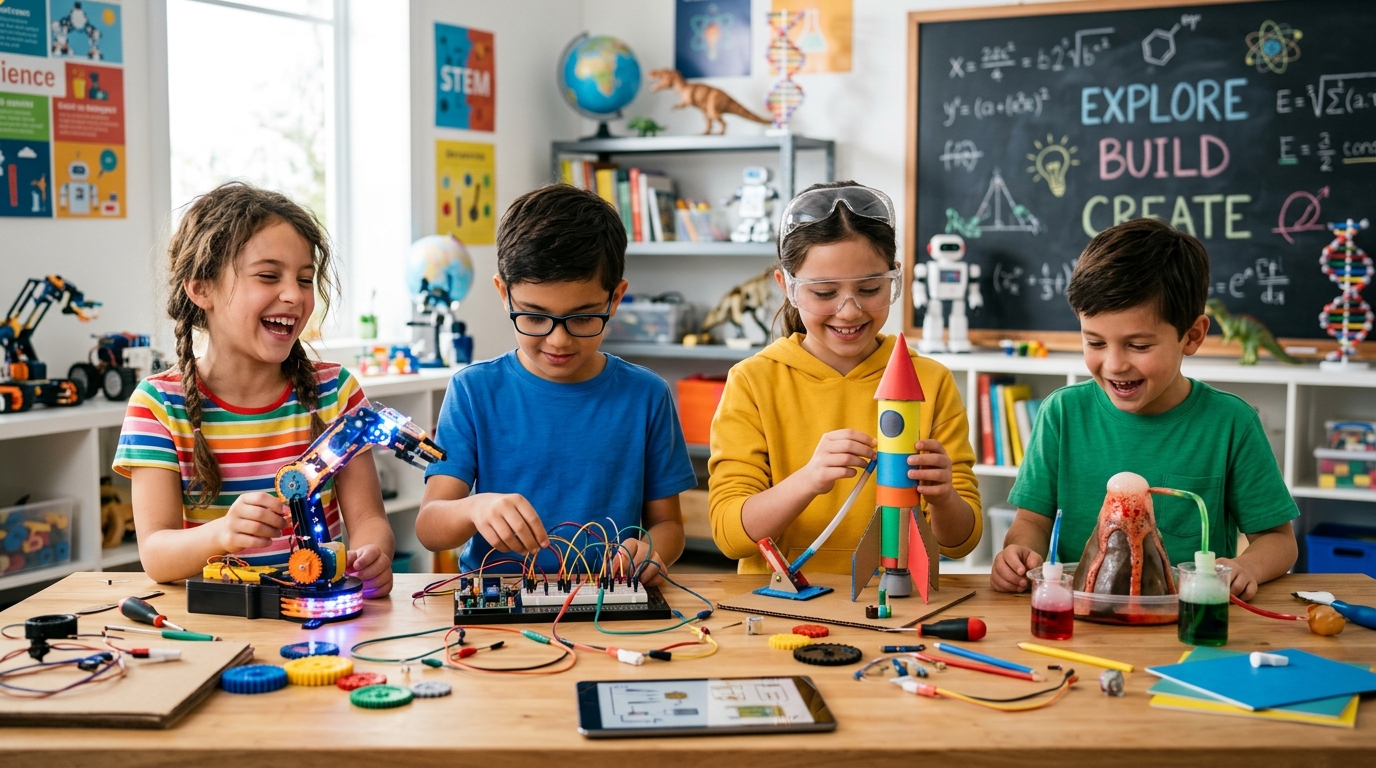
From backyard biology to kitchen chemistry and cardboard engineering, discover how to transform everyday learning into an interactive adventure. Science, Technology, Engineering, and Math are no longer siloed subjects—they are the building blocks of innovation.
Have you ever heard the expression, "Hey, it's not rocket science!"? In the world of modern education, that phrase is becoming obsolete. Sometimes, it is rocket science—and that's exactly the point. The global educational landscape has witnessed a massive, transformative shift toward STEM integration, moving away from fragmented, textbook-heavy instruction toward holistic, inquiry-based models.
This comprehensive guide explores the four pillars of STEM, offering concise project blueprints, pedagogical insights, and a curated library of external resources to help parents and teachers ignite a lifelong passion for learning in their students.
The Four Pillars of Hands-On Learning
Science is often taught as a set of static facts in a textbook, but true scientific understanding comes from observation, experimentation, and occasionally, making a mess. For middle school students, exploring fluid dynamics can bridge the gap between abstract physics and observable phenomena.
Project Idea: The Taylor-Couette Laminar Flow Model
This fascinating experiment visualizes fluid dynamics using two concentric cylinders. By placing a viscous fluid (like corn syrup or glycerin) between a stationary outer cylinder and a rotating inner cylinder, and adding drops of food coloring, students can observe laminar flow. When the inner cylinder is turned, the colors stretch into thin lines. Incredibly, when turned in the exact opposite direction, the colors un-mix and return to their original dot formations. This demonstrates the reversibility of Stokes flow and teaches kids about viscosity, fluid layers, and physical forces. You can find detailed guidance on creating a laminar flow model.
Project Idea: The Condiment Diver
A classic lesson in buoyancy and the ideal gas law. Take a clear, empty 2-liter plastic bottle, fill it with water, and drop in a small ketchup or soy sauce packet. Seal the bottle tightly. When students squeeze the sides of the bottle, the increased pressure compresses the tiny air bubble inside the condiment packet, increasing its density and causing it to sink. Releasing the pressure allows it to float back to the top. For more details on this classic experiment, check out the Exploratorium's Condiment Diver activity. It is a brilliant, inexpensive way to visualize complex physics principles.
Backyard Biology: The Common Brown Butterfly
Science isn't just about chemistry and physics; it's also about biology and ecology. Using online templates, students can practice fine motor skills and spatial awareness by building 3D paper models of butterflies. Parents and teachers can pair this hands-on craft with an outdoor excursion using tools like the iNaturalist app to observe local pollinators, record biodiversity data, and engage in genuine citizen science.
Technology education has moved far beyond simple keyboarding skills. Today, we want children to transition from being mere consumers of technology to active creators. This means demystifying the black boxes of their devices and teaching them the logic that powers the digital world.
Project Idea: Arduino LED Magic Effects
For students ready to dive into hardware programming, the Arduino platform is revolutionary. A brilliant starter project involves a color-changing RGB LED paired with an OLED mini screen. The system uses a tri-color LED that switches to a new color every few seconds, while the Arduino is programmed to simultaneously display the name of the color on the OLED screen. This requires students to wire a breadboard, understand basic circuitry (resistors, grounding, power), and write C++ based code to control the logic. Resources like Robocraze and other platforms offer hundreds of these beginner-to-advanced project blueprints.
Project Idea: Real-Time Environment Monitoring
Older students can combine a DHT (digital humidity and temperature) sensor with an RTC (real-time clock) module and a TFT screen. The Arduino reads the sensor values and time data, updating the display continuously. This project teaches students about data collection, IoT (Internet of Things) concepts, and how technology can be used to monitor and solve environmental challenges.
Screen-Free Tech: Logic Gates with Everyday Items
Technology doesn't always require a screen. You can teach the foundations of computer science—logic gates (AND, OR, NOT)—using dominoes or water valves. Setting up a series of dominoes where two separate lines must fall simultaneously to knock over the final block perfectly illustrates an "AND" gate, laying the cognitive groundwork for future software engineering.
Engineering is the application of science and math to solve real-world problems. In the context of K-12 education, it is fundamentally about the Engineering Design Process: asking questions, imagining solutions, planning, creating, testing, and improving. It teaches resilience, as failure is an expected and celebrated part of the iterative process.
Project Idea: The Cardboard Tube Marble Run
A staple of Makerspaces worldwide, the DIY marble run is an incredible exercise in structural engineering, gravity, and friction. Using paper towel rolls, toilet paper tubes, scissors, and painter's tape, children are tasked with getting a marble from point A to point B as slowly as possible. They must experiment with different angles of descent, test various elbow connectors, and troubleshoot when the marble flies off the track. Advanced versions can be built inside large cardboard boxes, utilizing cut-in-half tubes as open ramps to let kids observe the marble's momentum.
Project Idea: Straw Geodesic Domes
Architecture and spatial geometry collide in this engaging activity. Using standard drinking straws and pipe cleaners (or playdough) as joints, kids can construct 3D geodesic domes. They learn firsthand how 2D shapes (specifically triangles) can form incredibly strong and stable 3D structures. They quickly discover that a square base will wobble and collapse under pressure, but a structure built entirely of interconnected triangles distributes force evenly, supporting surprising amounts of weight.
Project Idea: Simple Machines and Levers
How can a child lift a heavy textbook with just one finger? By engineering a lever. Using a standard 12-inch ruler as the lever and a sturdy marker or wooden spool as the fulcrum, students can experiment with mechanical advantage. By moving the fulcrum closer to the heavy book, they realize that increasing the distance over which they apply force decreases the amount of effort required. It's a "eureka" moment that makes abstract physics wonderfully tangible.
Mathematics is the hidden language of the universe, but for many students, it feels like a confusing jumble of abstract rules. The key to engaging children in math is making it visible, tangible, and relevant to their daily lives. By integrating math into hands-on projects, the dreaded question of "when will I ever use this?" completely disappears.
Project Idea: Candy Math and Experimental Probability
Probability is a concept perfectly suited for hands-on learning. Give a student a fun-sized bag of colorful candies (like M&Ms or Skittles). Before opening it, ask them to determine the theoretical probability of pulling out a red candy based on the number of colors available. Then, have them open the bag, count the total candies, and calculate the experimental probability. They can graph the results, compare their bag's distribution to a classmate's, and learn about sample sizes and the Law of Large Numbers—all while enjoying a sweet treat.
Project Idea: The Geometry of Packaging
Have students deconstruct everyday cardboard boxes (cereal boxes, toothpaste boxes, shipping boxes) to explore surface area, volume, and geometric nets. By flattening a 3D box into a 2D net, they can measure the dimensions, calculate the area of each rectangular face, and understand how packaging engineers optimize materials to reduce waste and shipping costs. They can then be challenged to design their own mathematically precise packaging for an oddly shaped toy.
Project Idea: Financial Literacy and Budget Engineering
Math isn't just about shapes and chance; it's also about resource management. Give students a hypothetical budget (e.g., $100) and a catalog of building materials with assigned costs (e.g., cardboard is $10/sheet, tape is $5/roll). Challenge them to build the tallest freestanding tower possible without exceeding their budget. This forces them to balance structural integrity with financial constraints, requiring constant calculation, estimation, and strategic planning.
The Parent & Educator Role: Embracing Failure
As a facilitator of STEM activities, your most important job is not to know all the answers. Your role is to guide the inquiry process. When a child's cardboard marble run collapses, or their Arduino code throws a syntax error, resist the urge to step in and fix it immediately. Ask guiding questions: "What do you think went wrong here? How can we test a different approach? What did we learn from this attempt?" Teaching children to embrace mistakes as valuable data points is the most critical STEM skill you can impart.
External Resource Library
You don't have to reinvent the wheel. Educational organizations, universities, and makerspaces have developed thousands of free, vetted lesson plans. Explore the curated links below by subject area.
Ready to Start Building?
The beauty of hands-on STEM education is that it requires curiosity, not an expensive laboratory. With recycled cardboard, a few kitchen supplies, and a willingness to explore, you can help children unlock the fundamental mechanics of the world around them. Gather your materials, ask a big question, and let the innovation unfold.
Help Your Child Fall in Love with Reading
Picture This! teaches visualization step-by-step so children can genuinely understand—and enjoy—what they read.
Related Articles
Sources & References
- How to Create a Laminar Flow Taylor–Couette Model with Middle School Kids
- Condiment Diver: Fluids & Mechanics Science Activity
- Science Snacks | Exploratorium
- 299+ Arduino Projects for Beginners & Advanced (2026) [Free Code + PDF] - Techatronic
- Top 10 STEM Projects You Can Build in an Arduino Lab - Robocraze
- Engineering for Kids: Straw Geodesic Dome & Sphere
- Build a Cardboard Marble Run: Engineering Challenge - Makers' Muse
- Science Fair Project Ideas, Answers, & Tools
- Free STEM Lesson Plans for K-12 Teachers - ORISE
- Teach Engineering: Ignite STEM learning in K-12