
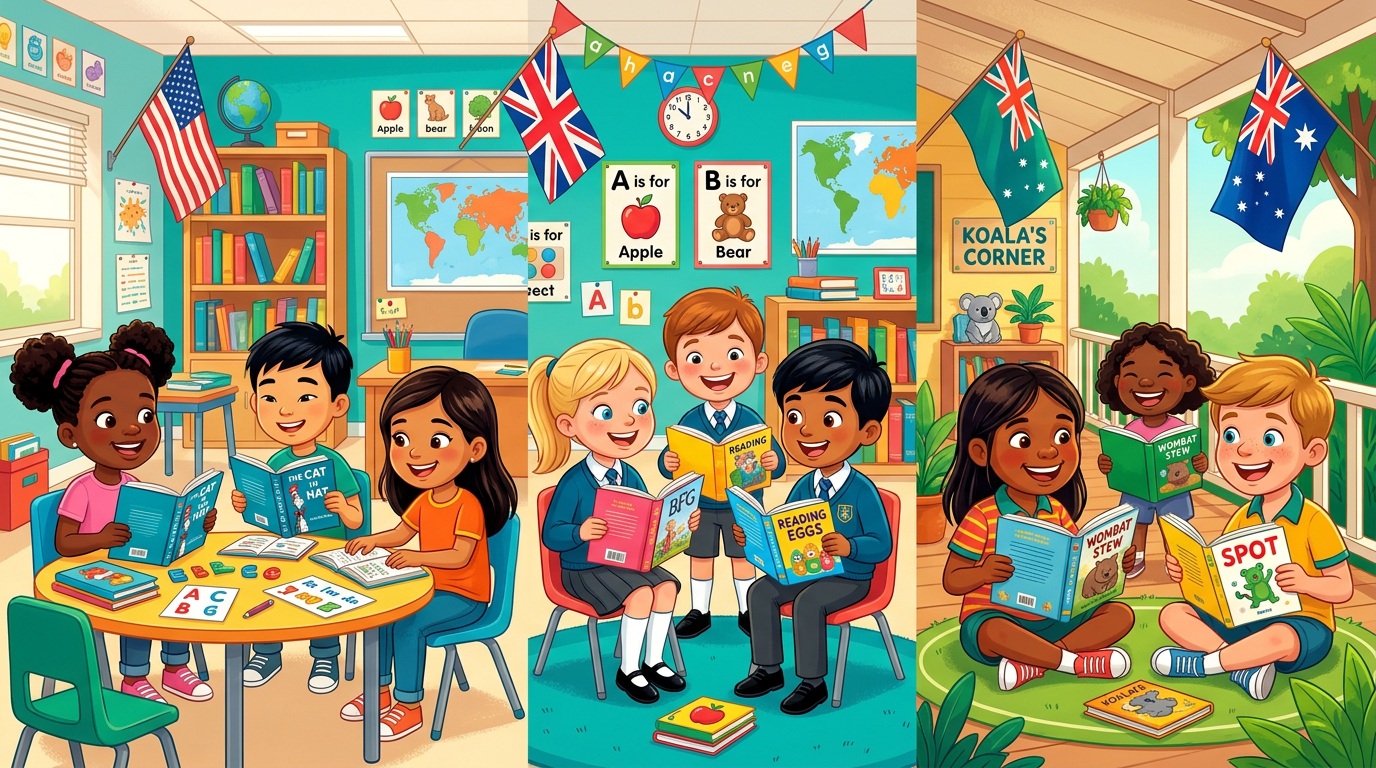
How the US, UK, and Australia Teach Reading
The journey to childhood literacy is a universal milestone, yet the curriculum guiding our children there looks remarkably different depending on where you live. Explore how three nations are embracing structured literacy to help kids thrive.
At a Glance: The Global Phonics Landscape
| Feature | 🇬🇧 United Kingdom | 🇦🇺 Australia | 🇺🇸 United States |
|---|---|---|---|
| Primary Phonics Approach | Statutory Systematic Synthetic Phonics (SSP) | Transitioning to SSP (State by State implementation) | Rapid legislative shift to the Science of Reading |
| Key Early Assessment | Year 1 Phonics Screening Check (National) | Year 1 Phonics Check (Mandatory in leading states like SA, VIC, NSW) | Universal Screeners (e.g., DIBELS, Acadience) 3x per year |
| Pacing & Curriculum | Highly structured, National Reading Framework | ACARA v9.0, explicit phoneme-grapheme focus | Highly decentralized, state-led legislative mandates |
| Decodable Texts | Mandatory focus in early years | Strongly recommended and rapidly replacing predictable texts | Increasingly required by state Science of Reading laws |
Try our:
Curriculum Deep Dives
Click below to explore how each region tackles phonics instruction.
England: The Pioneer of the Phonics Check
England is widely recognized as the global pioneer in the mandated, systemic implementation of Systematic Synthetic Phonics (SSP). The genesis of this educational revolution can be traced back to 2006 with the publication of the Rose Report, an independent review of early reading commissioned by the government. Sir Jim Rose's findings were unequivocal: high-quality, systematic phonic work should be the prime approach to teaching children to read, and it should be taught explicitly and discretely from the very beginning of formal schooling.
The most defining feature of the English phonics landscape is the Year 1 Phonics Screening Check, introduced as a statutory assessment in 2012. Administered nationwide over a specific week in June, this short, light-touch assessment is taken by all Year 1 pupils (typically aged five or six). The check takes approximately ten minutes and is conducted one-on-one with a familiar teacher. Children are asked to read 40 words out loud. Crucially, this list is divided into 20 genuine words (such as 'shop' or 'blossom') and 20 pseudo-words, which are often referred to as 'alien' or 'nonsense' words (such as 'sut', 'meck', or 'vap').
"The inclusion of pseudo-words is a stroke of pedagogical genius. It serves as the ultimate litmus test for decoding ability. Because a child has never encountered the word 'meck' before, they cannot rely on visual memory, environmental context, or picture cues to guess it. They must successfully apply their knowledge of grapheme-phoneme correspondences—sounding out /m/ /e/ /k/ and blending them seamlessly."
"You Say, I Say"
Navigating Accents in Phonics
A unique challenge in teaching phonics globally is the variation in English accents. While we all share the same 26 letters and approximately 44 phonemes, the way we articulate those sounds—and thus how we teach children to spell them—differs dramatically between the US, UK, and Australia. Click to explore how local dialects change the rules of the game!
Takeaways for the Frontlines
For Parents
Embrace the Nonsense
Don't be alarmed if your child brings home lists of "alien" or nonsense words. Practicing pseudo-words like "flimp" or "chud" is the absolute best way to ensure they are actually decoding letters into sounds.
Demand Decodables
In the early stages of reading, your child's take-home books should be decodable. If the book relies heavily on repetitive sentence patterns with words they haven't learned to sound out, it encourages bad guessing habits.
For Teachers
Audit Your Curriculum
Take a hard look at your classroom resources. If your literacy block includes the "three-cueing system" (encouraging kids to look at the picture to guess the word), it is time to shift away from Balanced Literacy.
Universal Screening is Key
Whether it's the UK's Phonics Check, Australia's adoption of the same model, or the US's reliance on DIBELS, early screening is non-negotiable. Screen early and intervene immediately.
The Evidence-Based Checklist
Are you or your child's school using evidence-based reading practices? Check off the boxes that apply to see how aligned your program is with the Science of Reading.
Score: 0 / 6
Start checking the boxes to evaluate your reading program!
Help Your Child Fall in Love with Reading
Picture This! teaches visualization step-by-step so children can genuinely understand—and enjoy—what they read.
Related Articles

Sources & References
- Focus on Phonics: Why Australia Should Adopt the Year 1 Phonics Check
- A Comparison of DIBELS 8th Edition Composite Score Percentile Ranks in Two Academic Years Across Three Samples
- A Tale of Two Texts: Decodable vs. Leveled Reading Materials
- England's Phonics Screening Check
- The Reading Framework - Teaching the Foundations of Literacy
- F to 2 Australian Curriculum English V9.0 Explained
- How the 'Science of Reading' is Reshaping Literacy Education
- The Science of Reading: 15 States Strengthen Early Literacy Policy in 2024
- Phonics and Different English Pronunciations
- Which States Have Science of Reading Laws in 2024?