
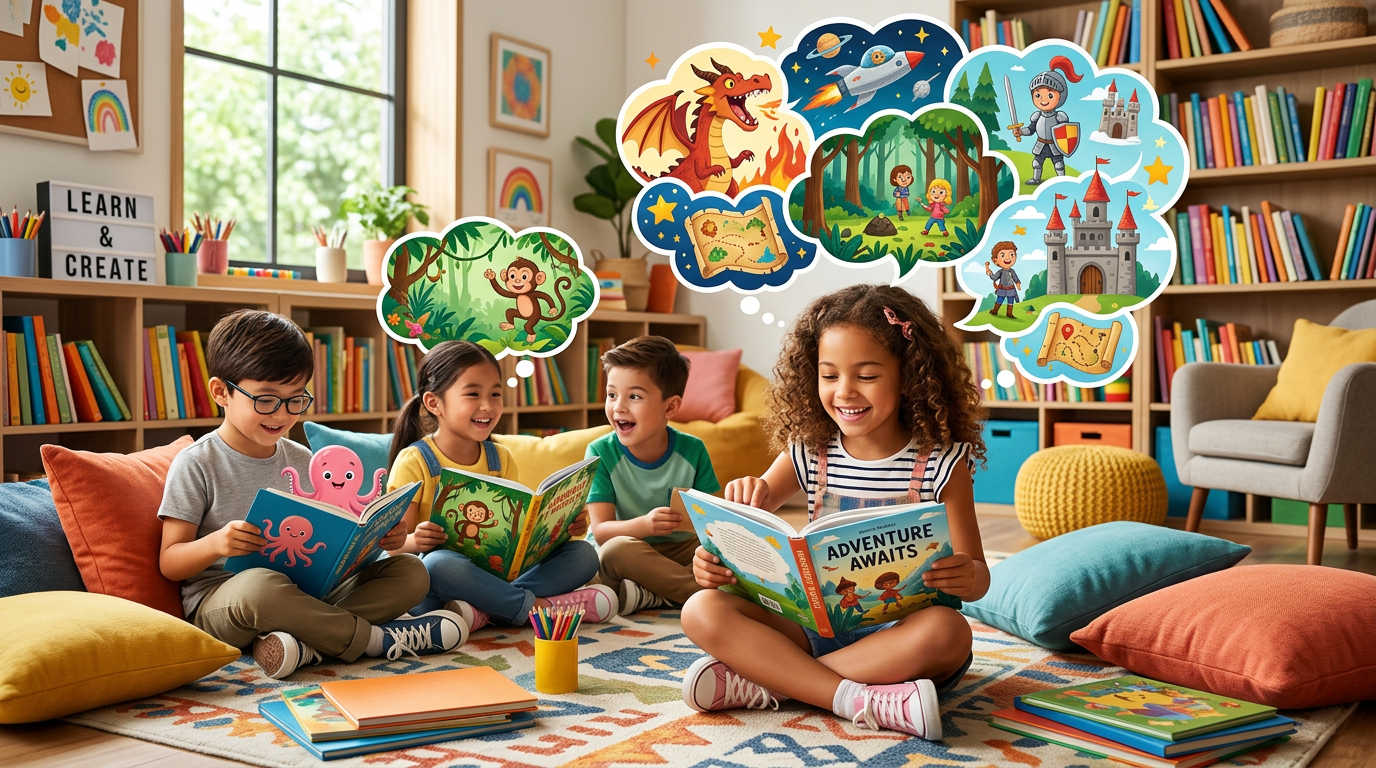
Building the Mental Movie
A Parent's Guide to Supporting Visual Learners
Transform stressful reading sessions into low-stress, highly engaging "mental movie" experiences. This guide provides actionable, step-by-step strategies to help your child bypass cognitive overload and build the vivid imagination required for true reading comprehension.
The Imaged Gestalt & Aphantasia
The neuropsychology of literacy has traditionally emphasized the mechanical mastery of sounding out words. However, the true cognitive pinnacle of literacy is the construction of an "imaged gestalt"—a mental representation where the sensory system brings parts together effortlessly through imagery to create a whole that is greater than the sum of its parts.
For many children, particularly those navigating the complexities of dyslexia, ADHD, or sensory processing differences, the standard reading session often collapses into a high-stress confrontation. This failure is frequently rooted in a "visualization deficit." When the cognitive load required for decoding consumes their entire working memory capacity, there are no resources left for the creation of the "mental movie" that makes reading meaningful and pleasurable.
What if my child can't see pictures in their head?
Some individuals experience Aphantasia, sometimes called a "blind mind's eye." When asked to picture an apple, they might only see the dark back of their eyelids. However, their mind still knows the details of what an apple looks like. If your child struggles to literally "see" mental images, do not panic. The strategies below—especially the structural framing and sensory tools—are designed to help children conceptualize and feel the details of a story, moving beyond stressful mechanical reading into deep comprehension.
Setting the Stage: The Cozy Corner
Home should be a place of comfort, regulation, and safety. But for neurodivergent children, typical home environments can feel overwhelming. Bright lights, loud appliances, and unpredictable routines spike anxiety and consume cognitive load. Creating a sensory-friendly reading nook is about more than interior design; it is about establishing a controlled environment that signals the brain it is safe to relax and focus.
Sensory-Friendly Setup Checklist
Mastering the Transition to Reading
Transitions are the moments when a child must shift from one activity to another. To a toddler or a neurodivergent child who lives entirely in the "now," abruptly shifting from playtime to reading time isn't just a change of location; it is an abrupt interruption of their world. A developing brain loves predictability. When children know what to expect, their brains don't have to work as hard, which reduces stress and resistance.
Advanced Notice & Visual Timers
Inform children about upcoming changes mentally before they happen. Use clear, age-appropriate explanations. A visual timer is a powerful tool because it makes the abstract concept of "time" concrete. It acts as a bridge to manage expectations.
"First / Then" Language
Break transitions down into simple terms. Use a chart or simply state: "First we will clean up the blocks, Then we will sit in the cozy corner for a story." This promises a preferred activity or clear structure, easing the shift.
Auditory Cues & Songs
Introduce a specific transition routine, like a clean-up song. Consistency is key. Use it every single time. Over time, your child will associate the song with the action, making the shift automatic and stress-free.
Box Breathing
Before opening the book, use calming rituals. Box breathing is a dead-simple way to calm the brain down and get it ready to absorb material. Focus on the breath to get the brain out of an emergency state.
The 12 Structure Words Framework
When a child struggles to create mental images, telling them to "picture it" isn't enough. The Visualizing and Verbalizing framework provides 12 specific "Structure Words." These words act as a scaffold, guiding the child to systematically build a mental image piece by piece. Click on each word below to see the specific script you can use to prompt your child.
Focusing on: What
Identify the main subject or object in the scene. Parent Script: 'What is the main thing you picture when you hear this sentence?'
DIY Whisper Phones
Also known as fluency phones, these are low-tech tools that allow a child to hear themselves read. They provide immediate auditory feedback, which helps isolate sound, improve sentence fluency, and block out background noise—reducing cognitive load.
How to make one:
Purchase a piece of narrow PVC pipe and two 20x20mm 90-degree PVC elbow joints from a hardware store. Cut the pipe to the length of your child's face (ear to mouth) and attach the elbows to each end. The child speaks into one end and listens through the other!
Mind's Eye Pre-Reading
Some texts are hard for students to get into. The Mind's Eye strategy tackles this by grabbing attention before a single paragraph is read, priming the visual canvas of the brain.
How to do it:
Choose 20-30 important, highly descriptive words from the text. Before reading, slowly read these words aloud to your child, pausing between each. Ask them to build a picture in their mind using just those words. This creates a mystery that can only be solved by reading the story.
Think Alouds & Mistakes to Avoid
Model with "Think Alouds"
Often, parents ask questions like "Where is the dog going?" to test comprehension. While good, this doesn't teach a child how to understand. Instead, provide a play-by-play of your own skilled reading process using "I" language. Say: "I wonder...", "I'm guessing that...", or "I was confused by..." This demonstrates that making meaning is an active, problem-solving process. Research shows that thinking aloud helps parents model comprehension strategies in a natural, approachable way.
Common Parent Pitfalls & Fixes
Remember: It is not just about what you teach, it is about the low-stress, highly-imaginative environment you create.
Help Your Child Fall in Love with Reading
Picture This! teaches visualization step-by-step so children can genuinely understand—and enjoy—what they read.
Related Articles
Sources & References
- How to Teach Visualizing to Improve Reading Comprehension
- Verbalizing and visualizing structure words
- Can Visualizing and Verbalizing® Help with Reading Comprehension?
- Helping Parents to Think Aloud - Raising A Reader
- Coping with transitions: 10 practical strategies to support kids who struggle with transition
- Creating a Sensory-Friendly Home for Neurodivergent Children
- Calm meets cozy: setting up a reading corner kids actually use - Storkcraft
- Mental Imagery and Reading Comprehension | Dyslexia the Gift Blog
- Aphantasia: Learning And Teaching Without A Mind's Eye - TeachingTimes
- How Cognitive Load Affects Children with Dyslexia - Daring Dyslexic