
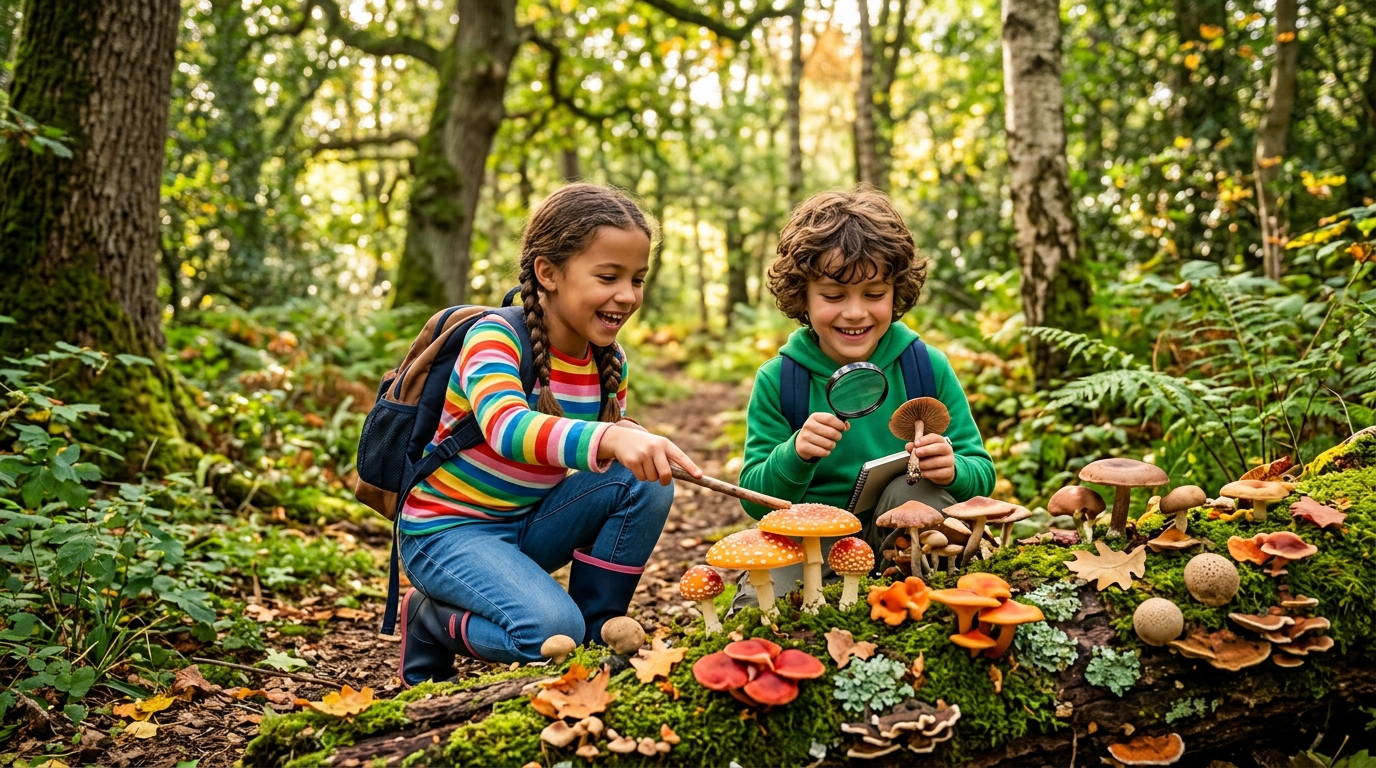
The Fungal Frontier
A Comprehensive Guide for Parents & Educators
Welcome to the new paradigm for youth horticulture. The traditional conception of gardening as a chlorophyll-dependent endeavor is currently undergoing a transformative shift toward mycology. This resource is designed to help parents and teachers use mushrooms to overcome "plant blindness," integrating S.T.E.A.M. education, biological artistry, and sustainable ecological practices into engaging, project-based learning for children.
Pedagogical Implications of Mycology
The integration of fungi into pediatric education represents a vital paradigm shift in biological curricula, which have historically suffered from what educators term "plant blindness." Vascular plants are often constrained by longer growth cycles and higher land requirements, making it difficult to hold the attention of younger students.
Fungi offer a far more dynamic demonstration of the life sciences. Because of their rapid development and the distinct, highly interesting morphology of their fruiting bodies, mushrooms provide immediate, tangible results. The cultivation of fungi provides a unique entry point into the biological sciences, offering tactile engagement with complex ecological systems.
Why Teach Fungi?
- Rapid Feedback: Fast growth cycles keep children highly engaged.
- Minimal Resources: Cultivation is a high-value activity requiring minimal land or resources, making it accessible for classrooms and urban homes.
- Core Competencies: Incorporating mycology links directly to science standards, food safety discussions, and taxonomic identification skills.
After-School Enrichment & Project-Based Learning
Mycology is ideal for Lower, Middle, and High School Project-Based Learning (PBL) courses. By establishing 10-class or multi-week schedules, educators can teach students to track actual life cycles using observation journals—documenting with images and words over the course of two weeks.
The Agriscience Classroom Curriculum
Advanced students can explore the Wild-Foraged Mushroom certification frameworks. This curriculum dives into taxonomy, food science, economics, and sustainability. Looking at these subjects through the lens of mycology is an engaging way to motivate students while teaching them about the interconnected ways fungi thrive in our soil, air, water, and bodies.
Interactive Mycology Vocabulary
Mycelium
Tap to flip
The vegetative part of a fungus, consisting of a network of fine white filaments. It plays a crucial role in breaking down organic matter and can be used to create sustainable building materials and packaging.
Fruiting Body
Tap to flip
The fleshy, spore-bearing organ of a fungus (what we commonly call the 'mushroom'). It is visually distinct, rapidly developing, and serves as the reproductive mechanism of the organism.
Spore Print
Tap to flip
A powdery deposit obtained by allowing spores of a fungal fruit body to fall onto a surface underneath. Used for taxonomic identification, microscopy, and creating natural biological artwork.
Bioremediation
Tap to flip
The use of living organisms, like fungi, to maintain the health of soil and plants by removing or neutralizing pollutants and toxins from a contaminated site.
Circular Economy
Tap to flip
An economic system aimed at minimizing waste and making the most of resources. In mycology, this involves using agricultural waste or upcycled materials to grow mushrooms.
Life Cycle Analysis
Tap to flip
An assessment where companies evaluate the environmental costs and benefits of their products (like energy, water, air, land) across all stages, aiming to increase sustainability.
Help Your Child Fall in Love with Reading
Picture This! teaches visualization step-by-step so children can genuinely understand—and enjoy—what they read.
Sources & References
- Free Mycology Curriculum for Educators – Fungi Foundation
- Fungal spores: hazardous to health? - PMC - NIH
- Mushroom Poisoning in Children | Johns Hopkins Medicine
- Growing Mushrooms at Home - Gardening Solutions - University of Florida
- A Beginners Guide to Fungal Spore Printing - NHBS
- How to Make a Spore Print - North American Mycological Association
- Mushroom cultivation in the circular economy - PMC - NIH
- 13 Best Mushrooms You Can Grow At Home - Epic Gardening
- Mycology in the Agriscience Classroom: A Curriculum Based on Wild Foraged Mushroom Certification - MSU College of Agriculture and Natural Resources
- K-12 S.T.E.A.M. Workshops for NYC Schools — Mi Oh My Farms