
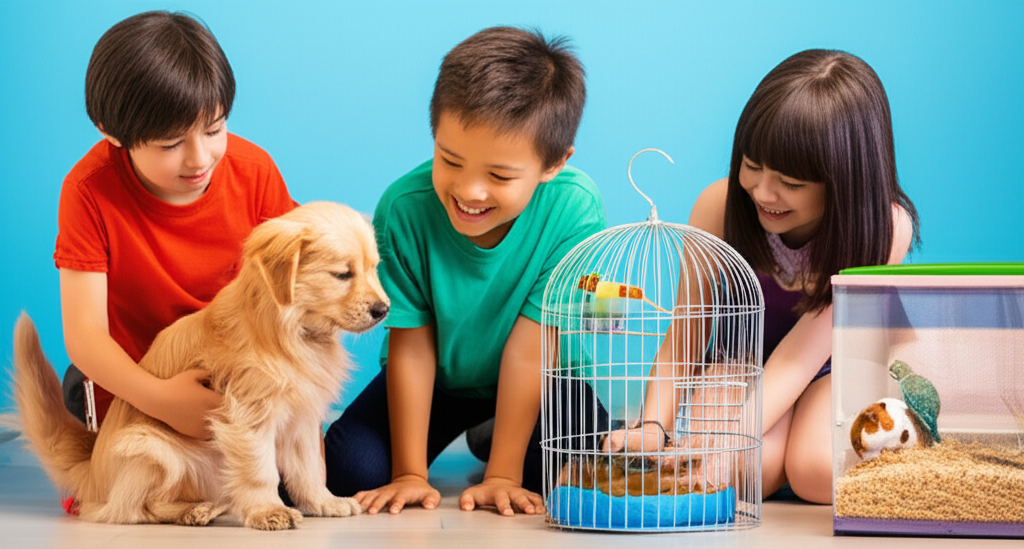
Paws & Progress: Fostering Empathy and Responsibility Through Pet Care
A comprehensive, research-backed guide for introducing early readers (ages 5-8) to the transformative power of the human-animal bond.
Welcome to the Kiddz.club ultimate guide on early childhood development and pet ownership. For parents and educators of children aged 5 to 8, navigating the introduction of a family or classroom pet is a monumental decision. It is not merely about adding a furry, feathered, or scaly friend to the environment; it is about unlocking a profound educational tool that naturally cultivates vital life skills.
During the critical developmental window of early literacy and cognitive expansion, children are uniquely primed to absorb the lessons of empathy and responsibility. Caring for another living creature transitions a child from an egocentric worldview to a socio-centric one. They learn to interpret non-verbal cues, anticipate needs, and prioritize the well-being of someone other than themselves. This article provides a deep dive into the psychological benefits of pet care, offering actionable strategies, interactive tools, and visual frameworks to ensure both the child and the pet thrive.
The Science of the Bond: A Research Report
Developmental psychologists and pediatric researchers have long studied the impact of animal companions on child development. The consensus is clear: guided, age-appropriate interactions with pets significantly accelerate emotional intelligence, executive functioning, and prosocial behaviors in early readers. Click the sections below to explore the detailed findings.
Milestones Linked to Pet Ownership
| Age Group | Appropriate Tasks | Developmental Milestone Achieved |
|---|---|---|
| 5 Years Old |
| Sensory Regulation & Cause-and-Effect: At 5, children are mastering their motor skills. Learning to modulate their strength to stroke a pet gently teaches sensory regulation. Observing that a pet approaches when offered food teaches foundational cause-and-effect and sequencing. |
| 6 Years Old |
| Routine Adherence & Fine Motor Development: Six-year-olds thrive on routine. Assigning a daily task like checking the water bowl builds executive function and reliability. The act of brushing improves hand-eye coordination and fine motor stamina. |
| 7 Years Old |
| Literacy Confidence & Mathematical Thinking: Pets are non-judgmental listeners, making them perfect audiences for early readers practicing phonics. Measuring food introduces practical math (volume, fractions) in a meaningful, daily context. |
| 8 Years Old |
| Advanced Empathy & "Theory of Mind": Eight-year-olds can begin to interpret complex non-verbal cues. Recognizing that a pet is retreating because it is tired shows advanced cognitive empathy. Leading training builds leadership and positive reinforcement skills. |
Note for Educators & Parents: All tasks should be supervised to ensure the safety of both the child and the animal. Milestones are general guidelines; adjust expectations based on the individual child's maturity and the pet's temperament.
Mind Map: From Pet Tasks to Life Skills
How does a simple chore transform into a vital life skill? Click through the dimensions below to explore the cognitive mapping of pet care responsibilities.
Physical Health & Motor Skills
Walking a dog promotes daily cardiovascular exercise, combating sedentary lifestyles. The intricate movements required to open food latches, manipulate a brush, or accurately pour water into a small bowl dramatically enhance fine motor skills and hand-eye coordination. Over time, children develop physical stamina and a subconscious understanding of spatial awareness as they navigate around a resting animal.
Practical Tips: Introducing Pets to Early Readers
Model the Behavior First
Children learn by watching. Before handing over responsibilities, narrate your own actions. "I am walking slowly so the bunny isn't scared," or "I am giving the dog one scoop of food so his tummy doesn't hurt." Explicitly state the *why* behind the *what*.
Create Visual Checklists
For 5-8 year olds, abstract concepts like "time to feed the cat" can be easily forgotten. Create a colorful, visual chart with drawings of the tasks. Let them place a sticker on the chart once the task is completed to build a sense of immense pride.
Use the "Two-Finger Rule"
To prevent aggressive grabbing, teach the "Two-Finger Rule." Ask the child to use only their pointer and middle finger to stroke the animal's back. This naturally limits their physical strength and encourages a gentle, intentional approach to physical contact.
Establish "Safe Zones"
Just like children, pets need quiet time. Designate the pet's bed or crate as a strict "No Bother Zone." Teach the child that if the pet goes to that specific area, they are asking for a break, teaching boundaries and respect for personal space.
Involve Them in Shopping
Empowerment builds investment. Take the child to the pet store and let them choose between two approved toys or pick the color of the collar. By having a voice in the pet's supplies, their sense of ownership and responsibility deepens significantly.
Praise the Process
Don't just praise the outcome. Instead of "Good job feeding the dog," say, "I saw how carefully you measured the food so Buster gets exactly what he needs. That is very responsible." Praise the specific actions to reinforce the desired behavior traits.
Readiness Assessment: Is Your Child Ready?
When interacting with other people's pets or stuffed animals, your child usually:
Help Your Child Fall in Love with Reading
Picture This! teaches visualization step-by-step so children can genuinely understand—and enjoy—what they read.
Related Articles
Sources & References
- (PDF) A Systematic Review of the Positive Effects of Pets on Child Development
- Impact of pet ownership in early childhood at ages 1 and 4–5 years on mental health at ages 7–8: findings from the INMA project
- Affiliation, empathy, and the origins of theory of mind
- Animal-assisted humane education enhances social-emotional skills among primary school students in Hong Kong
- Effectiveness of a school-based programme of animal-assisted humane education in Hong Kong for the promotion of social and emotional learning: A quasi-experimental pilot study
- Companion Animals and Child/Adolescent Development: A .
- Age-Appropriate Pet Responsibilities for Kids
- Pets And Children - AACAP.org
- How Pet Grief Shapes Children's Emotional Development and Resilience
- Canine perspective-taking