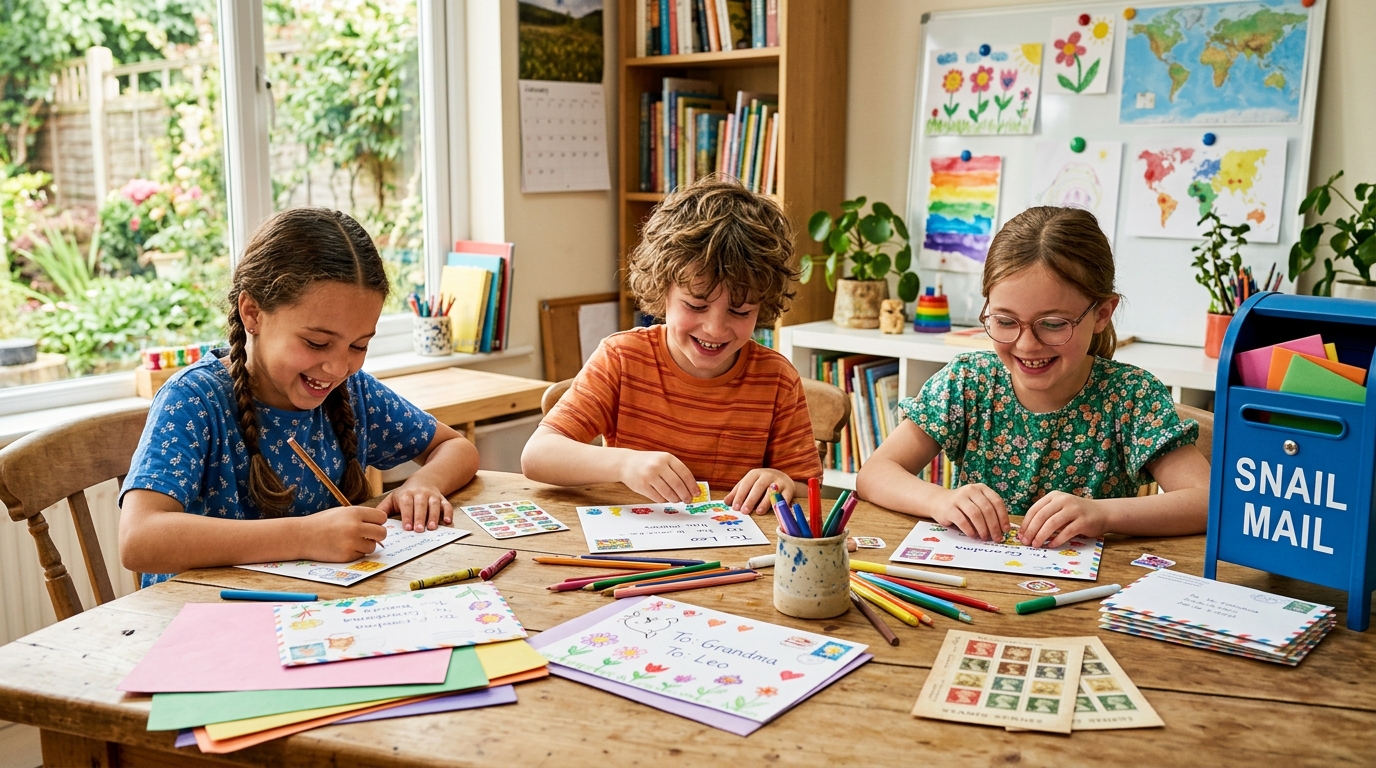
The Snail Mail Revival: Why Kids Are Trading Screens for Stamps
Gen Z and Alpha are leading an analog revolution of pen pals and handwritten letters.
The Analog Resonance
Seeking authenticity amidst digital saturation, over 85% of youth now actively engage with physical mail. This revival includes stamp clubs and international pen pal networks, offering profound developmental benefits like improved motor skills and emotional resilience. Let's explore why kids are picking up fountain pens.
By The Numbers: The Digital Burnout
The resurgence of physical mail is primarily driven by "digital burnout," a state where nearly 60% of youth report feeling overwhelmed by the incessant volume of digital messaging and algorithmic content.
- 84% of Gen Zalpha read their physical mail the day it arrives, viewing it as a "premium" experience.
- 2 Billion+ views on TikTok for hashtags like #StampCarving, #WaxSeals, and #SnailMailClub in the past year alone.
- 72% of young people state they would actively miss receiving physical letters if they stopped arriving, craving the tactile connection.
The Hidden Benefits of Snail Mail
Rewiring the Brain for Deep Literacy
Handwriting is key in the development of literacy and reading skills. The physical act of writing helps with phonemic awareness, spelling, reading comprehension, memory, and information retention. According to researchers at the National Institutes of Health (NIH), the intricate motor skills required to form letters by hand activate massive regions of the brain involved in thinking, language, and working memory—regions that remain largely dormant when merely typing on a keyboard.
When children engage in drafting a physical letter, they are forced to slow down their cognitive processing. They cannot simply hit backspace. They must formulate their thoughts, plan their sentences, and execute them with physical intention. This "cover-copy-compare" mental process solidifies vocabulary and grammar rules. Furthermore, engaging with paper textures, ink flows, and physical spacing provides a multi-sensory learning experience that dramatically boosts long-term memory retention.
Teachers and occupational therapists are increasingly using mail clubs as a stealthy way to provide direct, monitored handwriting instruction, especially in lower elementary grades. It transforms a tedious mechanical exercise into an exciting, purpose-driven mission.
The Art of the Envelope: Stamp Socials & Wax Seals
The snail mail revival is not just a literary movement; it is an explosion of tactile art. Enter the "Stamp Social"—a wildly popular after-school and weekend activity where children and teens gather to design, carve, and print their own stationery. It's a messy, creative, and highly rewarding hands-on experience that completely pulls kids away from their screens.
At the heart of this artistic resurgence is the creation of Cinderella Stamps. In philately (stamp collecting), a "Cinderella" is a stamp-like label that is not valid for national postage but is created for local use, decoration, or fantasy. Kids are inventing their own imaginary countries, designing the currency and postage, and trading these miniature artworks with friends.
To make these, children are learning the classic art of linocut printmaking. Using soft rubber blocks and carving tools, they etch intricate designs—from tiny mushrooms to geometric patterns to their own initials. They roll ink over the carved block and press it onto blank cards, creating bespoke stationery. Coupled with the rising trend of melting wax seals to close envelopes, children are experiencing the sensory joy of crafting something entirely unique from start to finish. The smell of the melting wax, the satisfying press of the brass stamp, and the vibrant colors of the ink pads create an immersive analog environment.
Essential Crafting Toolkit
- • Soft rubber carving blocks
- • V-gouge carving tools
- • Water-based ink pads
- • Blank cotton stationery
- • Non-toxic sealing wax beads
- • Brass wax seal stamps
Stationery Etiquette
Kids are re-learning the lost art of letter layout: the top-right date, the formal salutation, the thoughtful inquiry into the receiver's life, and the graceful sign-off. It's a masterclass in written manners.
Hands-On: 4 Snail Mail Craft Projects
Skip the screens and get messy! Here are four engaging, practical crafts to elevate your child's next letter.
Linocut "Cinderella" Stamps
Using beginner-friendly soft rubber blocks and V-gouge carving tools, kids can etch their own designs—like mushrooms, animals, or their initials. Press the carved block into water-based ink pads to create custom stationery or "Cinderella" fantasy stamps.
Sensory Wax Sealing
Bring back the old-world charm of sealing envelopes. Melt non-toxic wax beads using a wax warmer, pour a small circle over the envelope flap, and press a brass stamp into the warm wax.
DIY Envelope Liners & Washi
Why send a plain white envelope? Have kids trace an open envelope onto patterned paper or artwork they've drawn, cut it out, and glue it to the inside flap to create a custom envelope liner.
Brush Pen Lettering Practice
Combine occupational therapy with art! Provide kids with dual brush pens, tracing paper, and calligraphy guides. Have them practice the "Cover-Copy-Compare" method for challenging words before putting them on the final letter.
Navigating the Snail Mail World Safely
A common concern for parents and teachers is safety. How do you find a pen pal for a child without exposing their physical address to the internet? The tech industry has responded beautifully, creating hybrid platforms that marry digital safety with physical mail.
Platforms like Stamplo and Global Penfriends have revolutionized the process. In these parent-approved, encrypted systems, families undergo ID verification. Children write their letters, which are then subject to a "Four-Eyes Check"—meaning parents on both sides must review and approve the message before it is securely transmitted or printed and mailed by the service. Physical addresses are never exchanged directly between the children, ensuring complete privacy.
Similarly, classroom-to-classroom networks, such as the Peaceful Pen Pals Project, allow teachers to pair entire classrooms together. The letters are bundled and mailed from school to school, creating a safe, moderated environment for students to experience the thrill of receiving a thick package of international mail.
5 Steps to Launch Your Own Mail Club
Help Your Child Fall in Love with Reading
Picture This! teaches visualization step-by-step so children can genuinely understand—and enjoy—what they read.
Related Articles
Sources & References
- The Effects of Handwriting Experience on Literacy Learning - PMC - NIH
- Handwriting is key in the development of literacy and reading skills
- The Emotional Benefits of Writing: Child Psychologist Shares Proven Strategies
- 2025 Gen Zalpha Tiktok Trend Report | Growthcurve
- An Introduction to Letter Writing | Reading Rockets
- Peaceful Pen Pals Project - Kids for Peace
- Young people are leading a snail mail revival | Dazed
- Raising Resilient Kids through Letter Writing - Familius.com
- 2024–25 Recap: 24659 Letters Exchanged! - Letters to a Pre-Scientist