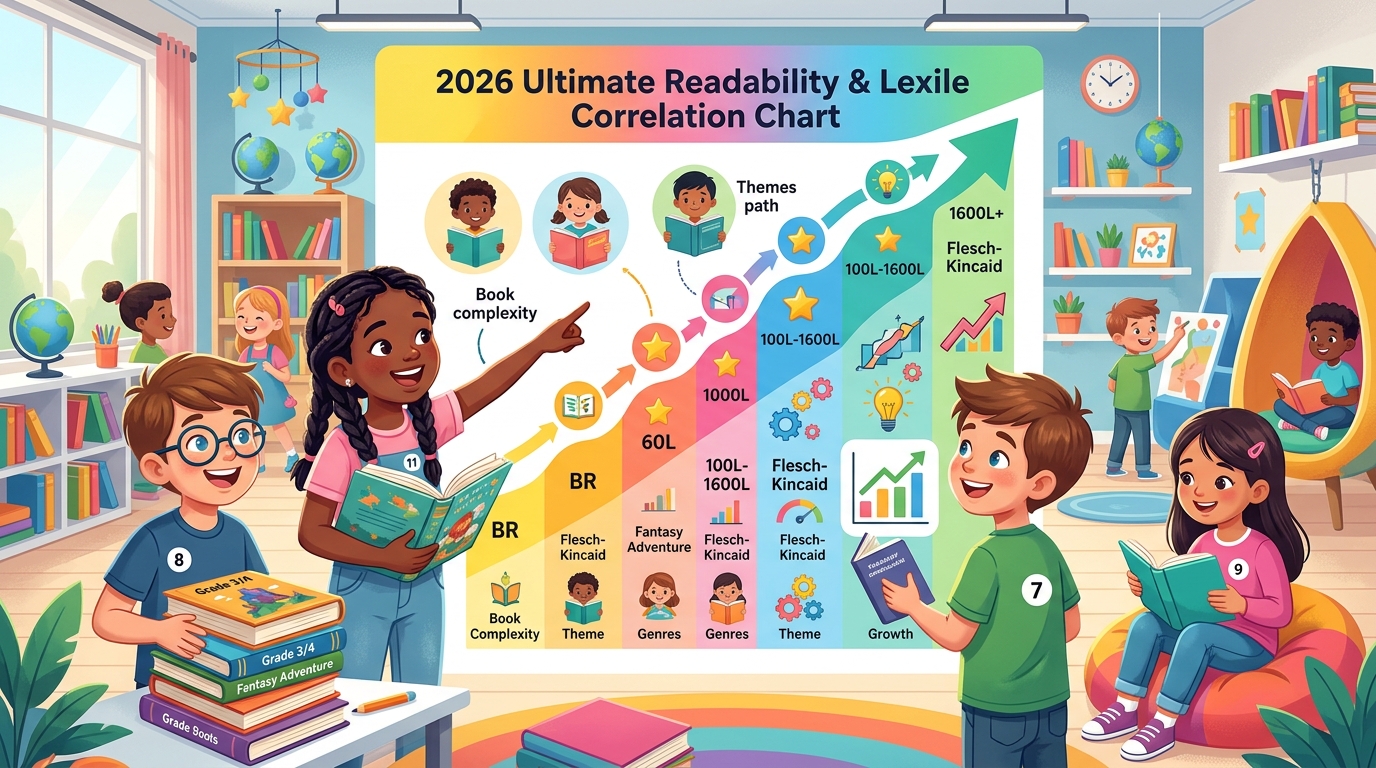
The 2026 Ultimate Readability & Lexile Correlation Chart
Navigate the labyrinth of reading levels with ease. Compare Lexile measures, Fountas & Pinnell guided reading letters, ATOS scores, and DRA levels in one definitive, easy-to-understand resource.
Have you ever looked at a book your child brought home from the school library and seen a cryptic code printed on the back? Perhaps it read "Level M," or "750L," or even "AR 3.2." If you felt like you needed a Rosetta Stone to decipher whether the book was appropriate for your second grader, you are certainly not alone.
Matching students with the right books is crucial, but navigating the maze of proprietary reading metrics can be overwhelming. What used to be a teacher's subjective choice is now driven by complex algorithms and state mandates. Today, we're decoding this "alphabet soup" so educators and parents can confidently unlock their child's literacy potential.
The 2026 Master Correlation Chart
Compare standard reading metrics across grade levels.
| Grade Level | Lexile® Measure | Fountas & Pinnell | ATOS (AR) | DRA |
|---|---|---|---|---|
| Kindergarten | BR400L – 200L | A – D | 0.1 – 0.9 | A – 4 |
| 1st Grade | 190L – 530L | E – J | 1.0 – 1.9 | 6 – 16 |
| 2nd Grade | 420L – 650L | K – M | 2.0 – 2.9 | 18 – 28 |
| 3rd Grade | 520L – 820L | N – P | 3.0 – 3.9 | 30 – 38 |
| 4th Grade | 740L – 940L | Q – S | 4.0 – 4.9 | 40 |
| 5th Grade | 830L – 1010L | T – V | 5.0 – 5.9 | 44 – 50 |
| 6th Grade | 925L – 1070L | W – Y | 6.0 – 6.9 | 60 |
| 7th Grade | 970L – 1120L | Z | 7.0 – 7.9 | 70 |
| 8th Grade | 1010L – 1185L | Z | 8.0 – 8.9 | 80 |
| 9th - 10th Grade | 1050L – 1330L | Z+ | 9.0 – 10.9 | 80+ |
| 11th - 12th Grade | 1185L – 1385L | Z+ | 11.0 – 12.0+ | 80+ |
Disclaimer: This chart provides approximations based on typical ranges. The correlation between systems is not perfectly linear because each framework measures different aspects of text complexity. A single row should be treated as a general guideline, not an exact scientific equivalent. Always consider a child's individual maturity, background knowledge, and interest in a topic alongside these numbers.
Decoding the Jargon: The Big Four Frameworks
To truly utilize the correlation chart, it is vital to understand the philosophy behind each measurement system. They are not simply different scales for the exact same metric (like Fahrenheit and Celsius); rather, they are entirely different ways of viewing a book's difficulty. Some analyze mathematical data, while others rely on human literary analysis.
Developed by MetaMetrics, the Lexile Framework is one of the most widely adopted quantitative readability metrics globally. Instead of assigning a grade level, it assigns a number ranging from below zero (BR, or Beginning Reader) to above 2000L. Lexile measures are purely quantitative, relying on a highly complex, proprietary mathematical algorithm that evaluates two primary factors: semantic difficulty (word frequency) and syntactic complexity (sentence length). The theory is that less familiar words and longer sentences place a higher cognitive load on the reader. Because it only looks at text structure, a book like John Steinbeck's 'Of Mice and Men' might receive a surprisingly low Lexile score (around 630L) due to its simple, conversational sentence structure, despite containing highly mature, abstract themes suitable for high schoolers. This highlights why Lexiles should be paired with human judgment. The recommended 'sweet spot' for a child's reading growth is picking books within a range of 100L below to 50L above their current tested Lexile measure.
The Fountas & Pinnell system, widely known as Guided Reading Levels, categorizes books along an alphabetical continuum from A (easiest) to Z+ (most difficult). Unlike Lexile, F&P is a qualitative assessment performed by human evaluators. Books are analyzed against ten specific text characteristics: Genre/Form, Text Structure, Content, Themes and Ideas, Language and Literary Features, Sentence Complexity, Vocabulary, Words, Illustrations, and Book and Print Features. For early readers (Levels A-D), the system heavily weighs predictability, repeated language patterns, and how closely the text aligns with picture cues. As readers progress toward the middle and upper alphabets, the focus shifts to inferential thinking, complex multi-syllabic vocabulary, and intricate plot structures without supportive imagery. It is important to note that while F&P has been historically ubiquitous in classrooms, recent shifts toward the Science of Reading have critiqued early F&P levels for encouraging children to guess words based on pictures rather than actively decoding the phonics presented in the text.
The ATOS readability formula is the engine behind the immensely popular Accelerated Reader (AR) program. ATOS scores are designed to be exceptionally parent-friendly because they translate directly into grade-level equivalents. An ATOS score of 4.5, for instance, implies the text is appropriate for a student in the fourth grade during their fifth month of school. The ATOS algorithm analyzes four variables: average sentence length, average word length, vocabulary grade level, and the total number of words in a book or passage. Because it includes the total word count, ATOS is often considered highly accurate for early chapter books and emergent reader texts where stamina plays a significant role in text complexity. A book might have simple vocabulary, but if it is 200 pages long, the ATOS score will adjust to reflect the sustained attention required by the reader.
The DRA is a standardized reading assessment administered by teachers in a one-on-one setting, primarily for students in grades K-8. The DRA level (ranging from A/1 up to 80+) indicates the highest level at which a student can read independently with accuracy, fluency, and comprehension. What sets the DRA apart is its heavy emphasis on the retell and comprehension components. A child may be able to fluently read all the words in a Level 28 book, but if they cannot accurately summarize the plot, identify the main characters' motivations, or recall key factual details, they will not pass that level. The DRA ensures that decoding skills are advancing strictly in tandem with cognitive comprehension, preventing the phenomenon of 'word calling'—where a child reads beautifully out loud but understands very little of what they just consumed.
A Crucial Shift: Leveled Texts vs. Decodable Texts
If you have followed educational news recently, you have likely heard of the "Science of Reading" (SoR). This nationwide movement has dramatically shifted how we approach the earliest stages of literacy, bringing intense scrutiny to traditional leveling systems (like Fountas & Pinnell's A-Z gradient) for students in Kindergarten through 2nd grade.
Historically, early leveled texts relied heavily on predictability. A Level A book might read: "I see the dog. I see the cat. I see the bird." Each sentence is accompanied by an obvious illustration. The unintended consequence of this structure is that it often teaches children the habit of "three-cueing"—looking at the picture and guessing the word based on context, rather than actually looking at the letters and sounding them out.
The Decodable Solution
The Science of Reading strongly advocates for the use of Decodable Texts in early instruction. Instead of relying on sentence patterns and pictures, decodable books contain only the phonics sounds and high-frequency words a child has been explicitly taught. A student learning short vowels and digraphs will read sentences like: "Tom sits in his shop. He sits with his pal Chad." While the story may seem less sophisticated, the child is actively breaking the alphabetic code rather than guessing.
When do reading levels become useful? Once a child has built a strong phonics foundation and can accurately decode words without relying on picture cues (usually around late 2nd or 3rd grade), the restriction of decodable texts is lifted. At this point, texts become "authentic," and systems like Lexile and ATOS become incredibly valuable tools for matching a student with texts that will appropriately challenge their vocabulary and comprehension stamina.
Finding the "Just Right" Book at Home
How to Use Lexile to Find Books
If your child takes a standardized test at school (like NWEA MAP or the Scholastic Reading Inventory), you will likely receive a reader Lexile score. Don't restrict your child to this exact number!
The targeted "sweet spot" for independent reading growth is a range spanning 100L below to 50L above their specific measure. Use the free "Find a Book" tool on the Lexile Hub online to search for books by topic and genre within this specific band. This ensures the book is challenging enough to teach new vocabulary, but accessible enough to prevent deep frustration.
The Classic 'Five Finger Rule'
No access to databases? No problem. Use the simple, time-tested Five Finger Rule when browsing the local library. Have your child open a book to a random page in the middle and begin reading.
- • 0-1 unknown words: Too easy (good for building fluency/confidence).
- • 2-3 unknown words: Just right! (Ideal for independent reading).
- • 4 unknown words: Challenging (Read this one together).
- • 5+ unknown words: Too hard for now (Save for later, or use as a read-aloud).
A Warning Against "Over-Leveling"
Reading levels are tools, not cages. One of the most common mistakes well-meaning parents and educators make is restricting a child strictly to their designated level. If a third-grader tests at a Lexile of 600L, it does not mean they are banned from reading a highly engaging 850L book about dinosaurs.
Motivation, background knowledge, and high interest can frequently trump a strict readability score. A child obsessed with space will effortlessly comprehend complex texts about black holes and supernovas that mathematically test well above their general reading level, simply because their domain-specific vocabulary and intense motivation push them through the cognitive struggle.
Furthermore, maintaining a Balanced Book Diet is critical. Children need:
- Independent Texts (At or slightly below level): For building fluency, stamina, confidence, and sheer joy.
- Instructional Texts (Slightly above level): For active learning, vocabulary expansion, and practicing new decoding skills (often done with a teacher or parent).
- Read-Aloud Texts (Significantly above level): For exposure to complex narrative structures, advanced vocabulary, and abstract themes. Your child's listening comprehension is much higher than their reading comprehension. Keep reading complex chapter books aloud to them long after they can read independently!
Nurture the Reader, Not the Number
While correlation charts and algorithmic measurements are incredibly helpful for tracking academic progress, remember that the ultimate goal of literacy isn't to reach a Lexile of 1300L—it's to raise an adult who loves to read, learns continuously, and interacts meaningfully with the world. Use these metrics to guide your selections, but let curiosity, imagination, and joy be the ultimate decision-makers in your child's reading journey.
Help Your Child Fall in Love with Reading
Picture This! teaches visualization step-by-step so children can genuinely understand—and enjoy—what they read.
Related Articles


Sources & References
- Lexile® Framework for Reading - MetaMetrics
- F&P Text Level Gradient™ & Guided Reading Levels - Fountas and Pinnell
- Text complexity, ATOS, and Lexile Measures - Renaissance Learning
- The Relationship Between Lexile Text Measures and Early Grades Fountas & Pinnell Reading Levels - MetaMetrics
- Lexile Educator Guide
- ATOS™ Readability Formula—AT A GLANCE - SCHOOLinSITES
- About Leveled Texts, the Text Level Gradient and Guided Reading - Fountas and Pinnell
- Lexile Grade Level Charts - LEXILE HUB
- Understanding Leveled, Decodable, and Authentic Text - Florida Department of Education
- How do Lexile and Fountas & Pinnell compare - LightSail Education