The 7 Best Alphabet Tracing Books for Graphomotor Development
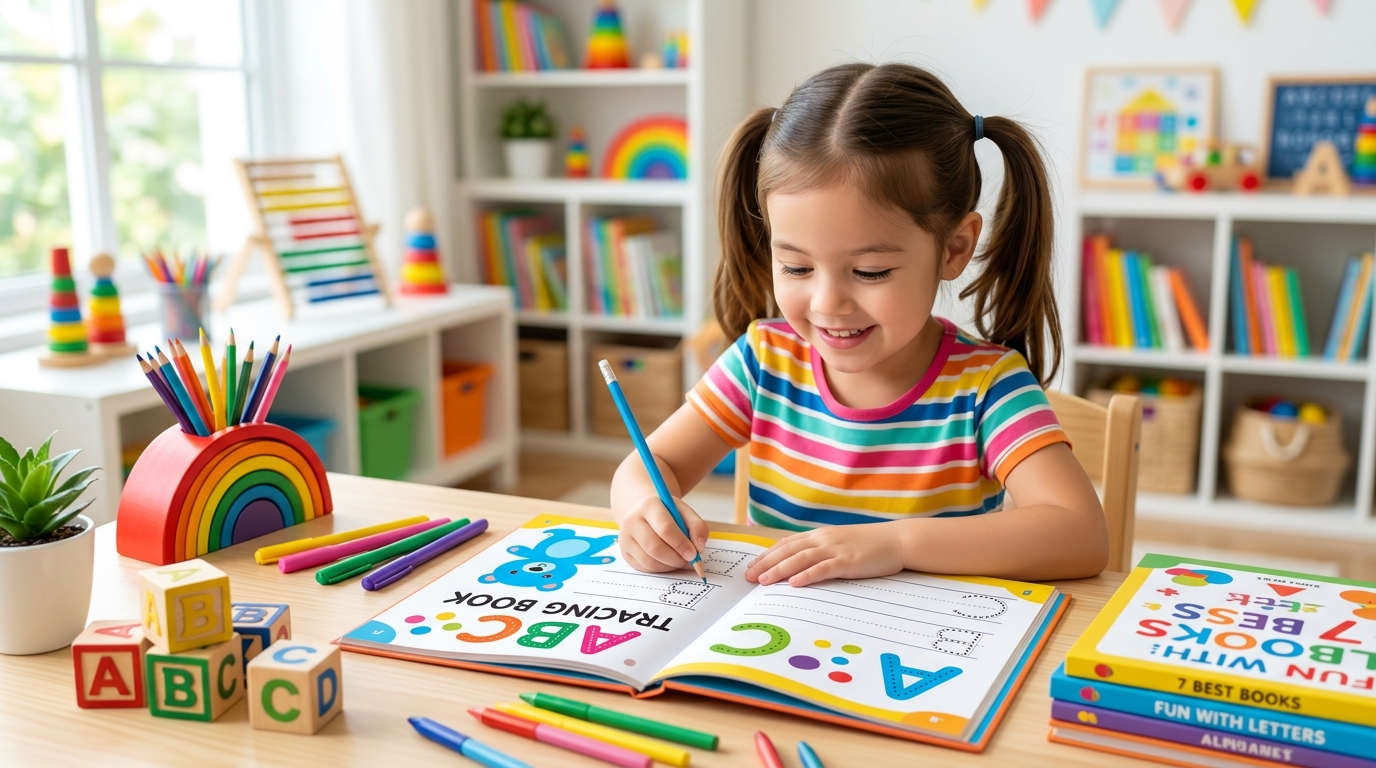
The transition from random toddler scribbles to precise, legible letter formation is one of the most complex neurological and physical milestones your child will achieve. Graphomotor development—the coordination of cognitive, visual-perceptual, and fine motor skills—requires practice, patience, and the right tools. We've evaluated the market's top workbooks based on pedagogical sequencing, occupational therapy standards, and downright fun. And if you'd like free pencil-control practice to use alongside any of them, our printable phonics coloring worksheets build the same fine motor skills while sneaking in letter sounds.
Kumon Publishing
Kumon My First Book of Uppercase Letters
The Kumon approach to handwriting is legendary for a reason. Instead of taking children through the alphabet in standard A-to-Z order—which can be incredibly frustrating for a child who hasn't yet mastered complex curves—this workbook introduces letters based on the physical strokes required to write them. Children begin with letters composed entirely of vertical and horizontal straight lines, such as L, T, H, and F. Once they build the fine motor control to master these, the book introduces angled lines (A, V, W, X), and finally progresses to complex curves (B, G, S). This pedagogical strategy ensures that children are never overwhelmed. The pages are colorful but not overly distracting, allowing the child to focus entirely on graphomotor execution. The progression is gentle, starting with short tracing paths and gradually moving to independent writing.
Learning Without Tears
Handwriting Without Tears: Readiness & Writing
Developed by an occupational therapist, the Handwriting Without Tears (HWT) program is the gold standard in many preschool and kindergarten classrooms. What sets this book apart is its use of consistent, simplified language cues. Instead of complex directional instructions, children learn that letters are built from just four components: 'Big Line,' 'Little Line,' 'Big Curve,' and 'Little Curve.' This drastically reduces the cognitive load required to remember how to draw a letter, making it highly effective for children with attention issues, language delays, or fine motor struggles. The workbooks utilize unique two-line formatting rather than traditional three-line paper, which naturally helps children understand proper letter placement and sizing. It is highly recommended to use this workbook alongside their physical manipulatives, like wooden letter pieces, for a fully rounded multisensory experience.
Priddy Books
Roger Priddy Wipe Clean: Lowercase Alphabet
For parents seeking a reusable option, the Roger Priddy Wipe Clean series is an absolute powerhouse. The standout feature of this specific book is its spiral binding. Unlike traditional glue-bound workbooks that constantly snap shut or curve near the spine, this book lies completely flat, providing a stable, frustration-free writing surface for young hands. The pages are constructed from extra-thick, glossy cardstock that easily withstands aggressive dry-erase markers and enthusiastic erasing. Each page focuses on a single letter with a clear three-step system: recognize the letter, trace the dotted lines with numbered directional arrows, and finally, practice writing it independently. The book also weaves in vibrant photographs of objects starting with the target letter, subtly building phonetic awareness alongside fine motor skills.
The SENSEsational Alphabet
SENSEsational Alphabet Book
This is not your average tracing book; it is a full-fledged multisensory learning experience. Designed to engage all of a child's senses, the SENSEsational Alphabet book incorporates visual, tactile, olfactory (smell), and auditory elements. Each page features a letter alongside an associated word. But here is where the magic happens: children can physically feel the textures of the illustrations—like a horse's mane or a lizard's scales—and even smell integrated scents like apples and roses. Furthermore, the book is incredibly inclusive, featuring both the American Sign Language manual alphabet and Braille on every single page. The tactile nature of the large letters makes it an incredible tool for finger-tracing before a child is even ready to hold a pencil. It's a phenomenal resource for graphomotor development through neural integration.
Scholastic Early Learners
Scholastic Wipe-Clean Workbook: Pre-K Alphabet
Scholastic has leveraged its decades of educational expertise to create a highly engaging, interactive wipe-clean workbook. What makes this book shine is that it doesn't stop at simple letter tracing. Over its 56 pages, it integrates crucial early learning concepts. Children will practice tracing uppercase and lowercase letters, but they will also engage in activities involving beginning letter sounds, rhyming, shape sequencing, and matching words. It feels less like a chore and more like a puzzle book. The glossy pages allow for repeated practice, which is essential for building graphomotor confidence. It provides a highly structured environment where making a mistake is no big deal—just wipe it away and try again. The inclusion of engaging, teacher-approved photography keeps children visually stimulated.
Hadley Designs
Hadley Designs ABC Tracing Activity Book
If your child groans at the sight of a workbook, the Hadley Designs ABC Tracing Book might be the cure. This book disguises handwriting practice as playtime. Instead of endless rows of monotonous letters, this book is packed with varied activities. A single letter's page might include standard tracing, but it is immediately followed by an alphabet maze, a 'circle the matching letter' game, and fill-in-the-blank phonetic exercises. It keeps the child's brain actively switching gears, preventing the boredom that often accompanies repetitive fine motor tasks. It covers both uppercase and lowercase letters, and even includes number matching and counting exercises towards the back. It's a comprehensive, heavily praised workbook that functions as an all-in-one preschool curriculum.
Activity Treasures
Big Letter Tracing Book For Toddlers
When children are 2 or 3 years old, they do not possess the fine motor control necessary to trace standard-sized letters. They are still relying heavily on their gross motor skills—using their whole arm rather than just their fingers. This workbook is brilliantly designed specifically for this developmental stage. It begins with basic shape tracing (squares, circles, hearts) to teach the concept of following a path before letters are even introduced. When it does move to letters, the characters are absolutely massive. This giant sizing allows toddlers to successfully stay on the lines using thicker crayons or markers, building their confidence. It removes the pressure of precise, tiny movements, making it the perfect bridge between random scribbling and formal writing.
Parent & Educator FAQ
Everything you need to know about teaching early handwriting skills.
Help Your Child Fall in Love with Reading
Picture This! teaches visualization step-by-step so children can genuinely understand—and enjoy—what they read.
Related Articles



Sources & References
- Handwriting Without Tears
- My First Book of Uppercase Letters (Kumon Series) - Barnes & Noble
- Lowercase Alphabet (Wipe Clean Workbook) - Target
- SENSEsational Alphabet Book
- Which Handwriting Program Should You Choose? - Apex Occupational Therapy
- (PDF) The Effectiveness of the Size Matters Handwriting Program - ResearchGate
- The Best Preschool Workbooks for Learning Letters and Writing - Read Brightly
- My First Handwriting Book: Lowercase Letters | Chicago OT