The Science of Taste: Inside Pediatric Flavor Labs
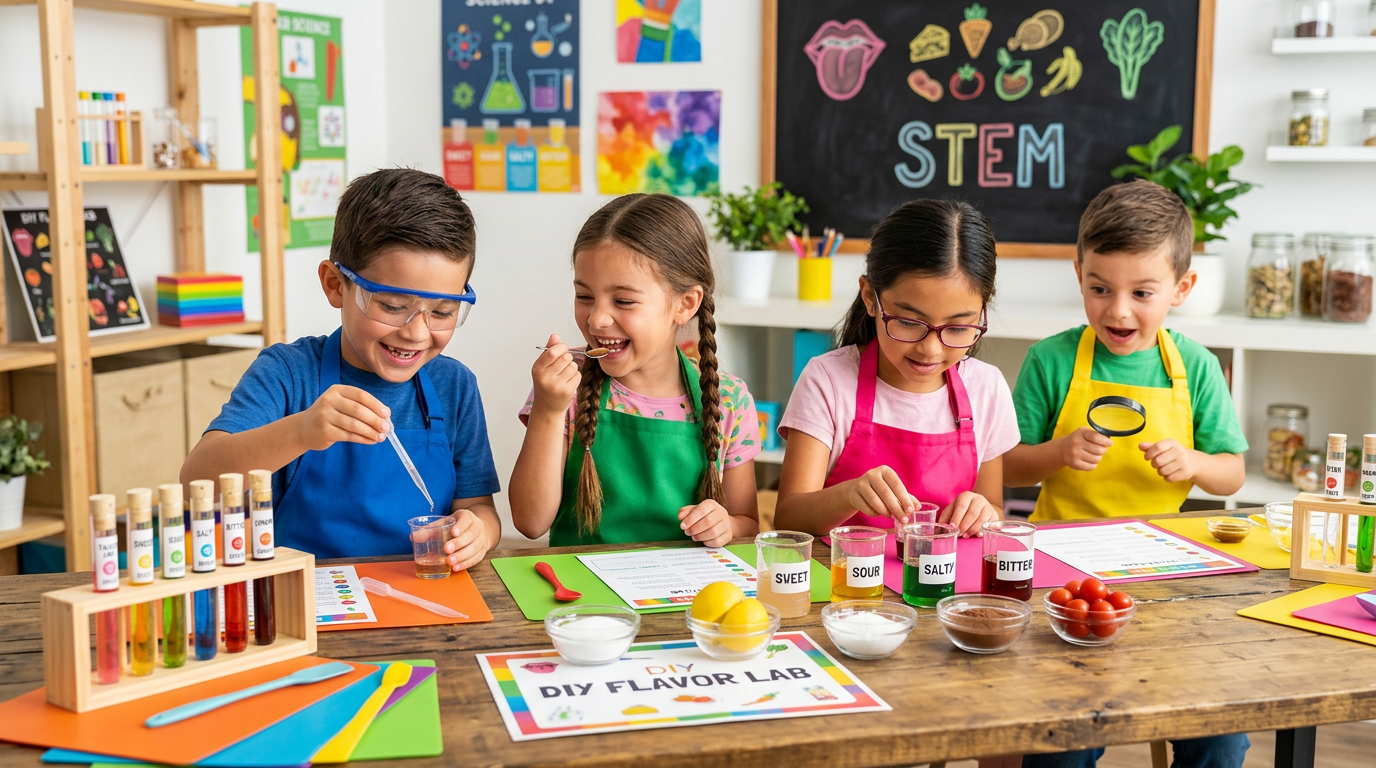
Welcome to the world of "Flavor Labs," where the kitchen counter transforms into a bustling science laboratory! Instead of just following a recipe, kids are encouraged to hypothesize, analyze acidity, and explore sensory profiles. By blending culinary arts with STEM learning, these labs turn everyday cooking into an incredibly delicious exploration of chemical reactions and biology. Organizations like The Flavor Labs are pioneering this approach, making science accessible and delicious.
5 Reasons to Start a "Flavor Lab" at Home
- 1Boosts STEM Literacy
Cooking is essentially edible chemistry. Children learn about physical states of matter (melting butter), chemical reactions (baking powder bubbling), and mathematical scaling (doubling a recipe using fractions).
- 2Cures Food Neophobia (Picky Eating)
Food neophobia is the fear of new foods. When a child approaches an unfamiliar vegetable as a "scientist" examining its sensory data rather than a "kid being forced to eat dinner," their anxiety drops and their willingness to taste skyrockets.
- 3Develops Fine Motor Control
Precision is key in both science and cooking. Tasks like measuring liquids in a beaker, whisking ingredients, and using specialized kitchen tools safely help develop vital hand-eye coordination.
- 4Fosters Independence and Agency
Creating a dish from start to finish gives children a profound sense of ownership and accomplishment. They aren't just consumers; they are capable creators and engineers of their own meals.
- 5Builds Nutritional Awareness
By dissecting what goes into their food—like understanding that our bodies need specific vitamins from sour citrus or energy from sweet fruits—children naturally build a vocabulary for healthy eating habits.
The Anatomy of a Taste Bud
To truly understand the science of cooking, we have to look closely at our primary scientific instrument: the human tongue. If you look at your tongue in the mirror, you will see it is covered in thousands of tiny bumps. These bumps are called papillae (pronounced puh-PILL-ee). While many people mistakenly think these bumps are the taste buds themselves, the papillae are actually the structures that house the taste buds.
Hidden inside the crevices of those tiny bumps are between 2,000 and 5,000 actual taste buds. Each single taste bud contains up to 100 microscopic taste receptor cells. These cells have tiny, hair-like projections called microvilli that reach up into the mouth. When you take a bite of food, your saliva dissolves the chemicals in the food, and those chemicals wash over the microvilli. If the chemical is a match for the receptor—like a lock and a key—an electrical signal is fired straight up to your brain, declaring, "Hey! This is salty!"
Explore the Five Basic Tastes
Sweet
The sensation of sweetness is our body's evolutionary way of identifying energy-dense carbohydrates. When you taste something sweet, like honey or a ripe strawberry, your taste receptors are detecting sugars. These sugars provide the quick fuel your body and brain need to stay active. In a laboratory setting, scientists often use sucrose solutions to isolate this specific taste profile.
Apples, bananas, honey, and marshmallows.
The Secret Ingredient: Your Nose!
It is incredibly common to confuse the words "taste" and "flavor," using them interchangeably. However, in a culinary science lab, these two words mean very different things! Taste strictly refers to the five chemical signals happening on the tongue: sweet, salty, sour, bitter, and umami. Flavor, on the other hand, is a massive, multi-sensory construction created entirely inside your brain.
In fact, scientists estimate that up to 80% of what we perceive as flavor actually comes from our sense of smell! When we eat, we experience two different types of smelling. The first is orthonasal olfaction, which is sniffing the food through our nostrils before we take a bite. But the real magic happens through retronasal olfaction. As we chew and swallow, the food releases volatile odor molecules that travel up the back of our throat and into our nasal cavity from behind.
Our brain takes the basic taste data from the tongue (e.g., "This is sweet and sour"), combines it with the complex aromatic data from the nose (e.g., "This smells like citrus oils"), factors in the texture (e.g., "This is crunchy"), and suddenly, your brain projects the full, vibrant flavor experience of eating a fresh, crisp apple. This is precisely why food tastes incredibly bland when you have a stuffy cold—your taste buds are working fine, but your olfactory system is offline!
DIY Flavor Lab Experiments
You don't need a professional studio to start experimenting. Try these simple, hands-on sensory tests in your own kitchen to bring the science of taste to life! For structured programs and expert guidance, check out The Flavor Labs offerings.
Help Your Child Fall in Love with Reading
Picture This! teaches visualization step-by-step so children can genuinely understand—and enjoy—what they read.