Less is More: Why Parents Are Buying Fewer Toys to Help Kids Thrive
In a world obsessed with giving our children everything, developmental science suggests that the greatest gift we can offer them is a little less. Discover the profound neurological and cognitive benefits of a minimalist playroom.
The Landmark Toledo Study: 4 Toys vs. 16 Toys
The foundational evidence for the "less is more" approach in pediatric play environments comes from a seminal 2018 study conducted by researchers at the University of Toledo. To quantify the quality of play, researchers observed 36 toddlers (aged 18 to 30 months) in two distinct environments over several hours.
✕ The 16-Toy Room
Toddlers experienced significant distraction. They moved rapidly from toy to toy, spending less time with each object. Their interactions were superficial, primarily involving touching the toy once and abandoning it for the next shiny object.
The 4-Toy Room
Toddlers engaged in sustained, focused play. They played with each toy for twice as long, and interacted with them in highly sophisticated, creative ways (e.g., using a toy meant for rolling as a pretend phone or a hammer).
"This study provides hard evidence that an abundance of toys creates a distraction. When toddlers have exposure to fewer toys, they play longer and in more sophisticated ways, supporting the development of motor and cognitive skills."
The 5 Hidden Benefits of a Minimalist Playroom
It is a common parental fear that without a constant stream of new, stimulating toys, a child will succumb to boredom. However, developmental psychologists have long argued that boredom is not the enemy of childhood; it is the crucible in which creativity is forged. When children are surrounded by single-purpose, battery-operated toys that do all the playing for them (flashing lights, singing automated songs, or moving on their own), the child is reduced to a mere passive observer. The toy is entertained, but the child is not engaging their imagination.
Conversely, when a child's environment features a scarcity of highly specific toys, they are forced to invent. A cardboard box transforms into a rocket ship, a fortress, or a racecar. A few simple wooden blocks become a sprawling cityscape. This phenomenon was brilliantly demonstrated in a famous German public health experiment known as "Der Spielzeugfreie Kindergarten" (The Toy-Free Kindergarten). In this study, classrooms systematically removed all conventional toys for three months.
While the children initially experienced a period of confusion and boredom, the transformation within weeks was astounding. Without predefined toys dictating the rules of play, the children began to collaborate, communicate more effectively, and use their basic surroundings to invent complex, imaginative games. They learned to rely on themselves and each other for entertainment, resulting in a dramatic increase in creative problem-solving and narrative play.
One of the most significant cognitive challenges facing modern children is overstimulation. When a playroom is overflowing with dozens of toys, children frequently suffer from choice paralysis. Instead of settling into a state of deep, focused play, they flit anxiously from one item to the next, never fully engaging with any single object for more than a few minutes. This constant context-switching trains the developing brain to expect immediate, rapidly changing stimuli, which can hinder the development of sustained attention.
A landmark 2018 study conducted by researchers at the University of Toledo provided quantifiable evidence for this. The researchers observed toddlers playing in two different environments: one with 4 toys and another with 16 toys. The results were striking. The children in the 4-toy room played for twice as long with each individual toy. More importantly, they played in a much more sophisticated manner.
Because they were not distracted by the visual noise of 15 other options, they explored the toys deeply. They would bang them, stack them, pretend to feed them, and incorporate them into imaginative scenarios. This deep, sustained engagement is crucial for neurological development, as it strengthens the neural pathways associated with focus, executive function, and the ability to enter a "flow state"—skills that are essential for later academic success and emotional regulation.
It might seem logical to assume that having more toys would lead to fewer arguments among siblings or playmates, as there is "plenty to go around." However, child behaviorists often observe the exact opposite. An abundance of toys can actually foster a sense of territorialism and entitlement. When every child can have exactly what they want at the exact moment they want it, they miss out on critical opportunities to practice essential social-emotional skills.
When toys are limited, children are naturally forced into situations where they must negotiate, share, and collaborate. If there is only one set of magnetic tiles, siblings must figure out how to build a castle together or agree on a system for taking turns. These micro-interactions are the building blocks of conflict resolution and empathy.
Furthermore, having fewer toys encourages more interactive, interpersonal play. Instead of retreating to separate corners with individual electronic devices or highly specific action figures, children are more likely to engage in cooperative role-playing games (like playing "house," "school," or "restaurant"), which require them to read each other's social cues, communicate effectively, and work toward a shared narrative goal.
The impact of a cluttered physical environment on mental health is profound, and it affects both children and adults. According to research from UCLA's Center on Everyday Lives of Families, there is a direct correlation between high-density household objects (clutter) and elevated cortisol levels (the primary stress hormone). A playroom bursting at the seams with toys creates a constant, low-level hum of visual noise and psychological stress.
For children, this chaotic environment can lead to feelings of overwhelm, making it difficult for them to self-regulate, wind down before bedtime, or process their emotions calmly. For parents, the perpetual mess serves as a constant reminder of chores left undone, contributing to parental burnout and frustration.
By intentionally curating a minimalist play space, families can drastically reduce this environmental stress. A clean room with a few thoughtfully displayed toys on a low shelf invites a sense of peace and order. It allows the child's nervous system to downshift, promoting a calmer demeanor, better sleep hygiene, and a more harmonious family dynamic where parents spend less time managing inventory and more time connecting with their kids.
When children are inundated with a constant influx of new toys—for every minor holiday, good grade, or trip to the grocery store—toys quickly lose their value. They become disposable commodities rather than cherished possessions. If a toy breaks, the child feels little remorse, assuming it will simply be replaced by something newer and shinier the next day. This cycle breeds a sense of entitlement and makes it incredibly difficult to instill genuine gratitude.
Conversely, when a child has only a select few toys, those items become incredibly precious. A child who has to wait for a birthday or a special occasion to receive a high-quality, much-desired toy will inherently treat that object with greater respect. They learn to take pride in their belongings, putting them away carefully so they don't get lost or broken.
This scarcity teaches the fundamental principle of delayed gratification—a trait strongly linked to long-term success and resilience, as famously demonstrated in the Stanford Marshmallow Experiment. By buying fewer toys, parents are not depriving their children; they are actively teaching them to value what they have, care for their environment, and experience the deep, lasting joy of anticipation and appreciation.
The Alternative: The Magic of "Loose Parts"
If we are buying fewer traditional toys, what should children play with? The answer lies in the Theory of Loose Parts, coined in 1971 by British architect Simon Nicholson. He proposed that in any environment, the degree of inventiveness and creativity is directly proportional to the number of variables in it.
Loose parts are materials with no specific set of directions that can be used alone or combined with other materials. They are open-ended, meaning a child can move, carry, combine, redesign, line up, and take them apart in multiple ways. They are the antithesis of the "one-and-done" plastic toy.
- Natural materials: Sticks, stones, pinecones, shells, mud, and water.
- Recycled materials: Cardboard boxes, paper towel tubes, egg cartons.
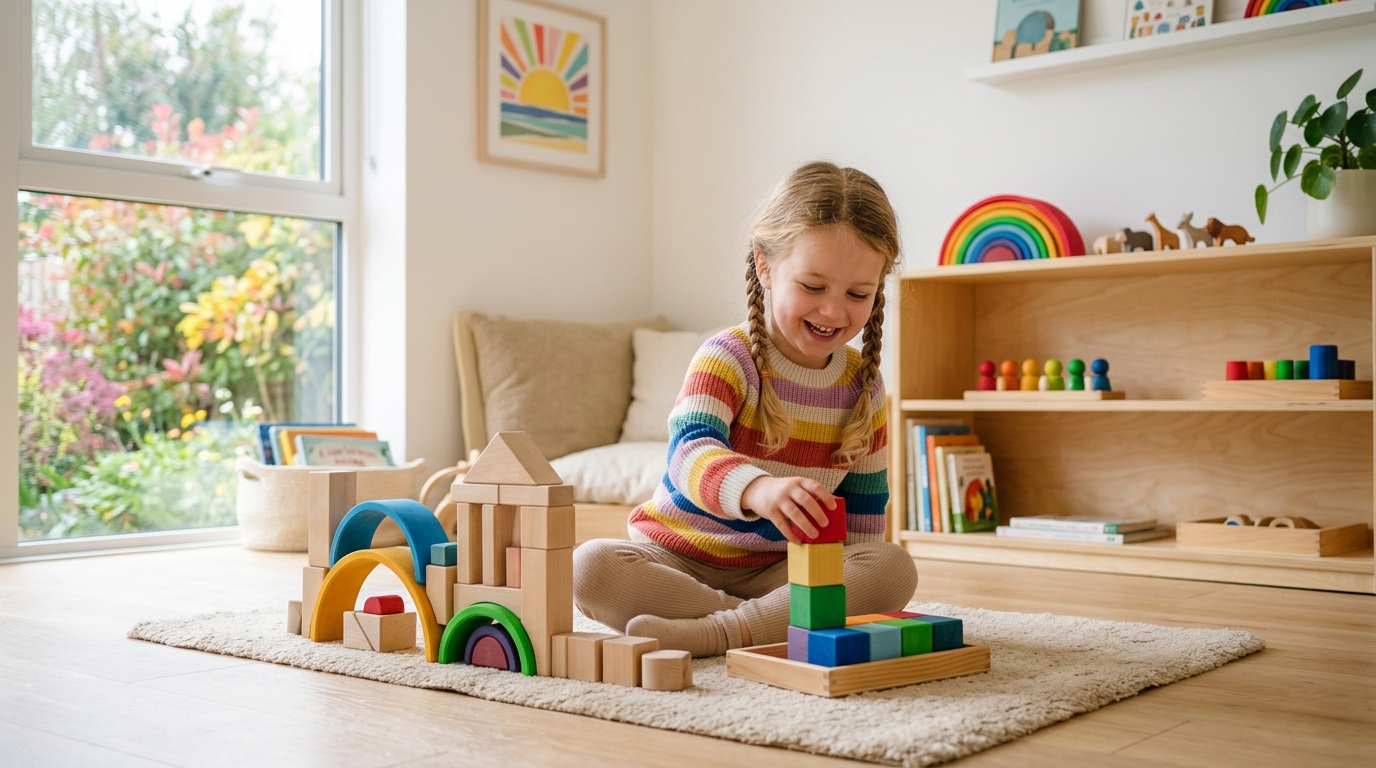
- Classic staples: Wooden blocks, play silks, plain wooden peg dolls, magnetic tiles.
"A good toy is 10% toy and 90% child."
— Joan Almon
The Action Plan: How to Transition to Fewer Toys
Shifting from a cluttered playroom to an intentional, minimalist space doesn't happen overnight. Use this three-phase strategy to reclaim your home and empower your child's play.
Embrace the Empty Space
Transitioning to a minimalist approach to toys requires a paradigm shift. It means fighting the cultural conditioning that equates love with material abundance. But as you watch your child turn a simple cardboard box into a submarine, and as you notice the peaceful quiet of a child deeply engaged in sustained play, you will realize that by giving them fewer toys, you have given them the space to discover themselves.
Help Your Child Fall in Love with Reading
Picture This! teaches visualization step-by-step so children can genuinely understand—and enjoy—what they read.