Free phonics worksheets
Every printable phonics worksheet on the site, in one place — designed by phonics teachers, organized by skill, and free to print at home or in the classroom. Packs marked "coming soon" are being prepared and will be downloadable shortly.
Pick the area your child is working on. The packs build on each other, but every one stands alone — you don't need to start from the beginning.
Worksheets by skill
Focused single-skill worksheet collections, each with its own page and free PDFs:
- Phonemic awareness worksheets and oral activity cards — rhyming through sound manipulation, before letter work
- Alphabet phonics worksheets (A to Z)
- Short vowel phonics worksheets (a, e, i, o, u)
- Phonics blends worksheets (30 PDFs)
- Initial consonant blend worksheets (20 PDFs)
- Final consonant blend worksheets (10 PDFs)
- Consonant digraph worksheets (sh, ch, th, ng, ck)
- Long vowel phonics worksheets
- Vowel team phonics worksheets (ai/ay, ee/ea, oa/ow)
- R-controlled vowel worksheets
- Single-letter worksheets (the Magic 7): letter A, letter T, letter P, letter I, letter N, letter M, and S
Seasonal collections for themed practice:
- Christmas phonics worksheets
- Halloween phonics worksheets
- Easter phonics worksheets
- Valentine's Day phonics worksheets
- Thanksgiving phonics worksheets
- Summer phonics worksheets
Also see the kindergarten phonics worksheets collection and the phonics coloring worksheets collection.
Quick links by stage
Pre-K / Nursery (ages 3–4) — oral sound games, letter recognition and tracing
Preschool (ages 4–5) — oral sound awareness, beginning sounds, letter sounds, getting ready to blend
Just starting out (ages 4-5) — first sounds, letter recognition, beginning blending
Building fluency (ages 5-6) — CVC words, sentences, sound mats
Phase 5 / advanced phonics (ages 6-8) — magic e, vowel digraphs, alternative spellings
Reference materials — sound mats, word lists, daily routines
Starting out — the first phonics sounds
The seven sounds s, a, t, p, i, n, m are the right place to begin. Together they unlock more readable words than any other starting set — sat, pin, tap, man, sit, map are all decodable from day one.
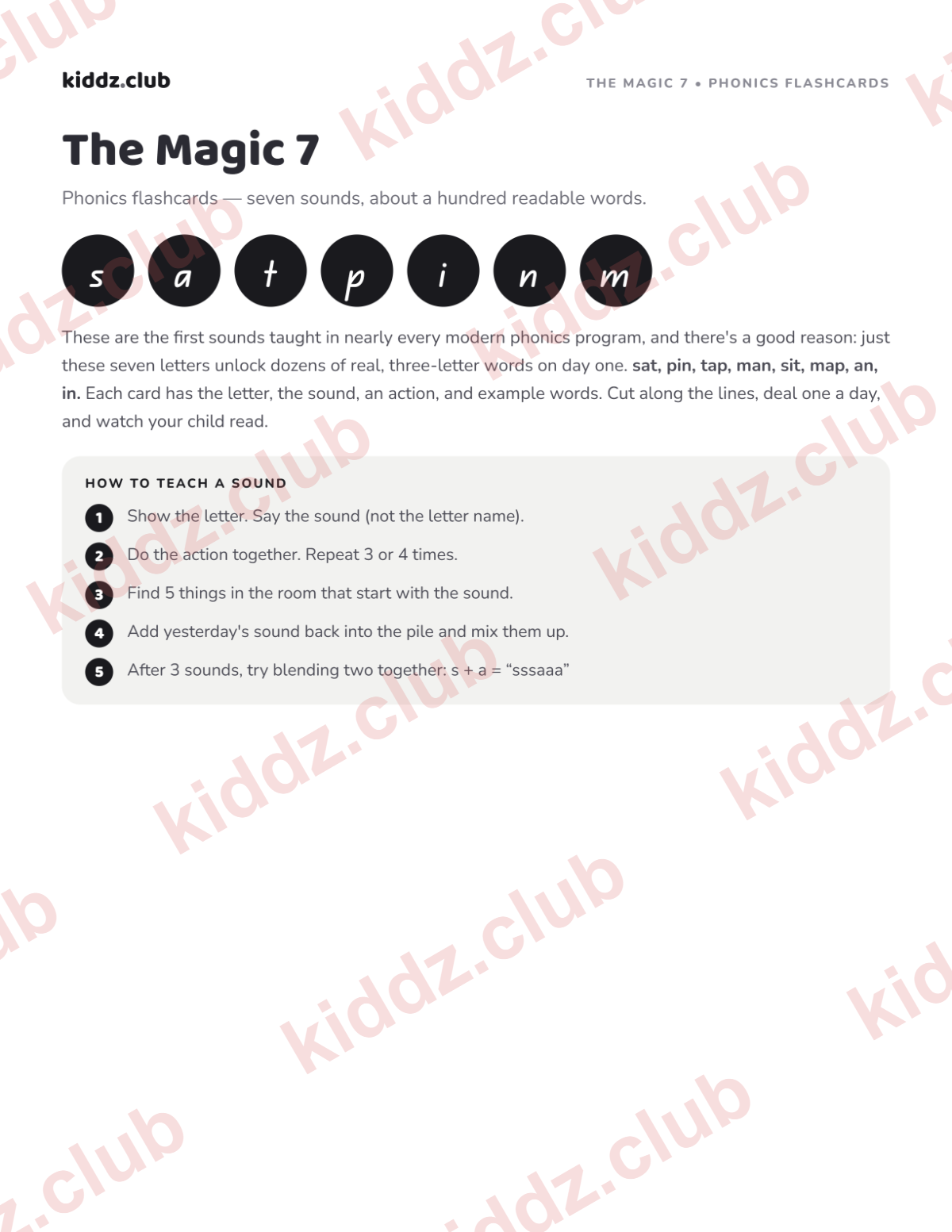
The Magic 7 Phonics Flashcards
A free 7-page printable: cover, cut-out flashcards (one per sound), and a sound mat to use during practice. Each card has the letter, the sound, the action, and example words.
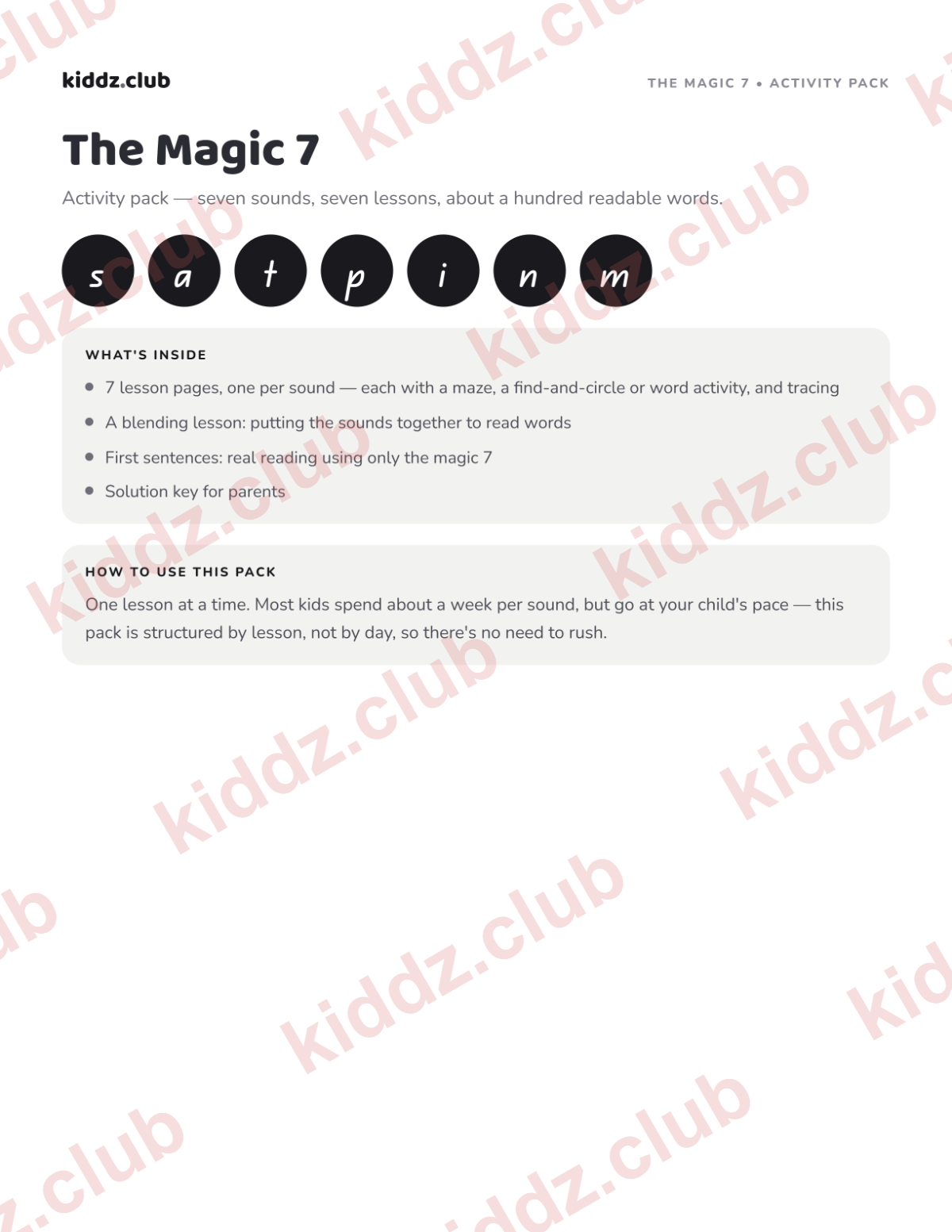
The Magic 7 Activity Pack
A 13-page activity pack: 7 lesson pages (one per sound), each with a letter-shape maze, a find-and-circle activity, and tracing rows. Includes a blending lesson, first sentences, and a parent solution key.
One page per sound — the Magic 7, letter by letter
Each Magic 7 sound also has its own worksheet page with full teaching notes: why the sound sits where it does in the sequence, how to say it correctly, a five-minute lesson plan, and the words it unlocks. Work through them in order:
Building fluency — CVC and first sentences
Once your child knows individual sounds, the next step is putting them together into words and short sentences. These printables cover the bridge from blending sounds to reading actual text.
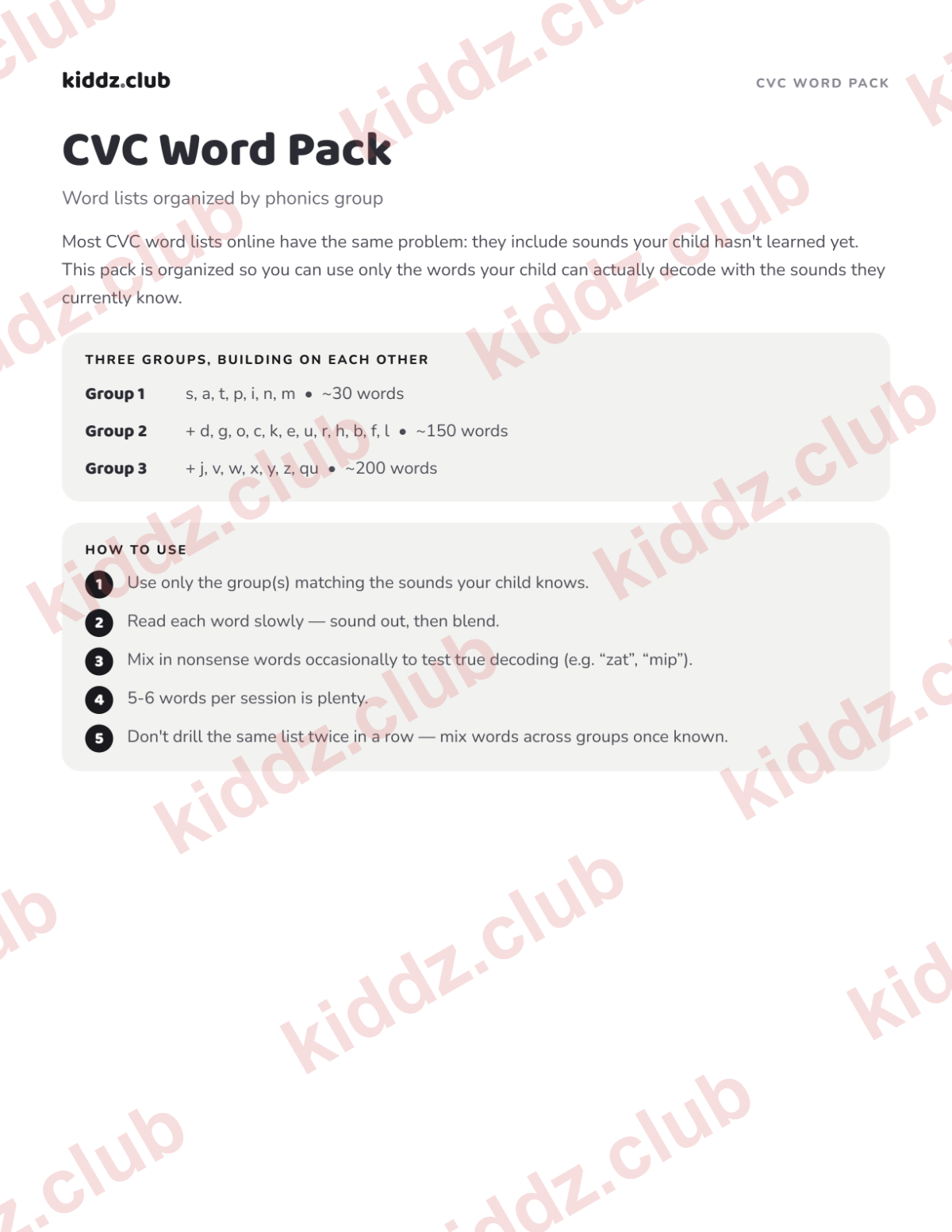
CVC Word Pack
The full set of CVC (consonant-vowel-consonant) words your child can decode, organized by which phonics sounds they know. Three progressive phonics groups — print only the ones matching what your child has learned.
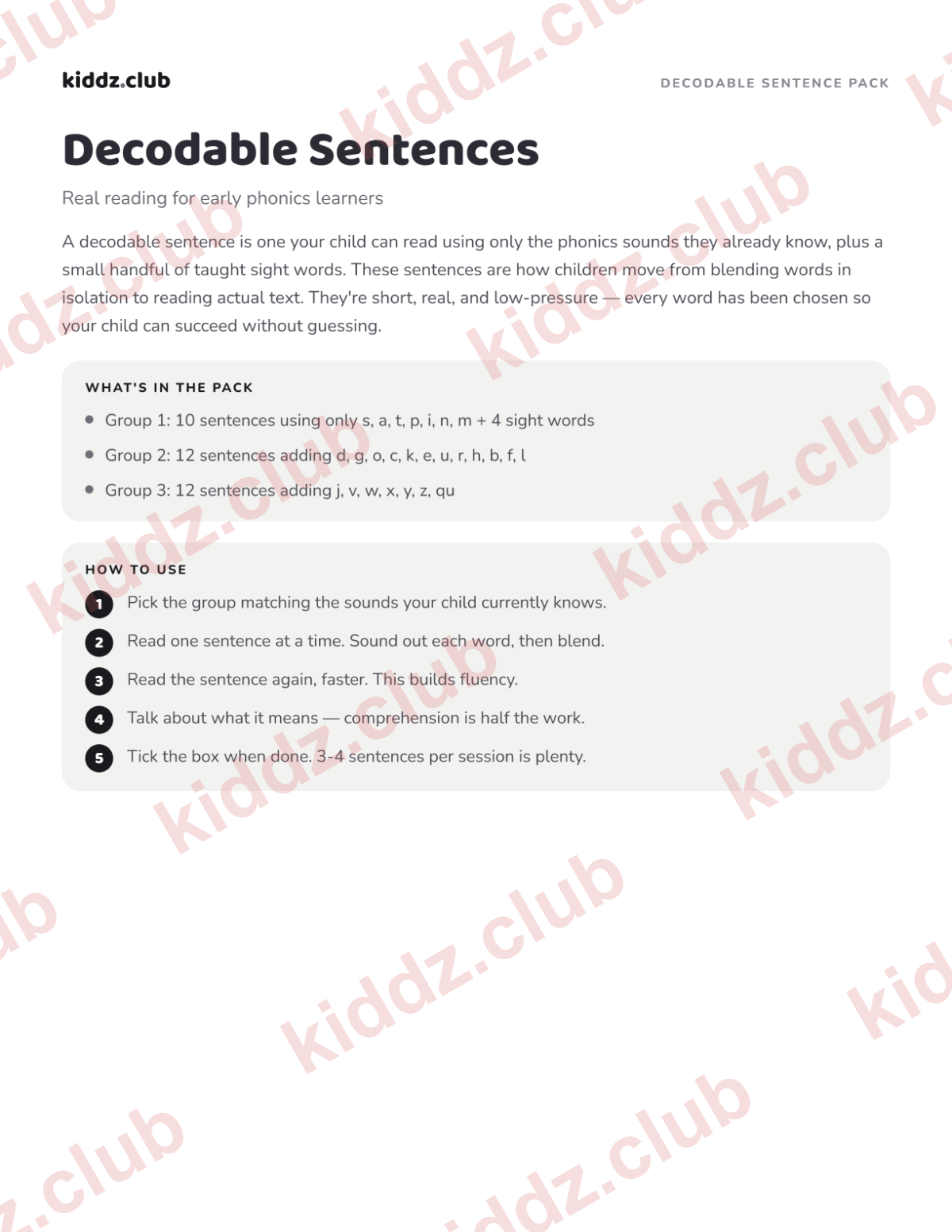
Decodable Sentence Pack
34 short sentences using only sounds your child has been taught. Three sets at increasing difficulty, with checkboxes for each sentence. The bridge between word lists and real books.
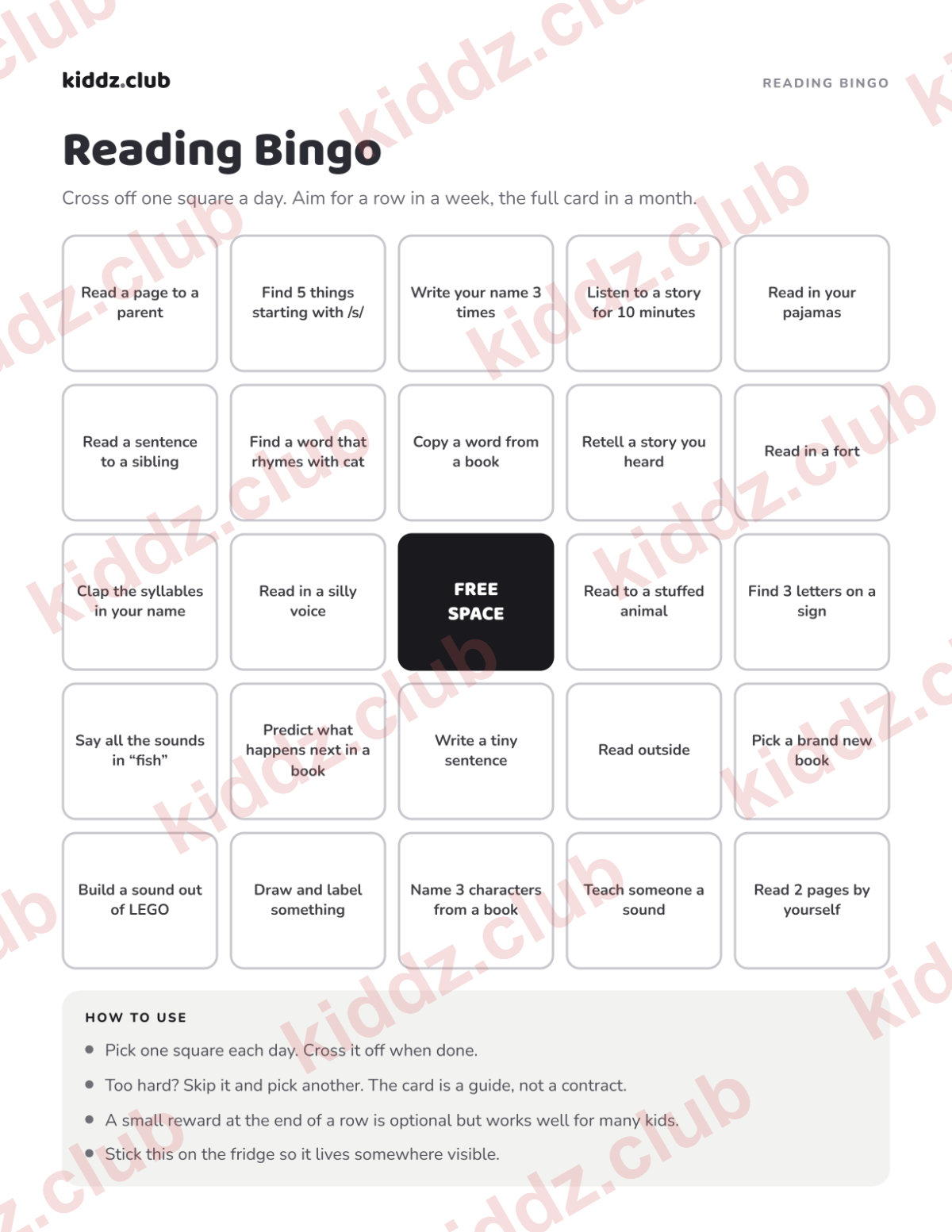
Reading Bingo
A printable bingo card with 25 small reading-related activities — read a page, find five things starting with /s/, write your name, retell a story you heard. Built to live on the fridge for a month.
Advanced phonics — Phase 5 territory
Once basic sounds and CVC words are solid, the next big territory is the alternative spellings — magic e, vowel digraphs (ai, ay, ee, ea, oa, ow), and the patterns that govern when each spelling is used. This is where most online resources go thin; ours go deep.
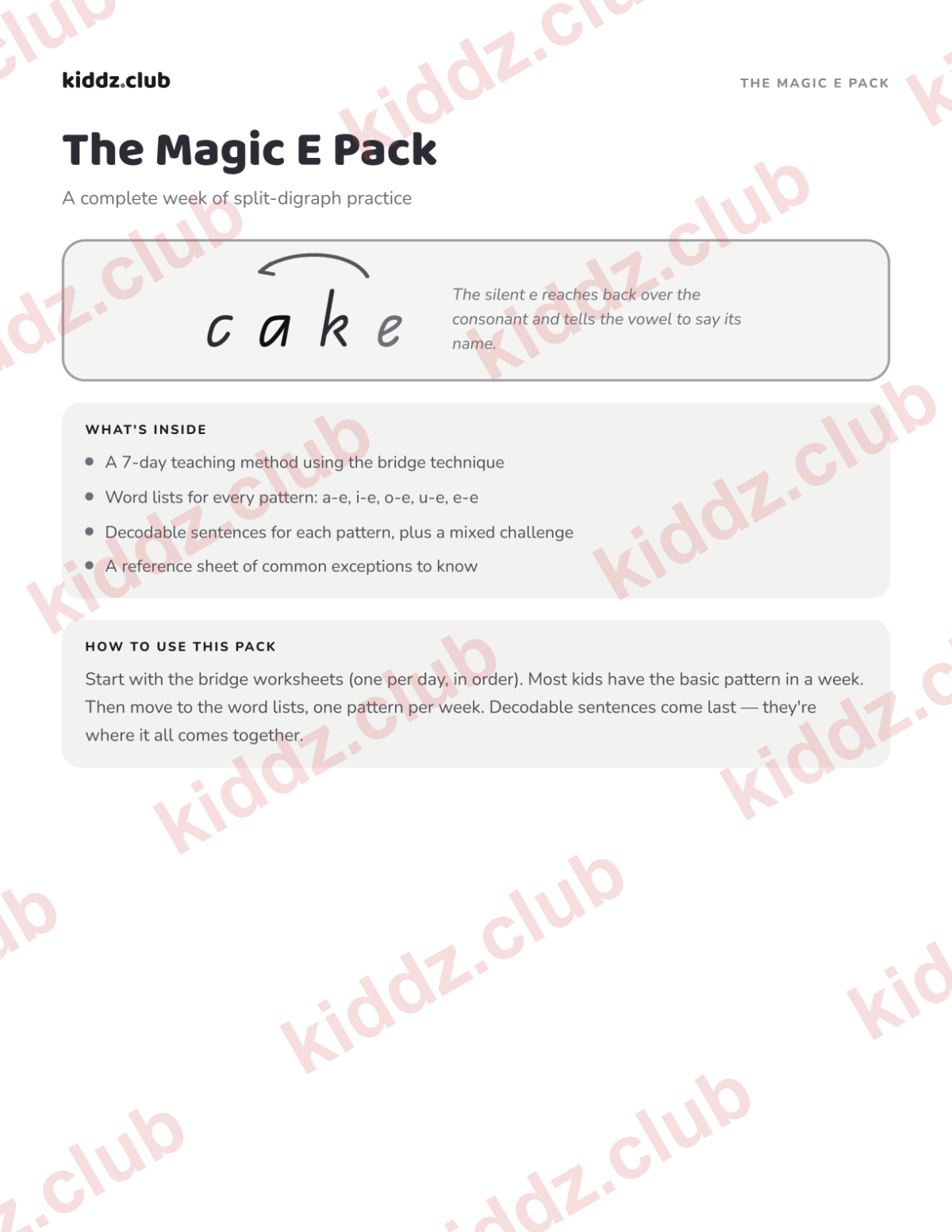
The Magic E Pack
A 20-page structured pack covering split digraphs (a-e, i-e, o-e, u-e, e-e). Includes seven sequenced bridge-method worksheets, full word lists for every pattern, decodable sentences, and an exceptions reference sheet.
Reference materials
Single-page references that live on the wall, the fridge, or the practice table.
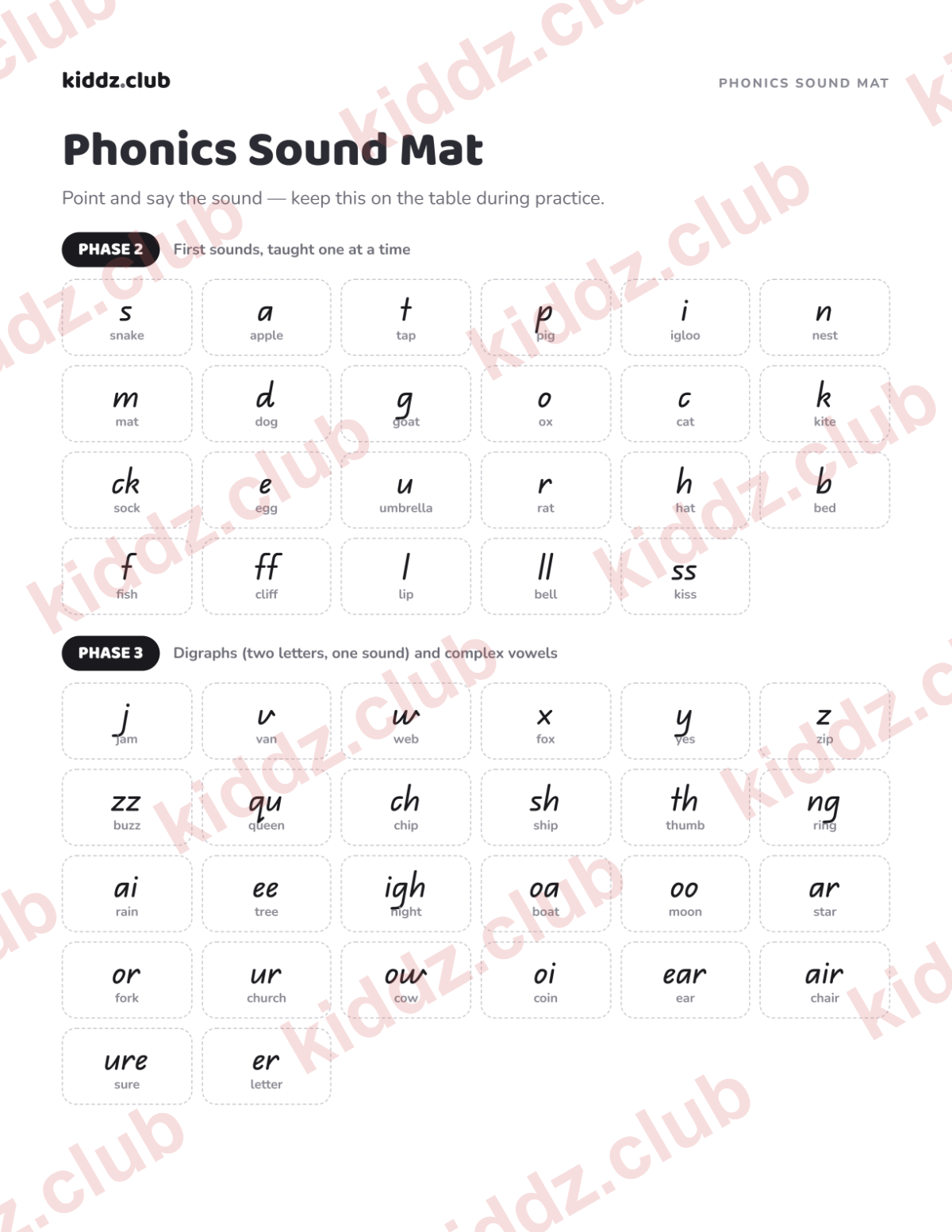
Phonics Sound Mat
Every common phonics sound on a single sheet, organized by phase. Phase 2 (the first sounds) and Phase 3 (digraphs and complex vowels). Used by Reception teachers; surprisingly hard to find a clean free version online.
Interactive tools
Beyond the printables, a few free interactive tools that don't fit on paper:
- CVC Word Generator — tick which sounds your child knows, get a custom list of decodable words and sentences. Print or save as PDF.
- Phonics Sound Player — tap any of the 44 English sounds to hear it pronounced properly, with example words and common spellings.
- Reading Age Estimator — answer eight quick questions and get a calibrated reading stage plus one concrete next step.
How to use these worksheets
A few small things that make a real difference:
One worksheet at a time. A child working through a single sheet calmly will learn more than a child working through five sheets quickly. There's no race.
Five to ten minutes is plenty. Daily practice in short sessions beats long sessions once a week. Stop while it's still fun.
Teach the sound, not the letter name. When you point at s, say /sss/ — not "ess." Names matter eventually; sounds matter first.
Print on regular paper or cardstock. Most worksheets are designed for letter-size paper (A4 also works). The flashcards print better on cardstock if you want them to last.
Free for personal and classroom use. Print as many copies as you need. We just ask that you don't republish or resell.
What's next: more advanced reading help
If your child is past the basics and reading short books, we have detailed parent-facing articles covering common questions:
- How to teach phonics at home
- The 5-minute reading routine that actually sticks
- What to do when your child guesses instead of reading
- Sight words vs phonics — do I need both?
Get our 5 best phonics packs by email
Pop your email in and we'll send the Kindergarten Phonics Starter Bundle — Magic 7 flashcards, Magic 7 activity pack, CVC word pack, decodable sentences, and the sound mat.
No spam, ever. Your printables arrive either way.
Want the entire printables library?
Kiddz.club members can download every printable on the site as one zip — plus full access to the Picture This! reading program. Start with a free 7-day trial.
Common questions
Are these worksheets really free?
Yes. Every printable on this page is free for personal use, classroom use, and tutor use. Print as many copies as you like. We ask only that you don't republish or resell them.
What format are the worksheets?
PDF. They're designed to print on standard US letter (8.5 × 11 inch) paper, but most also fit A4 fine. Open in any PDF reader and print.
What age are these for?
The starter materials work for ages 4-5. CVC and fluency materials work for ages 5-7. Advanced/Phase 5 materials work for ages 6-8. Each pack notes its target age.
Do they follow a specific phonics method?
The materials follow synthetic phonics — the approach used by Letters and Sounds (UK), Read Write Inc., Jolly Phonics, and most modern early-literacy programs. They're compatible with all of these but not branded for any one of them.
Can I use these for homeschooling?
Yes. Many of our users are homeschoolers and home educators. The pack structure is designed to work standalone, without needing a school-aligned curriculum.
Do they work for kids with dyslexia?
The materials use systematic phonics, which is the recommended approach for children with dyslexia. They're compatible with Orton-Gillingham-style instruction. They're not a substitute for professional support if your child has a diagnosed reading difficulty, but they pair well with it.
Ready for More Than Worksheets?
Picture This! teaches visualization step-by-step so children can genuinely understand—and enjoy—what they read.