Letter A phonics worksheets — free printable activities
A free phonics worksheet for the letter A and the short /a/ sound — the first vowel taught in most phonics programs. Part of the Magic 7 Activity Pack, which covers the seven foundational sounds children meet at the start of their reading journey.
Why letter A comes second
In the Magic 7 sequence — s, a, t, p, i, n, m — A arrives right after S, and for a good reason: every word needs a vowel. Without A, your child can say sounds but can't build anything. The moment A joins S, blending practice can begin: sss-aaa.
The short /a/ sound (as in apple, ant, at) is also stretchy — you can hold it (aaaaa), which makes it the easiest vowel to blend. That's why nearly every synthetic phonics program (Letters and Sounds, Jolly Phonics, Read Write Inc.) puts it first among the vowels.
One important note: the sound is /a/ as in apple, not the letter name "ay". Names don't blend into words — ess-ay-tee doesn't say sat. Sounds do.
What's on the Letter A page
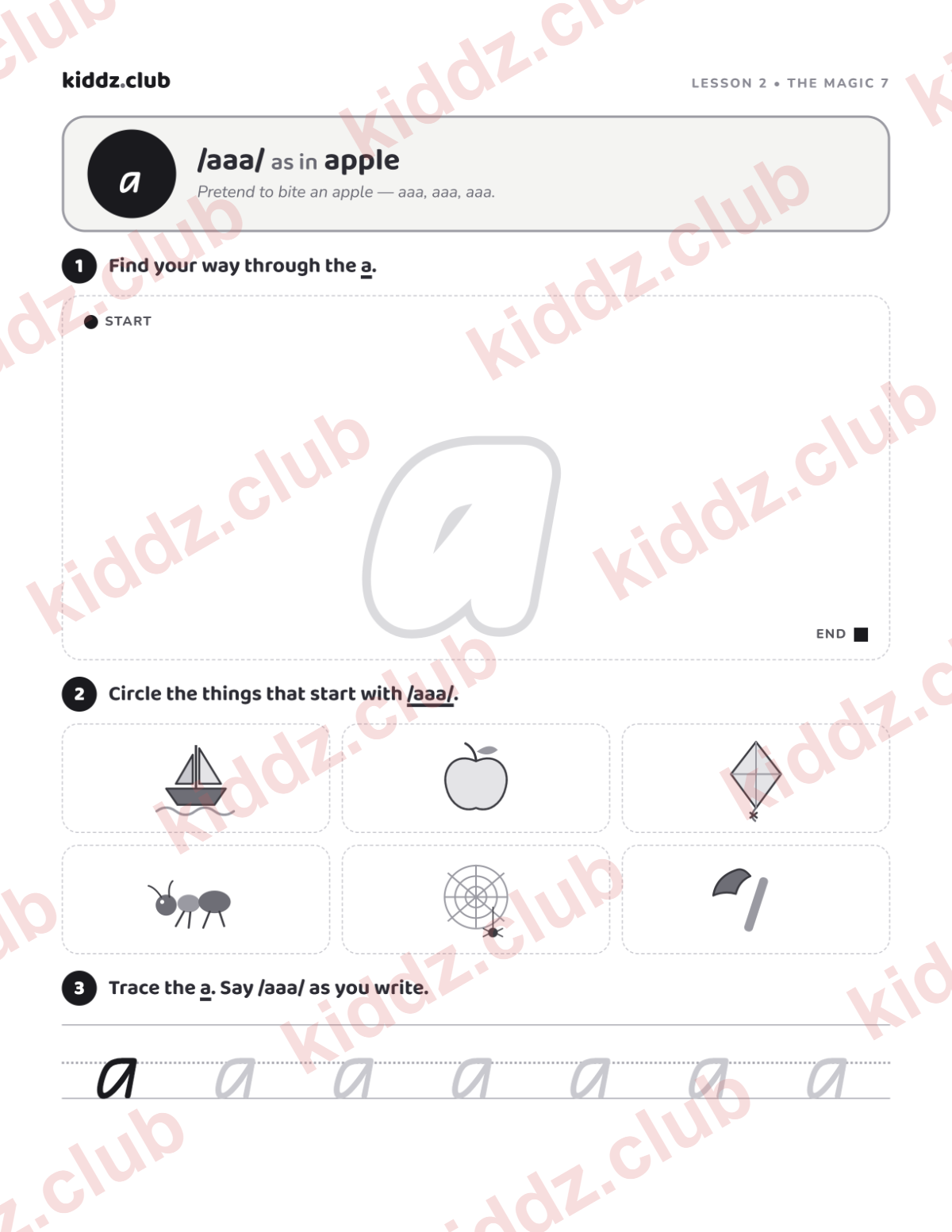
The Magic 7 Activity Pack covers seven sounds in one PDF. The Letter A lesson page has three activities:
Activity 1 — A letter-A-shaped maze. The lowercase a drawn as a maze, with a path from START to END. Kids trace the path with a finger or pencil while saying /aaa/. The maze shape reinforces visual letter recognition.
Activity 2 — Find and circle. Small icons on the page (apple, ant, and several distractors). The child circles every one that starts with /a/.
Activity 3 — Letter tracing. A model lowercase a on the left, six light-gray practice letters to trace while saying /aaa/ aloud.
How to teach the short /a/ sound
A simple five-minute approach:
- Show the letter. Point at a. Say /aaa/ as in apple — stretch it. Have your child copy.
- Use the action. "Pretend ants are crawling up your arm — a-a-a-ants!" Kids remember sounds tied to physical actions.
- Find things that start with /a/. Apple, ant, alligator (in a picture book), astronaut.
- Blend with S. Say sss-aaa together and slide the sounds into each other. Not a word yet — but it's the very first blend.
- Stop while it's still fun.
That's a full session. Repeat tomorrow. Once /s/ and /a/ are both solid, T is next — and then real words appear.
What comes after A
T arrives next, and suddenly sat, at, as are readable — real words, from just three sounds. This is the moment most children realize reading is possible, and it's why the s-a-t-p-i-n order beats alphabet order.
The pack includes all seven in order: s, a, t, p, i, n, m. One lesson page per sound, plus a blending page, first sentences, and a parent solution key.
When this worksheet is the right level
Use this worksheet if:
- Your child is 4-5 years old
- They've met the /s/ sound (or are starting phonics from scratch)
- They haven't yet blended sounds into words
Skip this worksheet if:
- Your child can already read three-letter words confidently
- They've completed the Magic 7 set already — try the Short A worksheets or the CVC Word Pack next
Related resources
Part of the free phonics worksheets library. This page is linked from the preschool and pre-K hubs.
Companion materials for the letter A and the Magic 7 set:
- Letter S phonics worksheets — the sound before this one
- Letter T phonics worksheets — the sound after this one
- Magic 7 Phonics Flashcards — cut-out cards for each of the seven sounds
- Short A phonics worksheets — deeper /a/ practice for kindergarten
Common questions
What sound does A make?
In early phonics, A makes the short /a/ sound as in apple. The long "ay" sound (as in ape) comes much later, with magic-e and vowel teams. Teach short /a/ first.
Why teach the sound before the letter name?
Names don't blend into words; sounds do. ay-tee doesn't say at — /a/-/t/ does. Most phonics programs teach sounds first, names later.
Why is the A worksheet part of a multi-letter pack?
Because A is never taught in isolation in a real phonics program — it's part of the first group (s, a, t, p, i, n, m), taught together because the letters combine to make words.
Are these worksheets really free?
Yes. Free for personal, classroom, and tutor use. Print as many copies as you like.
Ready for More Than Worksheets?
Picture This! teaches visualization step-by-step so children can genuinely understand—and enjoy—what they read.