
Phonics CVC words worksheets
Free printable CVC (consonant-vowel-consonant) word worksheets organized by which phonics sounds your child has been taught. Three progressive phonics groups — print only the ones that match what your child has learned so far.
What's a CVC word?
CVC stands for consonant-vowel-consonant — three-letter words like cat, sun, pig, mat, hop. They're the first proper words most kindergartners learn to blend, because they follow predictable rules: each letter makes its expected sound, and the three sounds run together to make the word.
Once a child can read CVC words confidently, real reading is around the corner. They're the bridge from "I know my sounds" to "I'm reading."
What's in the pack
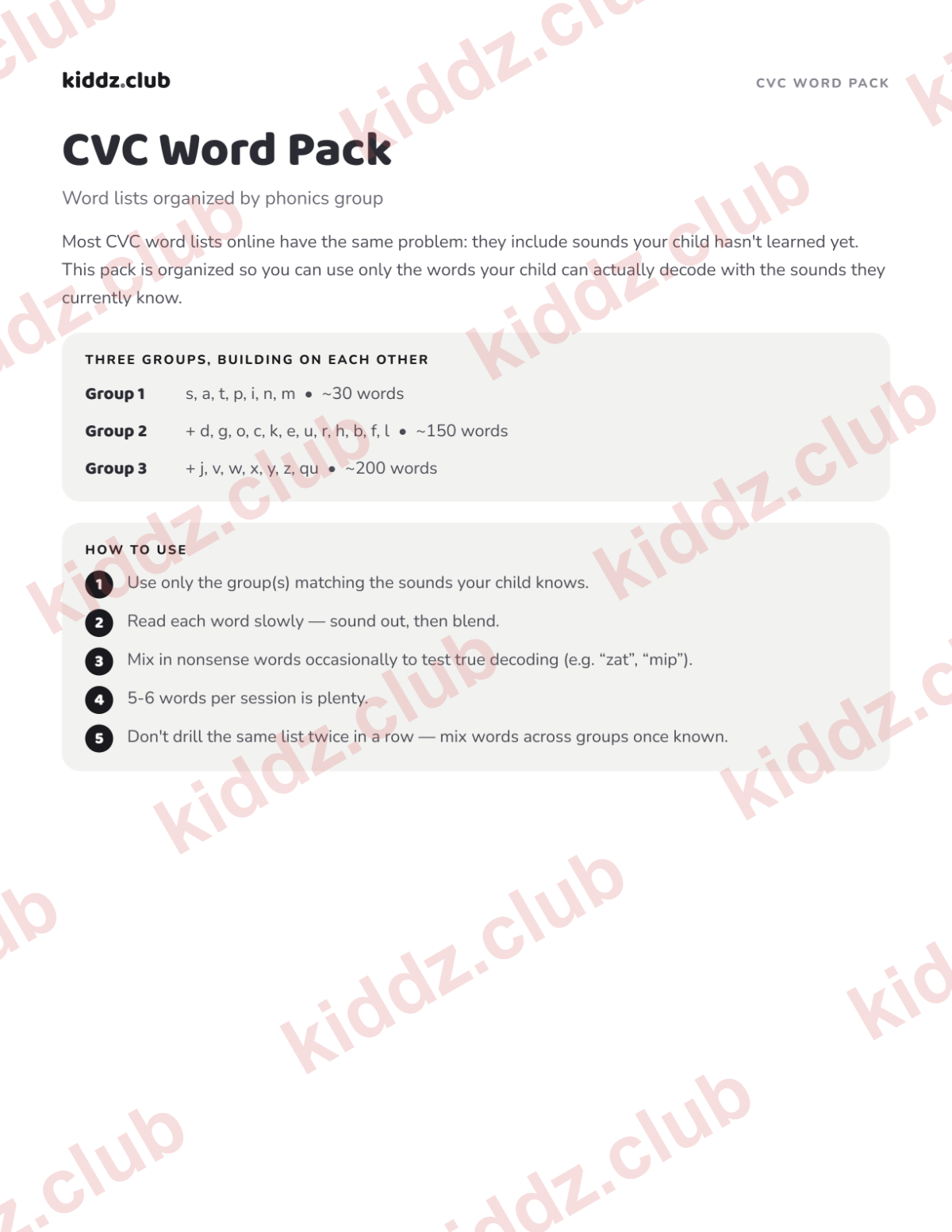
Structured CVC practice organized into three groups so you only print what your child has learned.
Group 1: Magic 7 sounds (s, a, t, p, i, n, m) — words readable using only the first seven phonics sounds. sat, pin, tap, man, sit, map, nap, pan, an, at, is, in, am. About 25 words.
Group 2: + Group 2 sounds (d, g, o, c, k, e, u, r, h, b, f, l) — words readable once your child has the second phonics group. Adds dozens of new CVC words: dog, cup, hen, red, big, fun, log, cat, bug, leg, hat, run, hop. About 60 words.
Group 3: All single-letter sounds — words using any of the 26 single letters with their basic sounds, before digraphs. jam, vat, wig, yes, zip, etc. About 100 words.
Sentence pages — each group includes a small set of decodable sentences using only the words from that group, so your child can practice reading them in real context.
How to use the CVC worksheets
A few things that make CVC practice actually stick:
Read aloud, slowly. Have the child sound out each letter, then blend. /c/ /a/ /t/ — cat. Don't let them guess from the picture or context — the goal is to read the word from its sounds.
Use the segmenting hand. Hold up three fingers and tap each one as the child says the corresponding sound. Then sweep the fingers together as they say the whole word. The physical motion makes the blending visible.
Don't move on too fast. Twenty CVC words read confidently is worth more than a hundred read shakily. Most kindergartners need two to three weeks of CVC practice before it feels effortless.
Mix in writing. Once your child can read a CVC word, ask them to write it. Reading and writing reinforce each other faster than either alone.
Read short sentences. A child who reads cat sat on a mat aloud is doing real reading. That feeling matters.
When CVC worksheets are the right level
Use these worksheets if:
- Your child knows individual phonics sounds (at least the first seven)
- They can identify the sound a letter makes when shown the letter
- They're starting to blend two-sound words orally (saying m-a → ma)
Skip these worksheets if:
- Your child is still learning individual sounds — finish the Magic 7 Activity Pack first
- Your child is reading two-syllable words confidently — move on to digraphs and the Magic E Pack
Common CVC patterns
CVC words cluster into rhyming families. Practicing one family at a time builds fluency faster than mixing words randomly.
-at family: cat, hat, mat, pat, sat, rat, bat, fat
-an family: can, fan, man, pan, ran, tan, van
-ap family: cap, gap, lap, map, nap, sap, tap, rap
-ig family: big, dig, fig, jig, pig, wig, rig
-op family: hop, mop, pop, top, cop, lop
-un family: bun, fun, gun, nun, run, sun
-en family: den, hen, men, pen, ten
Each family is a small pattern that makes blending feel predictable.
The CVC Word Pack — three progressive groups
Ready to print right now: the CVC Word Pack, organized into three progressive groups so you only print what your child has learned. Group 1 covers the Magic 7 sounds, Group 2 adds the second phonics group, and Group 3 covers all single-letter sounds — each group with word lists and matching decodable sentences, plus a parent guide.
Work through the groups in order, or start with whichever group matches the sounds your child's phonics program is currently teaching.
What comes after CVC
When your child can confidently read 50+ CVC words and short CVC sentences, the next territories are:
- CCVC and CVCC words — spin, stop, hand, milk, jump. Add a consonant blend to one end of the word.
- CVCe / magic e words — cake, time, home, cute. Add a silent e that lengthens the vowel.
- Digraphs — sh, ch, th, ng and the long-vowel digraphs (ai, ay, ee, ea, oa, ow).
For magic e words, see the Magic E Pack.
For real-text reading practice using CVC words plus a few common sight words, see the Decodable Sentence Pack.
Related resources
This printable is part of the free phonics worksheets library, specifically the kindergarten phonics worksheets collection.
Not blending yet? Start with the beginning sounds worksheets — hearing where a word starts is the skill that comes before CVC words.
For the parent-facing background:
- How to teach phonics at home
- What to do when your child guesses instead of reading
- Sight words vs phonics — do I need both?
Common questions
What's the difference between CVC, CCVC, and CVCC?
CVC = consonant-vowel-consonant (cat, sun, pig). CCVC = two consonants then vowel-consonant (stop, plan, frog). CVCC = consonant-vowel then two consonants (hand, milk, fast). Children typically learn CVC first, then CCVC and CVCC together once basic blending is solid.
Why don't these worksheets just have all CVC words on one page?
Because most kindergartners haven't been taught all the consonants yet. A worksheet with yes, zip, hex on it is useless if your child doesn't know /y/, /z/, /x/. The pack is organized so you can print only the page that matches the sounds your child already knows.
How many CVC words should my child read fluently before moving on?
Around 30-50 reads as a confidence level. They don't need to memorize every CVC word in English — they need to be able to decode a CVC word they've never seen before, sounding it out and blending it.
My child reads CVC words slowly — is that normal?
Yes. Early decoding is slow and effortful. Speed comes from repetition. Don't push for speed; push for accuracy. Speed builds itself as accuracy becomes automatic.
Can I use these for a child with dyslexia?
Yes. CVC practice is the foundation of every dyslexia intervention program (Orton-Gillingham, Wilson, Barton). The pack uses the same systematic, sequential approach — sounds before words, words before sentences. Pair with multi-sensory practice (writing in sand, building words with magnetic letters) for best results.
Are these worksheets really free?
Yes. Free for personal, classroom, and tutor use. Print as many copies as you need.
Ready for More Than Worksheets?
Picture This! teaches visualization step-by-step so children can genuinely understand—and enjoy—what they read.