
Phonics reading worksheets — free decodable sentences
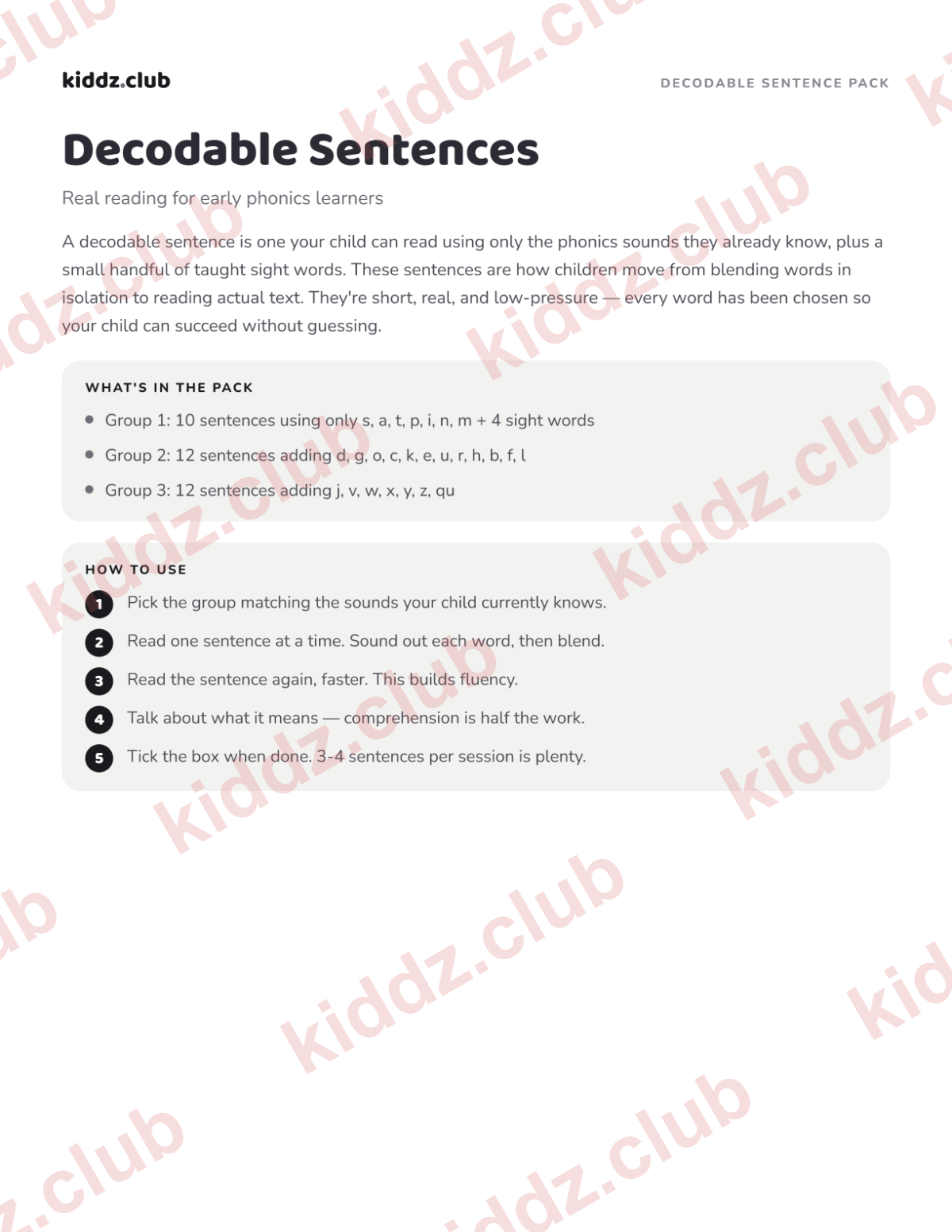
Free printable phonics reading worksheets featuring 34 short decodable sentences — each one made from sounds your child has already been taught. Three sets at increasing difficulty, with checkboxes so kids can track their reading.
The bridge between blending words on flashcards and reading actual books.
What's a decodable sentence?
A decodable sentence is one a child can read using only the phonics sounds they've been taught. No guessing from pictures, no memorizing whole words — every word in the sentence can be sounded out using known sounds.
Decodable sentences matter because they give a child the experience of reading real text before they've learned every sound. The first time a child reads "Sat on a mat. Pat is in." without help, they realize they're a reader. That moment is the engine of everything that follows.
This pack is structured so each set uses only sounds from a specific phonics group, building progressively.
What's in the pack
Three pages of decodable sentences plus a parent-facing intro page.
Set 1 (Magic 7 sounds: s, a, t, p, i, n, m) — 10 sentences using only these seven foundational sounds plus the sight word I. Sat on a mat. Pat is in. I am Pam. I sip. It is a tap. Tim sat. A pin is in. Pat is at it. Plus two more.
Set 2 (after Group 2 sounds added: d, g, o, c, k, e, u, r, h, b, f, l) — 12 sentences using all 19 sounds. The dog can run. A cat is in the bed. I had a red hat. The fox can hop on a log. Real-feeling sentences.
Set 3 (single-letter sounds, all) — 12 longer, more varied sentences using any of the 26 letters with their basic sounds. Mom got a big box. The kid had a fun nap. A bug is in the cup.
Each sentence has a small checkbox so the child can mark when they've read it confidently.
How to use the sentences
The right way to use these is not as a worksheet — it's as a reading exercise. Sit next to your child and read together.
Read each sentence twice. First time, slowly, sounding out unfamiliar words. Second time, faster, smoother. Speed comes from re-reading.
Don't help with sounding out unless they're truly stuck. Wait. Watch. Let them feel the satisfaction of figuring it out themselves. If they're stuck for 10 seconds, give them the first sound and let them continue.
Talk about what each sentence means. "What did Pat do?" "Where is the cat?" Comprehension matters as much as decoding.
Tick the checkbox together. That small ritual at the end of each sentence is what makes the page feel like progress instead of work.
Read previous sentences as warm-up. Each session, start by re-reading two or three sentences from previous days. Builds fluency quickly.
When this pack is the right level
Set 1 is right if:
- Your child knows the first seven phonics sounds (s, a, t, p, i, n, m)
- They can blend three-sound words like sat, pin, tap with help
Set 2 is right if:
- Your child knows the second phonics group (d, g, o, c, k, e, u, r, h, b, f, l)
- They read CVC words from the first group fluently
Set 3 is right if:
- Your child knows all 26 single-letter sounds
- They read CVC words from any letters confidently
- They're nearly ready for digraphs and Phase 5 work
If your child isn't there yet, the Magic 7 Activity Pack and CVC Word Pack come first.
Why "decodable" matters
A common mistake in early reading: giving children books that are too hard, then helping them guess from pictures or memorize words by shape. This works briefly — they appear to be reading — but it bypasses the actual skill.
Real early reading means the child decodes each word from its sounds. That's slower at first, but it's the only path to fluency. A child who learns to decode can read any word; a child who learns to guess can only read words they've memorized.
Decodable sentences are designed to make decoding the only viable strategy. There are no pictures to guess from, and the sentences are deliberately short and direct. The child must read each word.
What comes after decodable sentences
When your child can read all 34 sentences fluently, the next steps are:
- Decodable books — short books built entirely from known sounds. Many libraries and bookstores carry "decodable readers" labeled by phonics phase.
- More advanced phonics — digraphs (sh, ch, th), then magic e, then vowel teams. See the Magic E Pack.
- Real children's books with phonics support — the Bob Books series, Read with Phonics series, and similar.
The goal isn't to keep them on decodable text forever — it's to use it as scaffolding until decoding feels automatic, then move into mainstream books.
Related resources
This printable is part of the free phonics worksheets library, specifically the kindergarten phonics worksheets collection.
Companion materials:
- Magic 7 Phonics Flashcards — pairs with Set 1 sentences
- CVC Word Pack — practice the words before reading them in sentences
- Phonics Sound Mat — quick reference during reading
For the parent-facing background:
- What to do when your child guesses instead of reading
- The 5-minute reading routine that actually sticks
- How to read with a kid who hates reading
Common questions
What does "decodable" actually mean?
A word is decodable if a child can read it by applying phonics rules they've already been taught. Sat is decodable for a child who knows /s/, /a/, and /t/. The is not decodable for that same child — it's a sight word that has to be memorized.
Are there any sight words in these sentences?
Set 1 uses only one sight word (I). Set 2 uses I and the. Set 3 uses I, the, a, is. We've kept sight words minimal because the point of the pack is decoding practice. Most early reading programs introduce these sight words alongside basic phonics, so they should be familiar.
How long does it take to read all 34 sentences?
Most kids work through one set per week (10-12 sentences). Total time across all three sets is usually 3-4 weeks. Don't rush — re-reading sentences several times is part of building fluency.
My child can read individual words but freezes on full sentences. What do I do?
This is normal. Reading a word and reading a sentence are slightly different skills — the second requires holding the word in mind while decoding the next one. Practice helps, but you can also help by pointing at each word as your child reads it. The pointing finger acts as a placeholder that takes some load off the child.
Can I use these for a child with dyslexia?
Yes. Decodable text is the recommended reading material for children with dyslexia precisely because it removes the guesswork. Pair with structured phonics instruction (Orton-Gillingham, Wilson, or similar) and read these sentences slowly, with multi-sensory support if helpful.
Are these worksheets really free?
Yes. Free for personal, classroom, and tutor use. Print as many copies as you need.
Ready for More Than Worksheets?
Picture This! teaches visualization step-by-step so children can genuinely understand—and enjoy—what they read.