
Phonics sound matching worksheet — free sound mat
A free printable phonics sound mat with every common phonics sound on a single landscape sheet. Phase 2 (the first sounds taught in kindergarten) and Phase 3 (digraphs and complex vowels for later in the year). Used by reception and kindergarten teachers worldwide.
What's a sound mat?
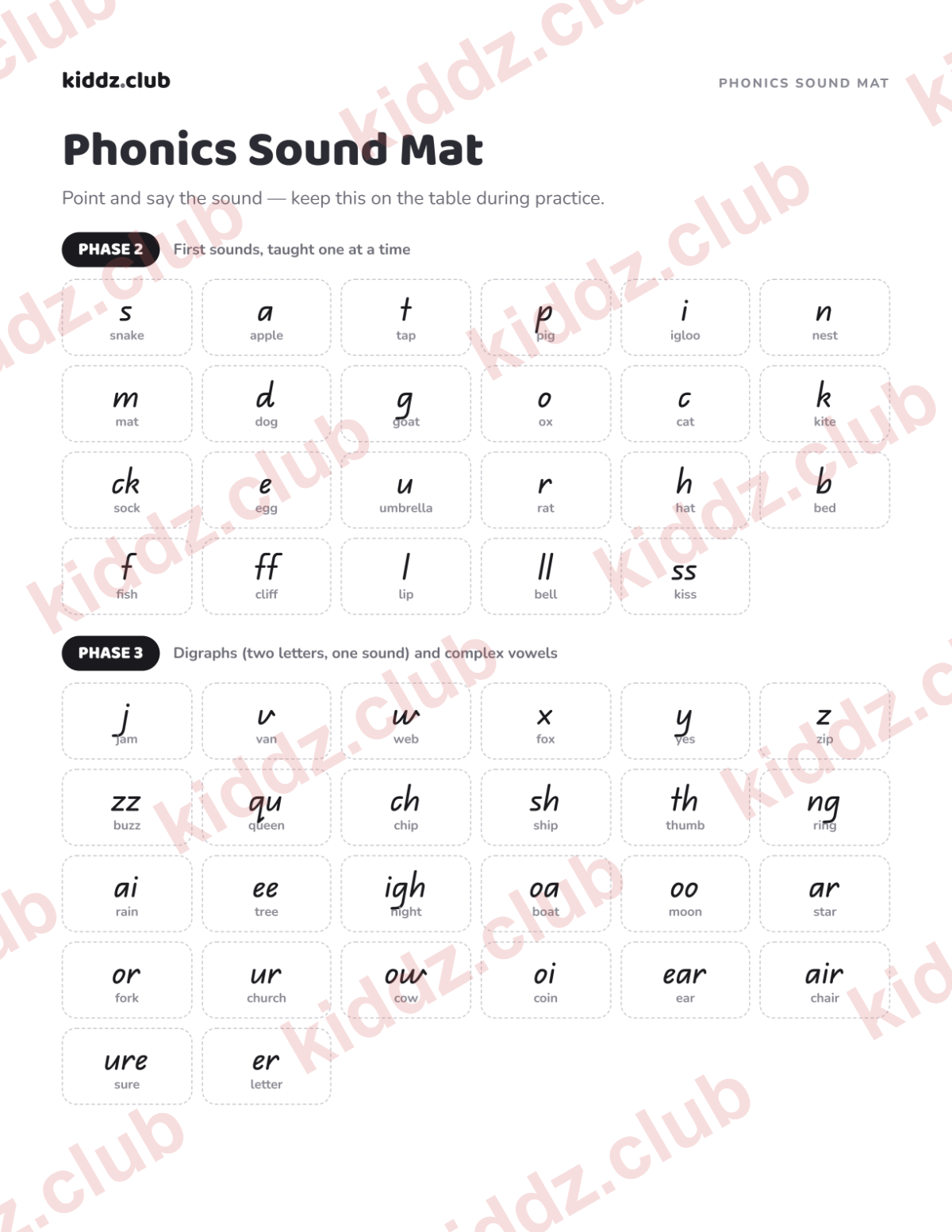
A sound mat is a single-page reference sheet showing all the phonics sounds a child has been taught — or will be taught — laid out clearly with example words. Kids glance at it during reading or writing to remind themselves which letters make which sounds.
Sound mats are standard in UK reception classrooms and increasingly common in US kindergarten. They serve three purposes:
As a writing reference. When a child wants to write a word but isn't sure how to spell a sound, they look at the mat. They find a sound that matches what they hear, and write the spelling shown.
As a reading reference. When a child reads a word with an unfamiliar sound, they can scan the mat to find a similar pattern they've seen.
As a teaching artifact. Pointing to the mat during direct instruction makes the lesson feel grounded — "this is the sound we learned last week, and here's the new one."
The mat doesn't replace structured phonics teaching. It supports it.
What's on the mat
The mat is laid out in two sections corresponding to the standard UK phonics phases (which match closely to most US phonics curricula).
Phase 2 — the first 19 sounds. s, a, t, p, i, n, m, d, g, o, c, k, e, u, r, h, b, f, l. These are taught first in nearly every modern phonics program — they're the sounds that unlock the most readable words. Each appears with the letter shape, the sound written phonetically (/sss/, /aaa/), and a keyword image.
Phase 3 — the next ~25 sounds. Includes:
- The "second consonants": j, v, w, x, y, z
- Consonant digraphs: sh, ch, th (voiced and unvoiced), ng
- Vowel digraphs: ai, ee, igh, oa, oo (long and short), ar, or, ur, ow, oi, ear, air, ure, er
This is the full phonics inventory most kids learn between ages 4 and 6.
The mat is designed for landscape printing — wider than it is tall — to fit all the sounds without crowding.
How to use the sound mat
Several ways:
On the practice table. During reading or writing practice, keep the mat between you and your child. They glance at it whenever they need to find a sound.
On the wall. Tape it above the desk, near the bookshelf, or wherever your child does their reading. Visible reference, all the time.
As a teaching tool. Point to a sound on the mat as you introduce it. Then point to it whenever you encounter it in a book. The mat becomes the index of "things we know."
As a checklist. Some parents highlight or color in each sound as their child masters it. Visible progress is motivating, and it tells you exactly what you've covered and what's next.
Why "phonics sound matching"?
The keyword for this page is phonics sound matching worksheet because that's what teachers actually search for — a single sheet showing every sound, used to match sounds to letters during reading and writing. The word "matching" is doing real work: this sheet exists so a child can match a sound they hear (or want to write) to a letter pattern they can see.
That's different from a worksheet that tests sound matching (where a child draws lines between pictures and letters). Both are useful; this page is the reference, not the test.
When the mat is the right tool
Use the mat if:
- Your child is starting to read and write
- They need a quick visual reminder of which letters make which sounds
- You're teaching phonics at home and want a reference for both you and the child
Don't lean on it if:
- Your child is too young to read it (under 4 — they'll be overwhelmed by the density)
- They're using it as a crutch and not actually learning the sounds — alternate between using the mat and practicing without it
- Your school uses a specific sound mat already — use theirs to avoid confusion across home and school
Pairing with other materials
The sound mat works best alongside structured phonics teaching. A typical kindergarten setup:
- Direct teaching with flashcards — see the Magic 7 Flashcards
- Practice with worksheets — see the Magic 7 Activity Pack
- Word and sentence reading — see the CVC Word Pack and Decodable Sentences
- The sound mat — used throughout, as the reference everyone returns to
The mat ties the whole system together visually. Without it, kids hold all the sounds they've learned in their head; with it, the sounds are externalized and easily checkable.
Related resources
This printable is part of the free phonics worksheets library, specifically the kindergarten phonics worksheets collection.
Companion materials:
- Magic 7 Phonics Flashcards for the first sounds
- Magic 7 Activity Pack for structured practice
- CVC Word Pack for word-level reading
For the parent-facing background:
Common questions
What's the difference between Phase 2 and Phase 3?
These are categories from the UK Letters and Sounds phonics framework. Phase 2 is the first 19 sounds (single letters mostly). Phase 3 is the next ~25 sounds, including digraphs (two letters making one sound). Most kindergartners learn Phase 2 in the fall and Phase 3 in spring, though pacing varies. US programs use different terminology but the same progression.
Why are sounds written like /sss/ and /aaa/?
The slashes mean "this is the phoneme, the sound itself, not the letter name." The repeated letters indicate sounds that can be stretched. We use this notation because it's standard in phonics teaching and helps avoid the trap of accidentally teaching letter names instead of sounds.
How big should I print this?
Letter size (8.5 × 11) is the default. For a wall poster, print at A3 or tabloid (11 × 17). Some teachers laminate it after printing for durability.
Why are there sounds like air and ure on the mat?
These are vowel-r digraphs that make distinct sounds in English (hair, sure). They're part of standard Phase 3 phonics teaching. Younger kindergartners may not have met them yet; older ones will use them frequently.
My child gets overwhelmed when looking at the whole mat. What do I do?
Cover the sounds your child hasn't learned yet with a piece of paper or a sticky note. Reveal them one at a time as they're introduced. Some teachers print two sound mats — Phase 2 only for early learners, full mat once Phase 3 begins.
Are these worksheets really free?
Yes. Free for personal, classroom, and tutor use. Print as many copies as you need.
Ready for More Than Worksheets?
Picture This! teaches visualization step-by-step so children can genuinely understand—and enjoy—what they read.