
Phonics worksheet for kindergarten — the Magic 7 Activity Pack
A free 13-page kindergarten phonics activity pack covering the first seven phonics sounds (s, a, t, p, i, n, m). Each lesson combines three activities on a single page: a letter-shape maze, a find-and-circle exercise, and a letter-tracing row. Designed to keep kindergartners engaged for 10-15 minutes per session.
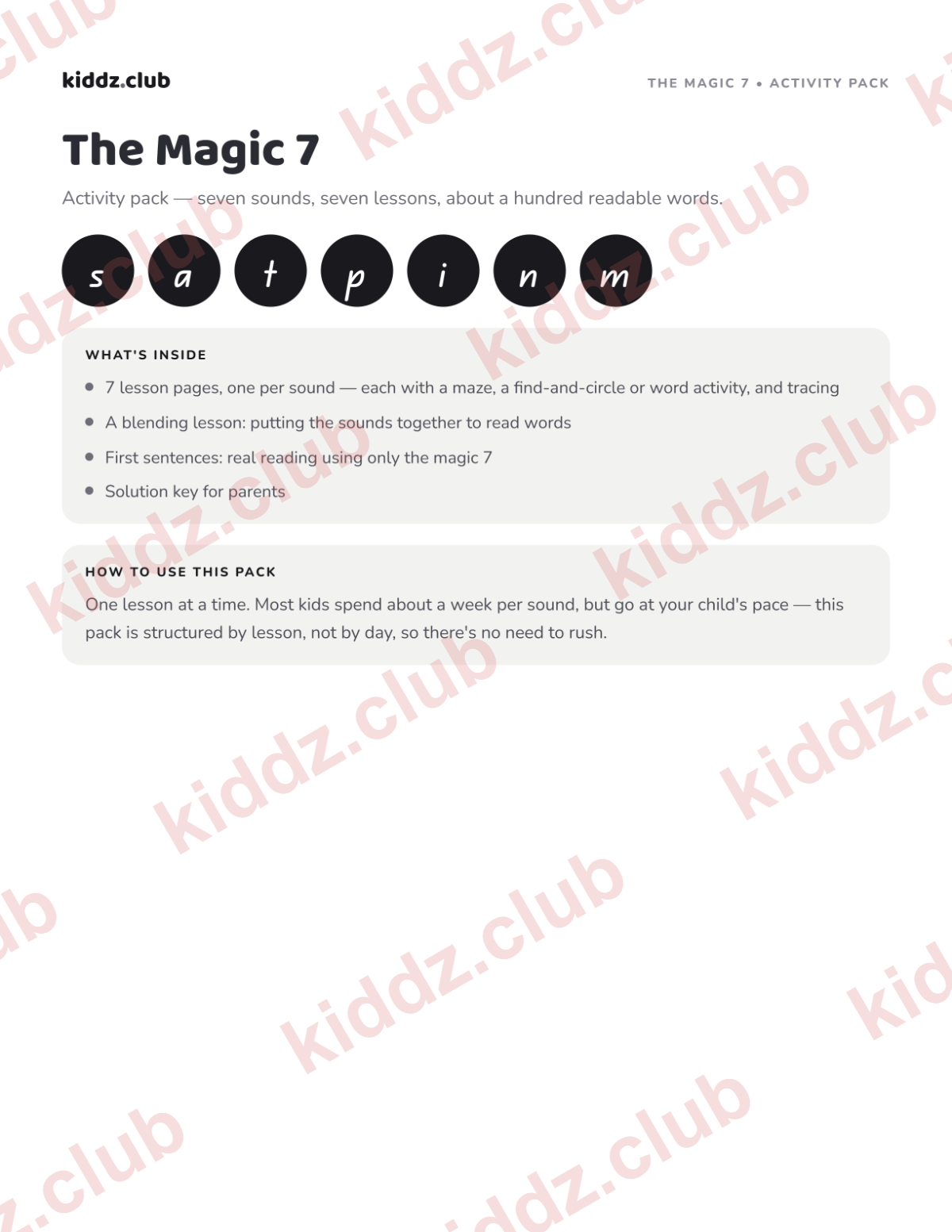
What's in the pack
The pack is organized as 13 pages:
Cover page — pack overview, with featured letter graphics and a contents list.
How to use this pack — three-step parent guide. Teach the sound first. Do the activities together. Move on when ready.
7 lesson pages — one per sound (s, a, t, p, i, n, m). Each lesson page has:
- A letter-shape maze. The letter drawn large with maze corridors inside. Kids find the path from START (top of the letter) to END (bottom). Solvable, mathematically generated — there's exactly one path through.
- A find-and-circle. Eight small drawings on the page; the kid circles the ones that start with the target sound. (For sounds without natural object icons — i and n — the activity is "read each word and color the dot when you've said it.")
- Letter tracing. A model letter on the left, six light-gray practice letters on the right. The kid traces over them while saying the sound aloud.
Blending lesson — twelve practice words (sat, pin, mat, tap, sit, pan, tin, nap, man, pit, sap, tan) shown as separate sounds, with a write-line under each so the child can write the blended word.
First sentences — eight decodable sentences using only the magic 7 sounds. Sat on a mat. Pat is in. I am Pam. I sip. Each has a checkbox for the child to mark when they've read it.
Solution key — for parents. Shows the maze paths for all seven letters, marked in red. Glance at it only if your child gets stuck.
Why these seven sounds, in this order
Most kindergarten phonics programs start with s, a, t, p, i, n, m rather than the alphabet — for three specific reasons:
These seven sounds unlock dozens of real words. sat, pin, tap, man, sit, map, nap, pan, an, at, is, in, am are all decodable using only these letters. The first time a kindergartner reads a real word, they decide reading is possible. You want that moment in week one, not month three.
They're easy to blend. S, a, i, n, m can all be stretched (sssss, aaaaa, mmmmm). Stretchy sounds blend smoothly into each other, which is what makes early blending feel achievable.
They're visually distinct. No confusing pairs like b/d or p/q in the first group. Kindergartners aren't being asked to also learn to tell similar shapes apart while they're learning sounds.
This is the same starting set used in Letters and Sounds (UK), Jolly Phonics, Read Write Inc., and most other modern phonics programs.
How to use the activity pack
The pack is designed to be flexible — there's no "Day 1, Day 2" pacing forcing a schedule. Each lesson is a single page, and most kids spend about a week per sound, but you can go faster or slower at your child's pace.
A typical week with one lesson:
Day 1 — Introduce the sound. Show the lesson page and look at the letter together. Say the sound, do the action, find five things around the house that start with it. Don't do the worksheet activities yet — just talk about the sound.
Day 2-3 — Do the maze together. Talk about what each picture is in the find-and-circle. Trace the first letter or two.
Day 4-5 — Finish the worksheet activities. Trace the rest of the letters. Read the sound out loud as the child writes it.
Day 6-7 — Review. Mix in cards from previous lessons. Try blending three sounds together if they know enough.
This pacing isn't a rule — every kid is different. Some breeze through a sound in two days; others need two weeks. The pack is built to support either.
When this pack is the right level
This pack is right if:
- Your child is 4-6 years old
- They recognize some letters but don't yet read words
- They can hold a back-and-forth conversation in sentences
- They enjoy short focused activities (5-15 minutes)
This pack is too early if:
- Your child is under 3
- They can't yet hold a pencil comfortably
- They aren't yet interested in printed letters
This pack is too late if:
- Your child can already read CVC words confidently
- They've already learned the first phonics group at school
If your child is in the "too late" category, try the CVC Word Pack or the Magic E Pack instead.
What's the maze about?
Letter-shape mazes are the strongest activity in the pack. Each maze is in the shape of the target letter — the S lesson has an S-shaped maze, the A lesson has an A-shaped maze, and so on.
Mazes work for kindergarten phonics because:
- The kid has to see the letter shape to navigate it. That builds visual letter recognition without it feeling like flashcard drill.
- Tracing the path is a fine-motor warm-up for letter-writing.
- They're satisfying. Finishing a maze is a small win that makes the kid want to keep going to the next activity.
The mazes are mathematically generated to have exactly one solution path — so they're solvable, fair, and not too hard for a 4-5 year old.
What comes after this pack
When your child can confidently identify all seven sounds, blend simple three-sound words, and write the seven letters from memory, the next steps are:
- Add the next phonics group — d, g, o, c, k, e, u, r, h, b, f, l. Same teaching method, four to six letters at a time.
- Practice blending and segmenting more. Use the CVC Word Pack — words organized by which sounds your child knows.
- Read decodable sentences. Use the Decodable Sentence Pack.
- Eventually, move into Phase 5 — magic e, vowel digraphs, alternative spellings. The Magic E Pack is where most kids head next.
Related resources
This printable is part of the free phonics worksheets library, specifically the kindergarten phonics worksheets collection.
Companion materials:
- Magic 7 Phonics Flashcards — pairs perfectly with this pack
- Phonics coloring worksheets — the bubble letters in this pack are made for coloring in; this collection gathers every colorable printable on the site
- Phonics Sound Mat — quick reference during practice
For the parent-facing background:
- How to teach phonics at home (without making it feel like school)
- The 5-minute reading routine that actually sticks
Common questions
Is this really a single phonics worksheet for kindergarten, or is it many?
The pack is a 13-page PDF. Each page is a complete activity — one phonics lesson — so you can think of each page as its own worksheet. We bundled them together because that's how the seven sounds build on each other.
How long does each lesson take?
Most kindergartners spend 10-15 minutes per lesson page. Younger kids may do half on one day and half the next; that's fine.
Do I have to do them in order?
The order s, a, t, p, i, n, m is recommended because it builds blending skills progressively. But the activity pages themselves work at any order if you've already taught the sounds another way.
What if my child can't do the maze?
It's normal for 4-year-olds to need help on the maze. Sit with them and help guide their finger. The point isn't to solve the maze independently — it's to look at the letter shape carefully.
Are these worksheets really free?
Yes. Free for personal, classroom, and tutor use. Print as many copies as you like. We just ask that you don't republish or resell.
Ready for More Than Worksheets?
Picture This! teaches visualization step-by-step so children can genuinely understand—and enjoy—what they read.