
Beginner phonics flashcards for kindergarten
Free printable flashcards covering the first seven phonics sounds every kindergartner needs to learn — s, a, t, p, i, n, m. Together, these seven sounds unlock dozens of readable three-letter words on day one. The pack includes a cover, two pages of cut-out flashcards, and a single-page sound mat.
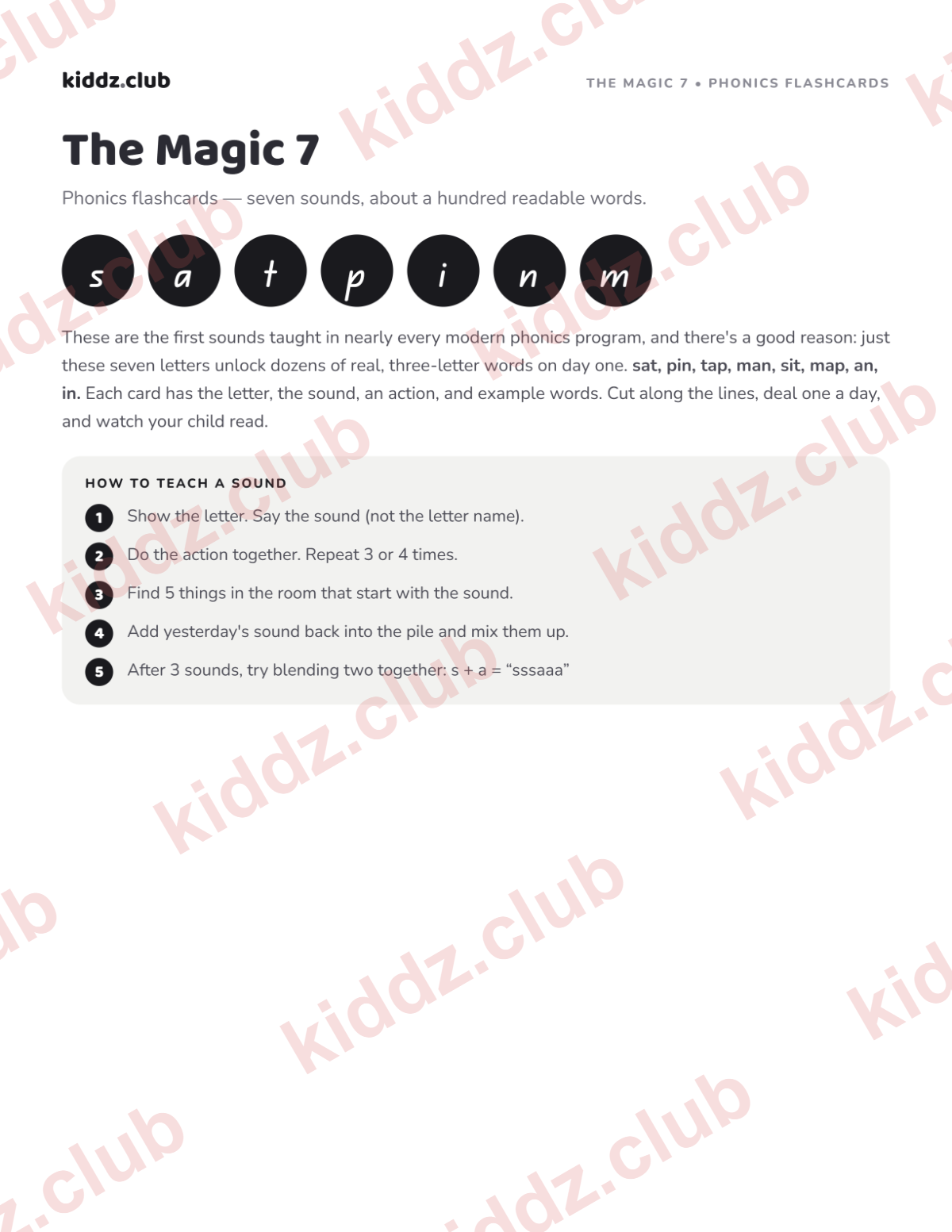
What's in the pack
Cover page — short intro for parents, with a five-step teaching method.
Two flashcard sheets — four cards per page, designed to be cut along dotted lines. Each card has:
- The lowercase letter at large size
- The phoneme (sound) written phonetically — /sss/, /aaa/, /t/ — so you teach the sound, not the letter name
- An action to do while saying the sound (wiggle like a snake for /s/, pretend to bite an apple for /a/)
- A keyword and four example words for each sound
Sound mat — all seven sounds on a single sheet, to keep on the table during practice. Lets your child glance up and see all the sounds at once.
Why these seven sounds first
Most parents start phonics with A, B, C — but the alphabet song is names, not sounds, and names don't blend into words. Ay-bee-cee doesn't make any word at all.
The order s, a, t, p, i, n, m is the same starting set used in nearly every modern phonics program (Letters and Sounds, Jolly Phonics, Read Write Inc.). Three reasons it works:
They unlock real words immediately. sat, pin, tap, man, sit, map, nap, pan, an, at, is, in, am — every one is decodable from these seven sounds alone. That first "I read a real word!" moment is what makes a kindergartner want to come back tomorrow.
They're easy to stretch and blend. S, A, I, N, M can all be held — sssss, aaaaa, mmmmm. Stretchy sounds make blending easier. Try blending bat (where /b/ is a quick pop) versus mat (where mmm stretches into aaa) and you'll hear the difference.
They're visually distinct. No confusing pairs like b/d or p/q in the first group. Kindergartners see the letters clearly without having to also learn to tell similar shapes apart.
How to use the flashcards
A simple five-minute kindergarten phonics session looks like this:
- Show one card. Make the sound together, with the action, three or four times.
- Find five things in the room that start with that sound.
- Add yesterday's card to the pile. Show the cards in random order — child says the sound for each.
- Once you have three sounds, try blending. Lay out s — a — t and slide the cards together while saying the sounds slowly. "sss-aaa-t — sat!"
- Stop while it's still fun.
One sound a day, repeated over a week, is plenty. Don't try to introduce all seven in one go — the repetition is what makes them stick.
Tips for parents new to teaching phonics
Teach the sound, not the letter name. When you point at s, say /sss/ — not "ess." Letter names actively get in the way of blending later.
Pure consonant sounds are physically hard to make. /t/ tends to come out as "tuh," /p/ as "puh." Get as close as you can to the pure phoneme without making it weird.
Practice on the swing, in the bath, or walking to school. Sound games don't need a desk.
A bad five-minute session does more damage than a missed day. If your child is resisting, stop and try again tomorrow.
What to do once these seven are solid
When your child can hear and produce all seven sounds, recognize the letters, and blend three-sound words made from them, the next group is usually d, g, o, c, k, e, u, r, h, b, f, l — taught the same way, four to six letters at a time. After that come the digraphs (sh, ch, th, ng) where two letters make one sound.
For continued practice with these seven sounds, try the Magic 7 Activity Pack — a 12-page pack with a maze, find-and-circle, and tracing activity for each sound.
For when your child is ready to start blending into words, see the CVC Word Pack and the Decodable Sentence Pack.
Related resources
This printable is part of the free phonics worksheets library. It sits at the heart of two grade-level collections:
- Preschool phonics worksheets — for ages 4–5 tuning in to their first sounds
- Kindergarten phonics worksheets — the full kindergarten pathway these flashcards lead into
For the parent-facing background, see:
Common questions
What age are these flashcards for?
Most kindergartners (4-5) are ready for these. Some 3-year-olds engage with them happily; some 6-year-olds who missed solid kindergarten phonics also benefit from going back to the magic 7. Try one card and see how your child responds.
How should I print them?
Standard letter-size paper works fine. For more durable cards, print on cardstock and laminate after cutting. The PDF prints cleanly on A4 too if you're outside the US.
Why is the letter "s" the first one taught?
It's not arbitrary. /s/ is a fricative — a continuous sound you can stretch as long as you want (sssss). That makes it ideal for blending practice. It also has a clear, distinct sound that's hard to confuse with other phonemes.
Should I teach uppercase too?
Not yet. Lowercase letters appear in 95% of the text your child will encounter. Uppercase comes later, after lowercase letter-sound knowledge is rock solid.
How long until my child can read?
Wide variation, but a typical kindergartner who starts the magic 7 in the fall and practices most days will be reading simple CVC words by spring. Don't push the timeline — the goal is solid foundations, not speed.
Are these aligned with my child's school program?
The materials follow synthetic phonics, which matches what nearly every modern kindergarten program uses (Letters and Sounds in the UK, most US Tier 1 programs, Jolly Phonics, Read Write Inc.). Sound order may differ slightly between programs, but these seven sounds are the foundational set in all of them.
Is this really free?
Yes. Free for personal, classroom, and tutor use. Print as many copies as you need. We just ask that you don't republish or resell.
Ready for More Than Worksheets?
Picture This! teaches visualization step-by-step so children can genuinely understand—and enjoy—what they read.