Free kindergarten phonics worksheets
Printable phonics worksheets for kindergarten — or KG, as the stage is called in many school systems — covering the foundational skills children aged 4-6 need before they can read independently: letter sounds, beginning sounds, short vowels, and CVC blending. Every worksheet on this page is free, designed by phonics teachers, and downloads as a print-ready PDF for home or the classroom.
The materials follow the synthetic phonics approach used in most modern kindergarten programs (Letters and Sounds, Jolly Phonics, Read Write Inc., and similar). They start with the sounds that unlock the most words, in the order most schools introduce them.
Phonics worksheets for KG classes
If your school calls this stage KG — as schools across India, the Middle East and many international curricula do, often split into LKG and UKG — you're in the right place: KG and kindergarten are the same stage, and the phonics sequence is identical. Children in LKG usually start with the first-sounds material at the top of this page, while UKG children typically pick up from the short vowel and CVC sections. Everything downloads as a free PDF either way.
Quick navigation
The first seven sounds — s, a, t, p, i, n, m
Beginning sounds — hear the first sound in a word, all picture-based
Activity packs — multi-page printables with mazes, find-and-circle, tracing
Short vowel worksheets — one focused page per vowel: a, e, i, o, u
CVC words and first sentences — for kids who can blend basic sounds
First digraphs — sh, ch, th, ng, ck for late kindergarten
First consonant blends — two-consonant starts like st, bl, fr
Seasonal & holiday packs — complete lesson kits for Halloween, Christmas and more
Sound mats and references — wall charts and quick-look sheets
Daily practice support — bingo, routines, parent guides
The first seven sounds
In kindergarten, the most important phonics decision is which sounds to teach first. Most parents start with A, B, C — but the alphabet song is names, not sounds, and names don't blend into words.
The right starting set is s, a, t, p, i, n, m — sometimes called the "magic 7." Just these seven sounds unlock dozens of readable three-letter words on day one: sat, sit, pin, pan, tap, tan, tin, an, at, is, in, am. That first "I read a real word!" moment is the engine of everything that follows.
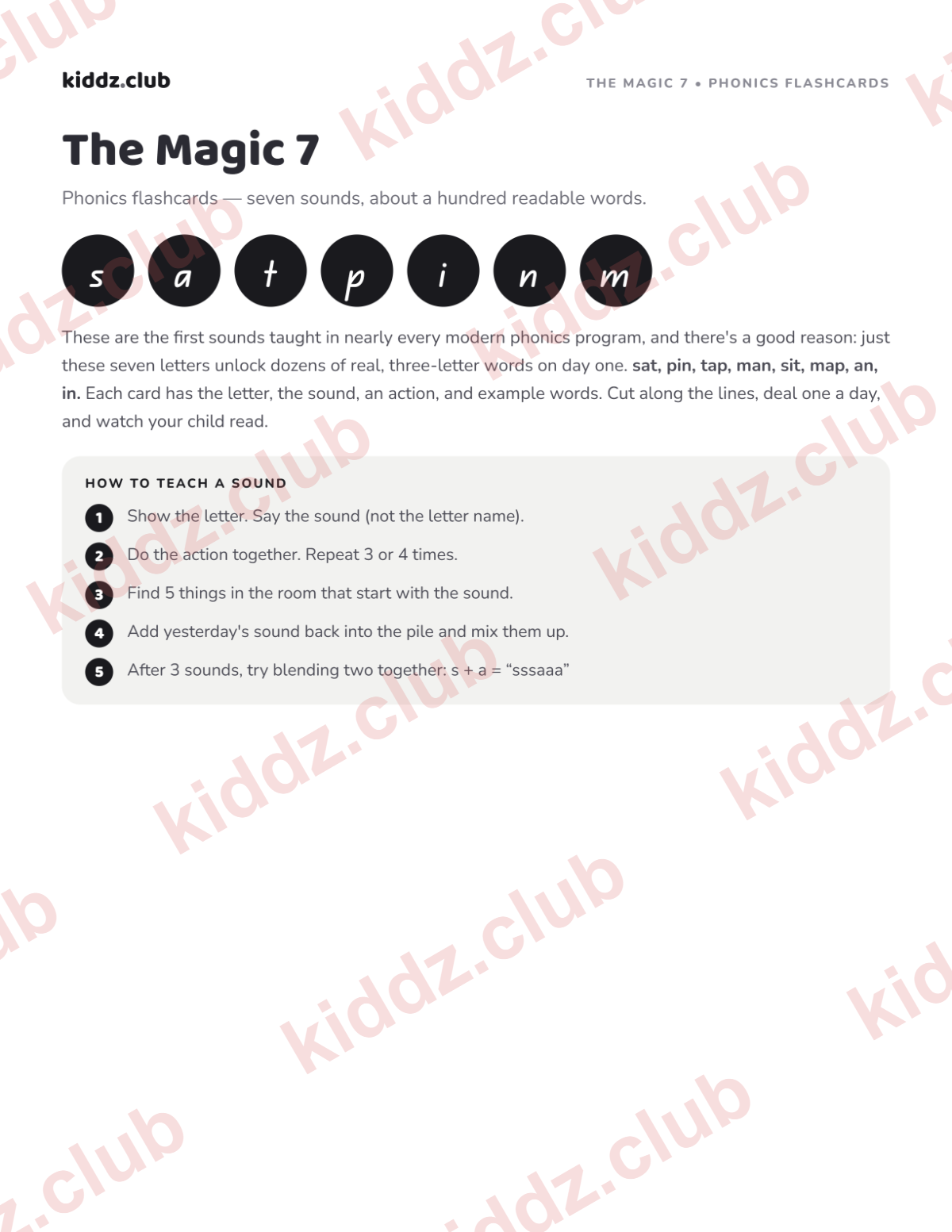
The Magic 7 Phonics Flashcards
A free 7-page printable: cover, cut-out flashcards (one per sound), and a sound mat to use during practice. Each card has the letter, the sound, the action, and example words.
Best for: First introduction to phonics. Daily 5-minute sessions.
One page per sound — the Magic 7, letter by letter
Each Magic 7 sound also has its own worksheet page with full teaching notes: why the sound sits where it does in the sequence, how to say it correctly, a five-minute lesson plan, and the words it unlocks. Work through them in order:
The rest of the alphabet
After the Magic 7, children learn the remaining letter sounds in small groups. Every letter of the alphabet has its own free worksheet — find all of them, organised in teaching order, on the alphabet phonics worksheets page.
Beginning sounds
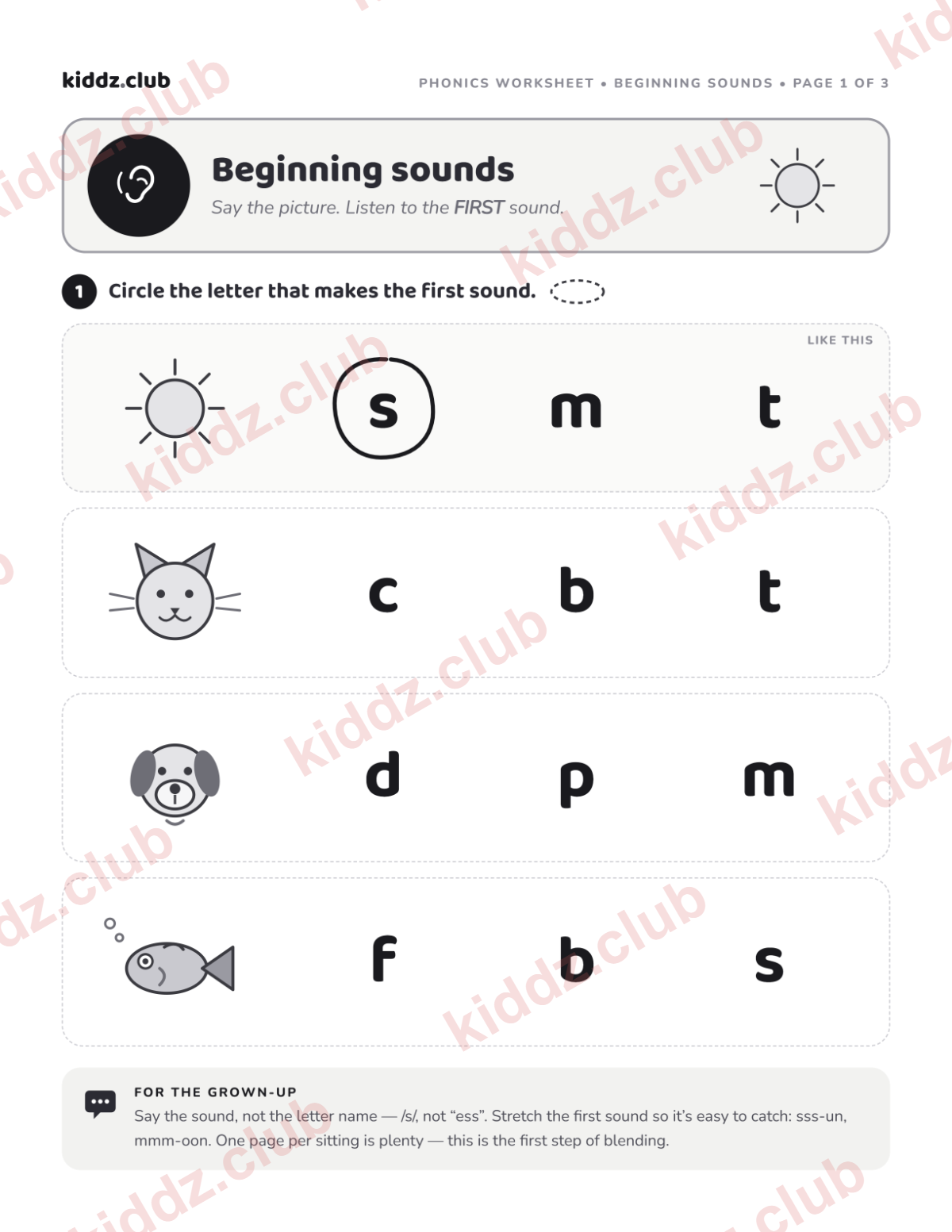
Before children can blend a word, they need to hear where it starts — the /s/ in sun, the /m/ in moon. This three-page printable practises beginning sounds entirely through pictures, so it works even before your child can read: circle the letter, spot the /m/ pictures, write the first sound.
Best for: Kindergartners who know some letter sounds and are starting to notice how words begin.
More on how to teach the skill — including the oral games that make it click — on the beginning sounds worksheets page.
Activity packs for kindergarten
Multi-activity printables that combine letter-shape mazes, find-and-circle exercises, and letter tracing on a single sheet. Built to keep kindergarten kids engaged for 10-15 minutes per session.
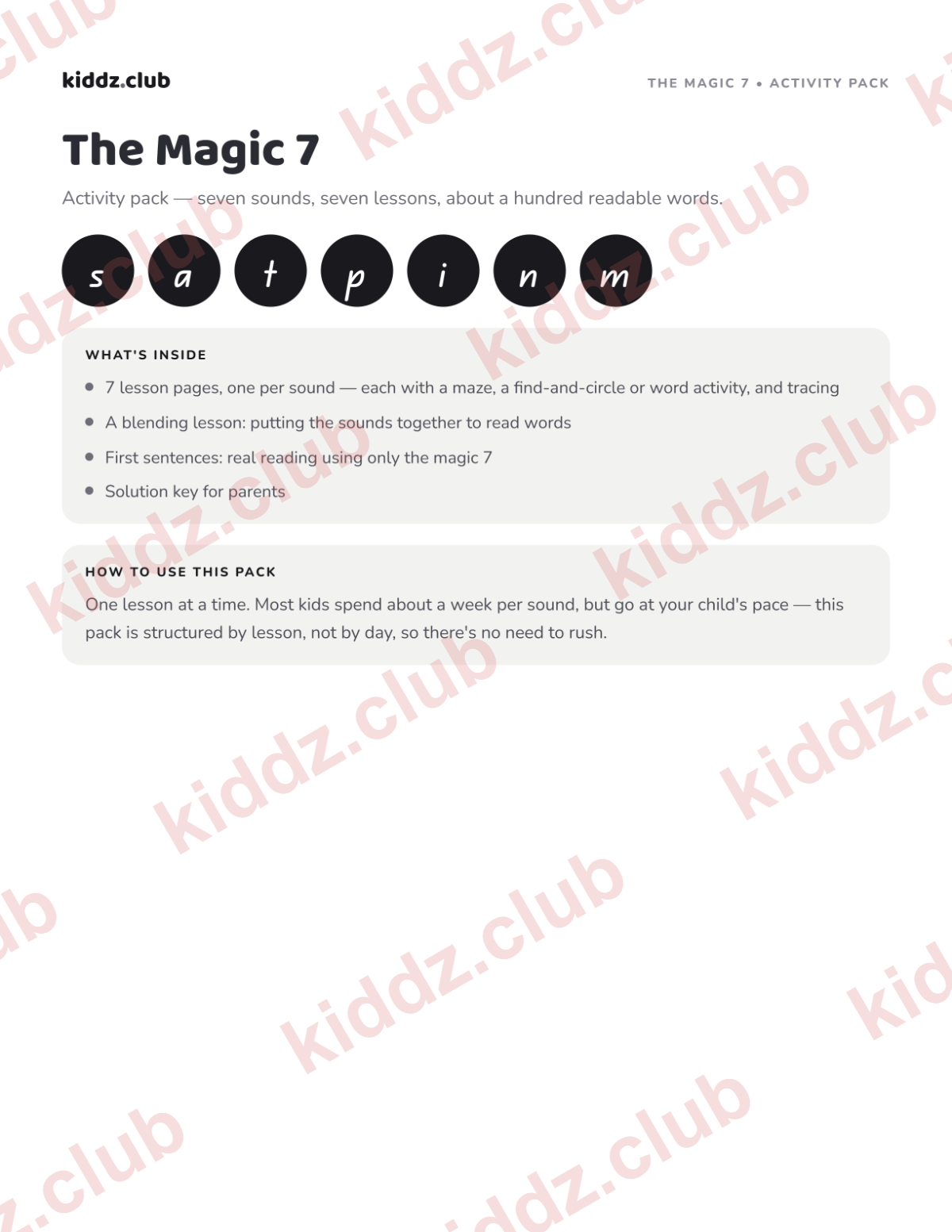
The Magic 7 Activity Pack
A 13-page activity pack covering all seven foundational sounds. Each lesson page has three activities:
- A maze in the shape of the letter
- Circle the things that start with the sound
- Letter tracing rows
Plus a blending lesson, first decodable sentences, and a parent solution key.
Best for: A full month of kindergarten phonics practice. One lesson per week, at the child's pace.
Short vowel worksheets
The five short vowels — /a/ as in cat, /e/ as in bed, /i/ as in pig, /o/ as in dog, and /u/ as in bug — are the sounds that power CVC words. Each free worksheet covers one vowel with three activities: find-and-circle, read-aloud, and missing-vowel. One page, one sound.
Start with the short vowel worksheets overview (which explains the recommended a → i → o → u → e teaching order), or jump straight to a vowel:
- Short a worksheet — /a/ as in cat; teach this one first
- Short i worksheet — /i/ as in pig
- Short o worksheet — /o/ as in dog
- Short u worksheet — /u/ as in bug
- Short e worksheet — /e/ as in bed; taught last, well apart from short i
Best for: Kindergartners who know most letter sounds and are starting to blend CVC words.
CVC words and first sentences
CVC stands for consonant-vowel-consonant — three-letter words like cat, sun, pig. These are the first proper words most kindergarten kids learn to blend. Once a child can read CVC words confidently, real reading is around the corner.
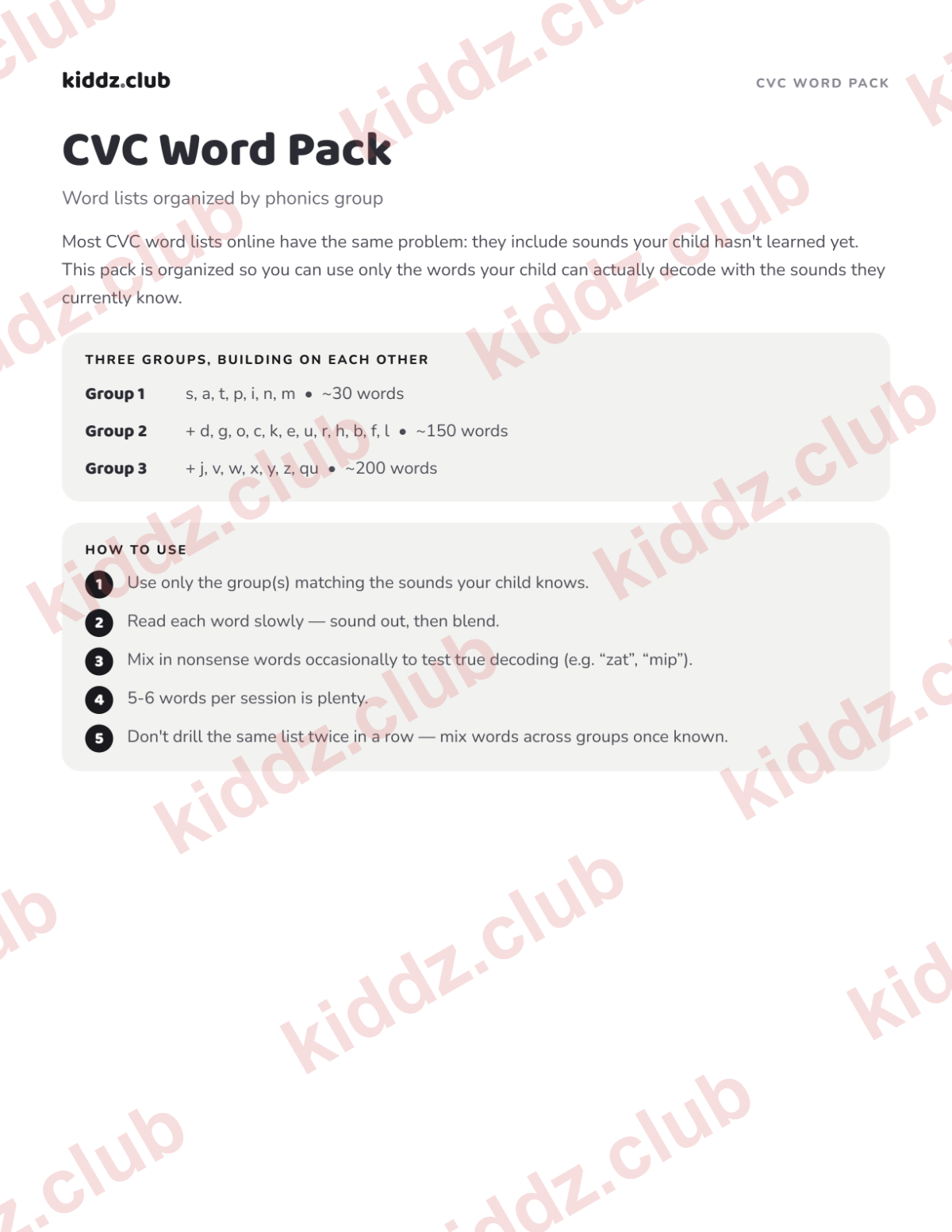
CVC Word Pack
The full set of CVC words your child can decode, organized by which phonics sounds they know. Three progressive phonics groups — print only the ones that match what your kindergartner has learned so far.
Best for: Kindergarten kids who know at least the first seven sounds and are starting to blend.
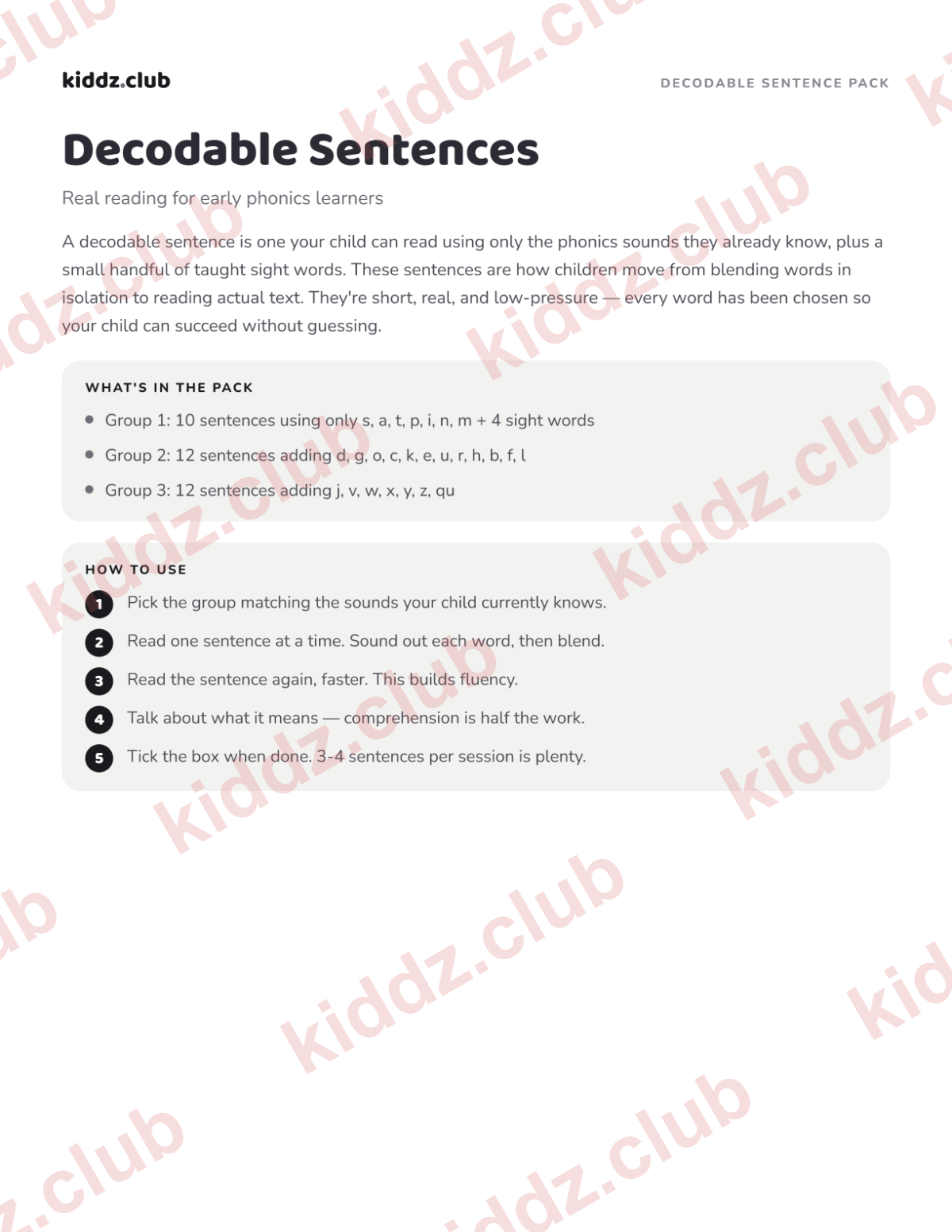
Decodable Sentence Pack
34 short sentences using only sounds your child has been taught. Three sets at increasing difficulty. The bridge between blending words in isolation and reading short books.
Best for: End-of-kindergarten and early Year 1.
First digraphs: sh, ch, th, ng, ck
Towards the end of kindergarten — once CVC blending is comfortable — many children are ready for their first digraphs: two letters that together make one new sound. The sh in ship isn't /s/ + /h/; it's a brand-new sound. Five free worksheets, one per digraph:
- SH worksheet — ship, shop, wish; teach this one first
- CH worksheet — chip, chin, much
- TH worksheet — this, thin, bath
- NG worksheet — ring, sing, long
- CK worksheet — duck, clock, black
All five are also collected on the consonant digraph worksheets page, with teaching notes on how digraphs differ from blends.
First consonant blends
A blend is two consonants where you can hear both sounds — stop has an audible /s/ and /t/. Confident kindergarten blenders can start on the word-starting blends: l-blends (bl, cl, fl, gl, pl, sl), r-blends (br, cr, dr, fr, gr, pr, tr) and s-blends (sc, sk, sm, sn, sp, st, sw) — one free worksheet per blend.
Start with the initial consonant blend worksheets, or see the full set of 30 organised by blend family on the phonics blends worksheets page. Word-ending (final) blends usually wait for 1st grade.
Seasonal & holiday packs
Complete lesson kits built around a holiday: six decodable words per season, taught with flashcards, practised on a four-page worksheet, then read back in a fold-up mini-book. Same phonics, better costumes. All the artwork is outline line art, so these double as phonics coloring worksheets for quiet practice.
- Halloween phonics worksheets — bat, web, wig, moth, fang, moon
- Christmas phonics worksheets — elf, sled, gift, sock, bell, star
- Thanksgiving phonics worksheets — yam, ham, nut, corn, dish, feast
- Valentine's Day phonics worksheets — hug, red, card, ring, gift, cake
- Easter phonics worksheets — egg, hen, bun, chick, jam, grass
- Summer phonics worksheets — sun, hat, fish, shell, sand, beach
Sound mats and references
Single-page reference sheets that live on the wall, the fridge, or the practice table.
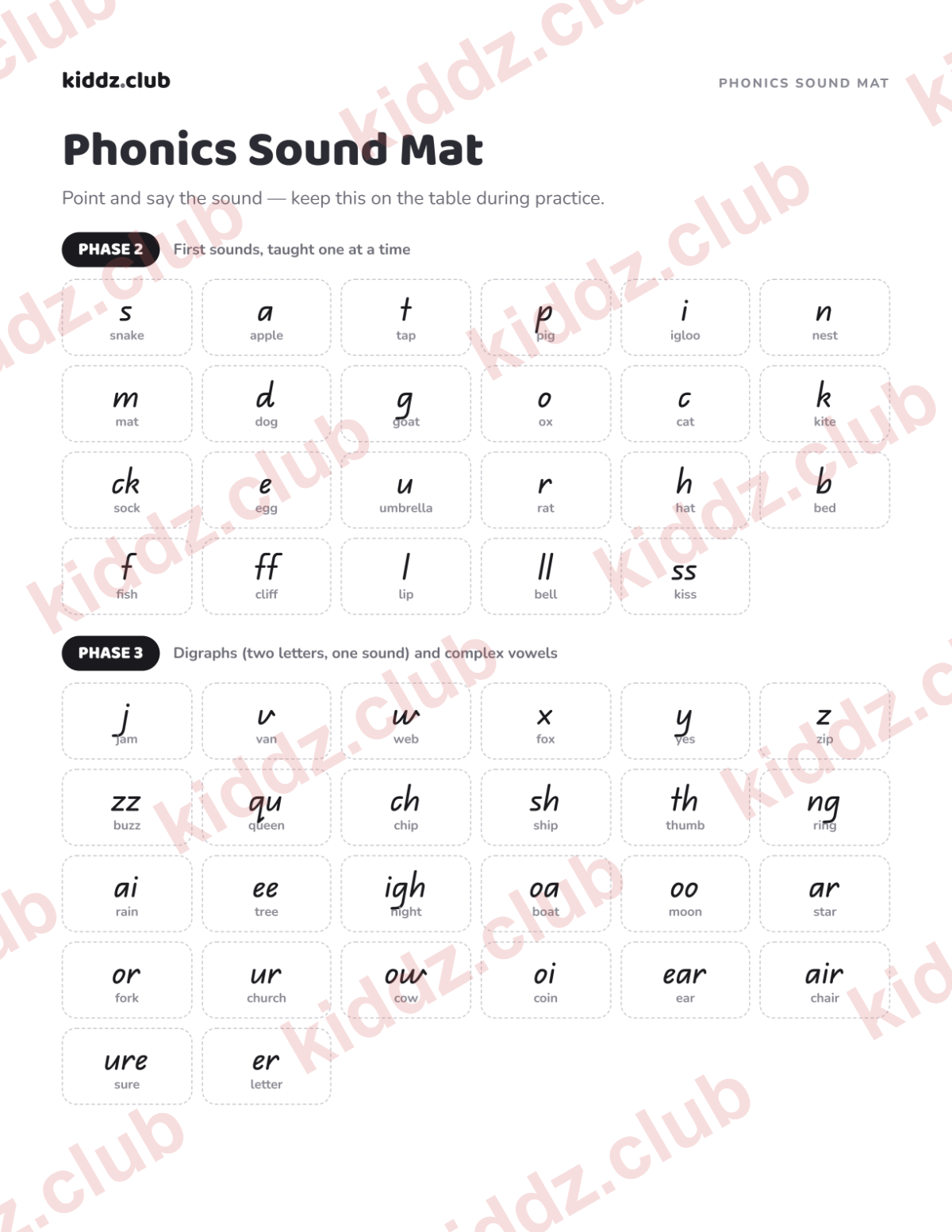
Phonics Sound Mat
Every common phonics sound on a single landscape sheet — Phase 2 (the first sounds taught in kindergarten) and Phase 3 (digraphs and complex vowels for later). Used by reception teachers worldwide.
Best for: Quick reference during reading or writing. Stick on the wall above the practice table.
Supporting daily kindergarten practice
The single biggest factor in how easily a kindergartner learns phonics isn't talent or curriculum — it's whether practice happens most days, in short sessions. These printables help make that habit stick.
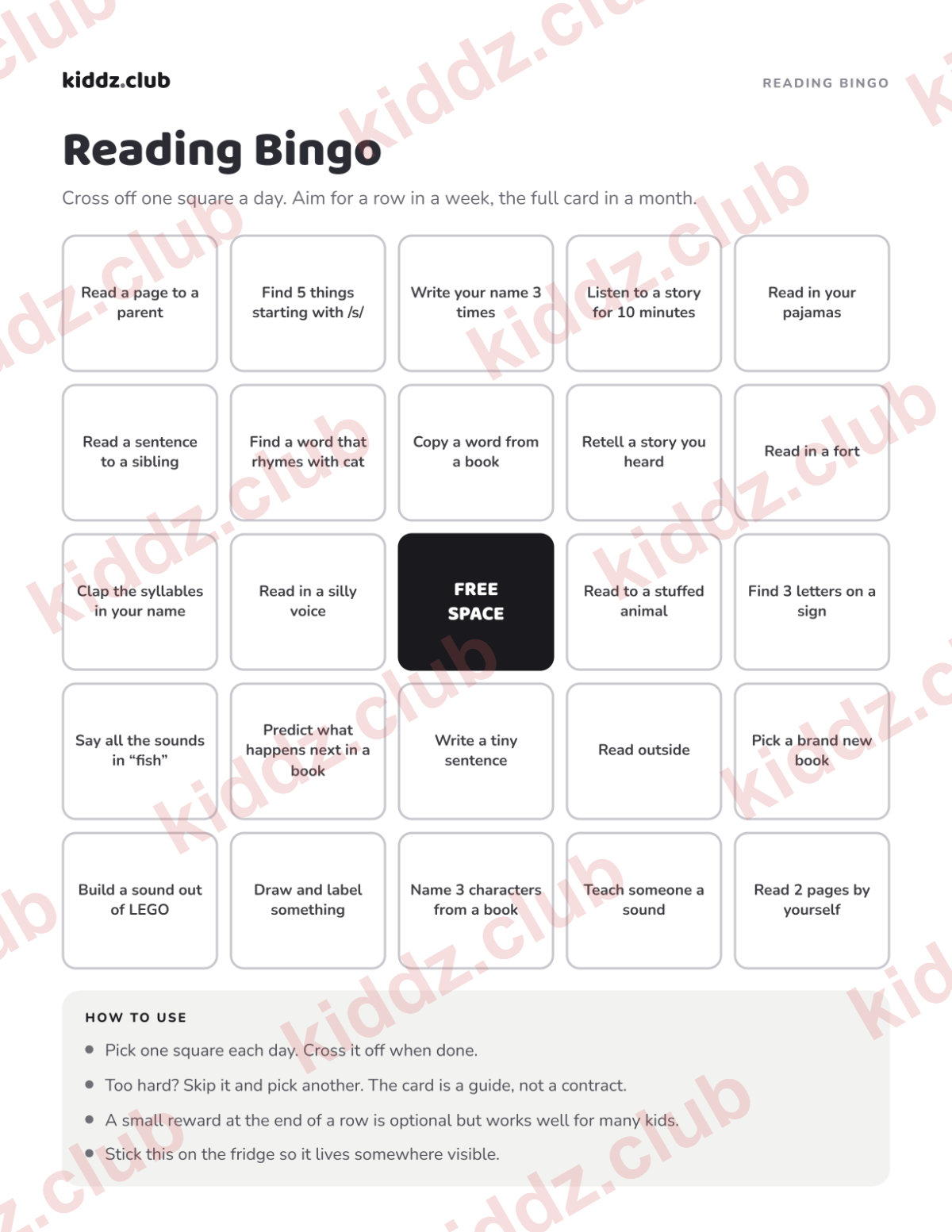
Reading Bingo
A printable bingo card with 25 small reading-related activities — read a page, find five things starting with /s/, write your name, retell a story you heard. Built to live on the fridge for a month.
Best for: Building the daily reading habit without battles. One square per day.
Interactive tools
Free tools that don't fit on a printable:
- CVC Word Generator — tick which sounds your kindergartner knows, get a custom list of decodable words and sentences. Print or save as PDF.
- Phonics Sound Player — tap any of the 44 English sounds to hear it pronounced properly (the /sss/ not "ess" rule, made audible).
- Reading Age Estimator — eight quick questions to find out where your kindergartner actually is, plus one thing to practice this week.
How kindergarten phonics actually works
A short field guide for parents of kindergarten kids — the things that matter most.
Teach the sound, not the letter name. This is the single most important rule in kindergarten phonics. When you point at s, say /sss/ — not "ess." Letter names actively get in the way of blending.
One sound at a time. Kindergartners aren't trying to learn the alphabet — they're learning to associate specific sounds with specific letter shapes. One sound a week, repeated daily, is plenty.
Stretchy sounds first. S, a, m, n, i can be held — sssss, aaaaa, mmmmm. That makes blending easier later. T, p (and other "popped" sounds) are harder to stretch and come slightly later.
Five minutes a day, six days a week. Beats thirty minutes once a week. Always.
Stop while it's still fun. A kindergartner who ends a session wanting more will come back tomorrow. A kindergartner who ends a session relieved will resist next time.
What comes after kindergarten
Once the first seven sounds are solid and your child is blending three-letter words, the next group of sounds is usually d, g, o, c, k, e, u, r, h, b, f, l — taught the same way, four to six letters at a time. After that come the digraphs where two letters make one sound: sh, ch, th, and ng — see the consonant digraph worksheets for all five.
For Year 1 and beyond, see our Phase 5 / advanced phonics resources including the Magic E Pack.
Not quite ready? If your child is still learning to hear the first sound in a word, start with the phonemic awareness worksheets and oral activity cards (for rhyming, syllables and sound play before letters), then the preschool phonics worksheets (ages 4–5) — and if letter shapes themselves are still new, begin one rung lower with the Pre-K phonics worksheets (ages 3–4).
What comes next → Once the foundational sounds are solid, move on to the 1st grade phonics worksheets — digraphs, blends, magic e, long vowel spellings, and r-controlled vowels.
Related articles for parents
If you're new to teaching kindergarten phonics, these articles cover the most common questions:
- How to teach phonics at home
- Signs of reading readiness
- The 5-minute reading routine that actually sticks
- My child can't sound out words — is something wrong?
Get the kindergarten starter bundle by email
Pop your email in and we'll send five packs — Magic 7 flashcards, Magic 7 activity pack, CVC word pack, decodable sentences, and the sound mat — straight to your inbox.
No spam, ever. Your printables arrive either way.
Want the entire printables library?
Kiddz.club members can download every printable on the site as one zip — plus full access to the Picture This! reading program. Start with a free 7-day trial.
Common questions about kindergarten phonics worksheets
Is KG the same as kindergarten?
Yes. KG is simply the short form of kindergarten used in India, the Middle East and many international schools — often split into LKG (lower KG) and UKG (upper KG). The phonics skills are identical, and every worksheet on this page suits KG classes: LKG children usually start with the first letter sounds, UKG children with short vowels and CVC blending.
Are these worksheets free?
Yes. Every kindergarten phonics worksheet on this page is free to download and print, for home or classroom use. They're full teacher-designed packs, not samples.
Can I download these as PDFs?
Yes — every download button on this page gives you a print-ready PDF. Save it, print it at home or at school, and reuse it as often as you like.
What phonics should a kindergartener know?
By the end of kindergarten most children can say the sound for each single letter, hear the first sound in a spoken word, blend three-letter CVC words like cat and sun, and read a few simple decodable sentences. Some also begin the first digraphs (sh, ch, th). The sections on this page follow that order, so you can start wherever your child currently is.
What age are these worksheets for?
These materials are designed for kindergarten-age children — typically ages 4 to 6. Some can be used a little earlier (the flashcards work for engaged 3-year-olds) or a little later (Year 1 kids who missed solid kindergarten phonics often benefit from going back to the magic 7).
Are kindergarten phonics worksheets really useful, or are they just busywork?
Worksheets aren't the core of phonics teaching — that's saying sounds, blending, and reading aloud together. But a well-designed worksheet gives a child a calm, focused activity they can do somewhat independently, which is what makes daily practice sustainable. The worksheets on this page are designed to support real practice, not replace it.
How long should a kindergartner spend on a worksheet?
Five to ten minutes is plenty. Longer than that and most kindergartners disengage. Better to do a short worksheet daily than a long one weekly.
Should I correct every mistake?
No. Correct the mistakes that affect understanding (sounding the wrong sound, confusing letters) and let small ones go. A kindergartner who feels constantly corrected will start to dread practice. Praise effort and progress, not perfection.
What if my child is struggling?
Drop down a level. If they can't blend, go back to oral blending games (no letters). If they can't recognize letters, go back to one sound at a time. Most kindergarten phonics struggle is about pace, not ability — slowing down almost always fixes it.
Are these worksheets aligned with my school's phonics program?
The materials follow synthetic phonics — the approach used in nearly every modern kindergarten program. They're compatible with Letters and Sounds, Jolly Phonics, Read Write Inc., Saxon, and most others. Sound order may differ slightly between programs; if your school uses a specific order, follow theirs and use these as supplementary practice.
Do they include anything for kids who already know their letters?
Yes. The CVC Word Pack and Decodable Sentence Pack are for kindergartners who've moved past letter-sound recognition into blending. The Sound Mat covers the sounds taught later in the year and into Year 1.
Ready for More Than Worksheets?
Picture This! teaches visualization step-by-step so children can genuinely understand—and enjoy—what they read.