
Phonics magic e worksheets — the Magic E Pack
A free 20-page printable pack covering all five magic e (split digraph) patterns: a-e, i-e, o-e, u-e, e-e. Includes seven sequential bridge-method lessons, full word lists for every pattern, decodable sentences, and a parent reference for common exceptions.
This is the most comprehensive free magic e resource we know of. Used by parents, teachers, and tutors working with children in Year 1, Year 2, and beyond.
What's "magic e"?
Magic e — also called silent e, split digraph, or CVCe pattern — is the phonics rule where a silent e at the end of a word changes how the earlier vowel sounds. Compare:
- cap (short a) → cape (long a)
- kit (short i) → kite (long i)
- hop (short o) → hope (long o)
- cub (short u) → cube (long u)
The e at the end is silent — but it "reaches back" over the consonant and tells the vowel to say its name. This pattern unlocks hundreds of common English words and is typically taught in Year 1 / 1st Grade.
The challenge for many kids: just telling them "the e is magic" doesn't make the rule stick. They need to see the relationship between the silent e and the earlier vowel — visualized, traced, and practiced.
That's what this pack is built to do.
What's in the pack
The pack is structured as seven sequential lessons, plus reference materials.
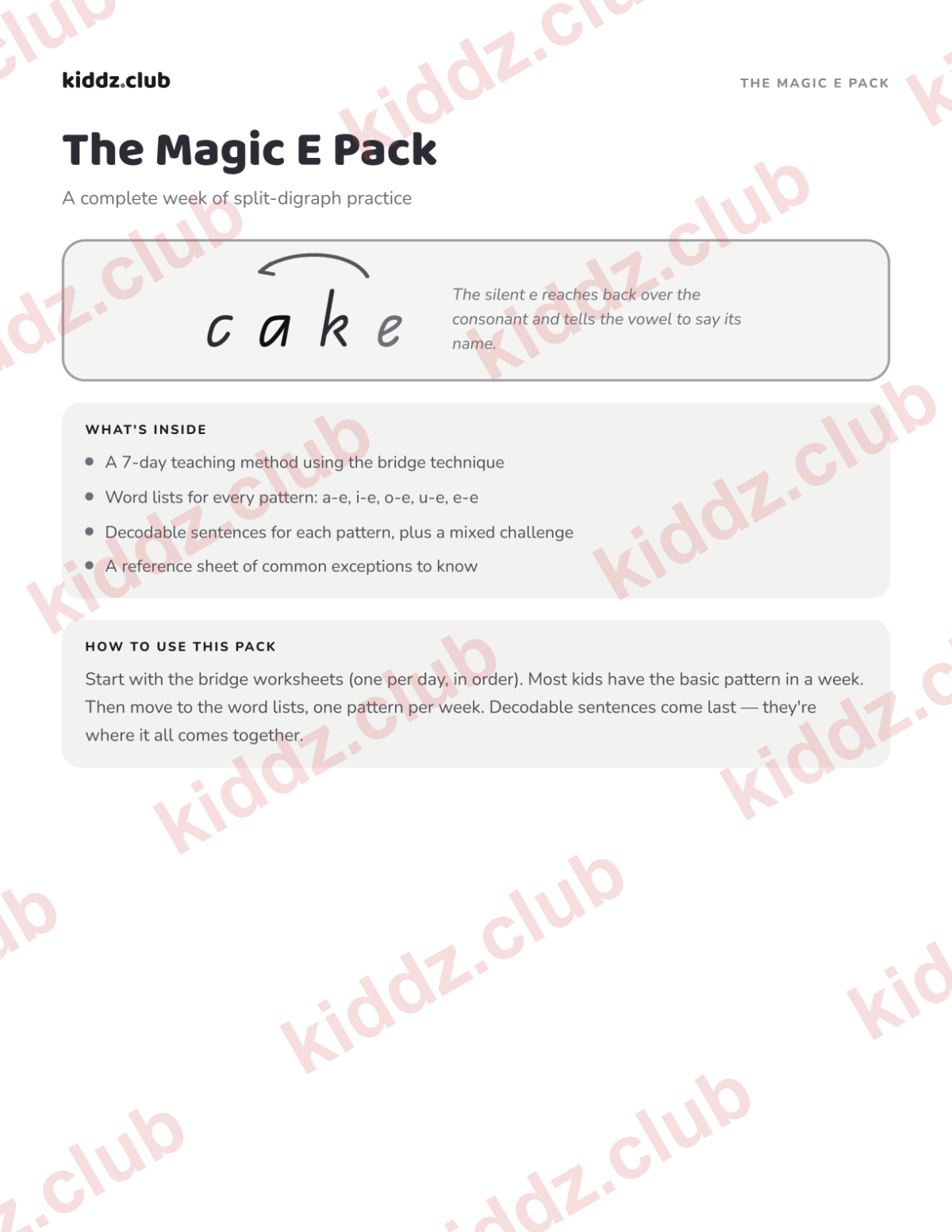
Cover and how-to-use (2 pages) — overview with the visual hook (a curved arrow from e over to cake's a), pack contents, and parent guide.
The 7-lesson bridge method (7 pages) — a structured sequence for teaching the magic e pattern from scratch. Each lesson builds on the last:
- Lesson 1: Hear the difference between short and long vowel sounds
- Lesson 2: Meet the bridge — see the curved arrow
- Lesson 3: Draw the bridge yourself
- Lesson 4: Read without the bridge
- Lesson 5: Mix short and long vowel words
- Lesson 6: Read magic e in sentences
- Lesson 7: Mixed practice across all patterns
Word lists by pattern (5 pages) — one per pattern. a-e, i-e, o-e, u-e, e-e. Common words, plus harder words, plus a parent note about exceptions.
Decodable sentences by pattern (5 pages) — a set of sentences for each pattern, plus a mixed-pattern challenge.
Exceptions reference (1 page) — common exceptions grouped into four families: -ve words (have, give, love), short-u o-e words (come, some, done), -le endings (table, apple — not actually magic e), and soft-c words.
Solution key for parents — included throughout where relevant.
The bridge method (and why it works)
Most parents teach magic e by saying "the e at the end is silent, and it makes the vowel say its name." For some kids that works. For many others, it doesn't — they nod, then look at cake and read it as kak.
The bridge method is the alternative that actually sticks. Instead of explaining the rule, it shows the rule visually:
c a k e
↶
A curved arrow from the silent e back over the consonant to the earlier vowel. The arrow makes the long-distance relationship between the e and the vowel visible. The child sees it, draws it themselves, then gradually drops the arrow as the pattern becomes automatic.
The seven sequential lessons walk a child through this method from "what's the difference between cap and cape?" to "I can read mixed-pattern sentences fluently." Most kids complete the sequence in 7-14 days, depending on pace.
When this pack is the right level
This pack is right if:
- Your child can read CVC words (cat, sun, hop) confidently
- They've met the long vowel sounds in passing but can't yet read magic e words reliably
- They're 5-8 years old (most commonly 6-7)
This pack is too early if:
- Your child is still learning individual phonics sounds
- They can't yet decode CVC words — start with the CVC Word Pack
This pack is too late if:
- Your child reads magic e words fluently already
- They're ready for the alternative spellings of long vowels (ai, ay, ee, ea, oa, ow)
How to use the pack
The seven lessons are designed to be done in order, one per session, with sessions roughly daily. Most kids spend 5-10 minutes per lesson.
A typical first week:
Day 1 — Lesson 1. Just listen. Read the word pairs aloud and hear the difference.
Day 2 — Lesson 2. Meet the bridge. Look at the curved arrows on the page and read the words together.
Day 3 — Lesson 3. Child draws the arrow themselves. Talk through what it does — "the e tells the a to say its name."
Day 4 — Lesson 4. Read without the arrow. If a word is tricky, child draws the arrow themselves and tries again.
Day 5 — Lesson 5. Mix short-vowel and magic-e words. cap, cape, hop, hope, bit, bite. Notice the difference matters.
Days 6-7 — Lessons 6 and 7. Sentences and mixed practice. Pattern feels familiar by now.
After the seven lessons, work through the word lists pattern by pattern (one pattern per week), then the sentence pages, then introduce the exceptions.
The pack works at the child's pace — there are no day labels in the pack itself, only lesson numbers. A child who needs two days per lesson can take it. A child who breezes through can move faster.
What comes after magic e
Once magic e words are confident, the next territory is alternative spellings of long vowels — the same long-vowel sounds spelled with vowel digraphs (ai, ay, ee, ea, oa, ow) instead of the magic e pattern.
This is Phase 5 territory in UK phonics terminology. It's where most online resources go thin; ours go deep.
Ready for vowel teams? Five-page activity packs for the six most common teams — ai/ay, ee/ea, oa/ow, oo, oi/oy and au/aw — each ending in a phonics game: vowel team phonics worksheets →
Related resources
This printable is part of the free phonics worksheets library. Also part of the 1st grade phonics pathway →
Earlier-stage materials your child may want first:
- Magic 7 Phonics Flashcards — the first seven sounds
- Magic 7 Activity Pack — multi-activity practice
- CVC Word Pack — three-letter word reading
- Decodable Sentences — first connected reading
For the parent-facing background, our cluster of articles on magic e:
- What is a split digraph? (And why is it called that?)
- How to teach magic e to a child who doesn't get it
- Magic e word lists — every common pattern
- When magic e doesn't work — the common exceptions
- Magic e vs vowel digraphs — same sound, different spelling
Common questions
What's the difference between "magic e" and "split digraph"?
They're the same thing, just different names. Magic e is the friendlier US-style name, common at home and in older programs. Split digraph is the technical UK term used in schools that follow the Letters and Sounds framework. Both describe the pattern vowel + consonant + silent e where the e makes the vowel long.
My child mostly gets a-e but freezes on i-e and o-e. Is that normal?
Yes. The five magic e patterns are usually taught (and learned) one at a time, not all at once. a-e is taught first because it's the most common; i-e second; then o-e, u-e, e-e. If your child is comfortable with a-e but not the others, work through the word list pages one pattern at a time.
What about words like have and give that look like magic e but aren't?
These are exceptions covered on the dedicated reference page. have doesn't follow the rule because English doesn't end words in v — the silent e is there for a different reason (a kind of orthographic placeholder). The exceptions are taught as a small group rather than as failures of the rule.
How is this different from regular silent e worksheets I can find online?
Three things. First, this pack uses the bridge method — a visual, sequential approach that's more effective than rote rule-teaching. Second, it covers all five magic e patterns systematically rather than just a-e. Third, it includes an exceptions reference, which most worksheets don't.
Can I use this for older kids who missed magic e?
Yes. The pack works well for any child who hasn't mastered magic e, regardless of age. Many parents use it with children up to age 9 who are catching up on phonics gaps. The materials don't look babyish.
Are these worksheets really free?
Yes. Free for personal, classroom, and tutor use. Print as many copies as you need.
Ready for More Than Worksheets?
Picture This! teaches visualization step-by-step so children can genuinely understand—and enjoy—what they read.