Letter S phonics worksheets — free printable activities
A free phonics worksheet for the letter S and the /s/ sound — the first letter taught in most phonics programs. Part of the Magic 7 Activity Pack, which covers the seven foundational sounds children meet at the start of their reading journey.
Why letter S is taught first
Most parents start phonics with A, B, C. But the alphabet song is names, not sounds — and names don't blend into words. Esss doesn't make any word.
The right starting set is s, a, t, p, i, n, m — and S leads it for three reasons:
S is stretchy. You can hold the /s/ sound as long as you want (ssssss). This makes it easy to blend with other sounds — sss-aaa-t slides naturally into sat. The first time a child blends a real word, they realize reading is possible.
S is visually distinct. The S shape isn't confused with any other letter. No b/d or p/q worries — kids see it cleanly.
S unlocks real words immediately. With S, A, and T, kids can read sat, sit, at, is, as. Real words from day one. That changes how the whole journey feels.
This is the same reasoning used by Letters and Sounds (UK), Jolly Phonics, Read Write Inc., and nearly every modern synthetic phonics program.
What's on the Letter S page
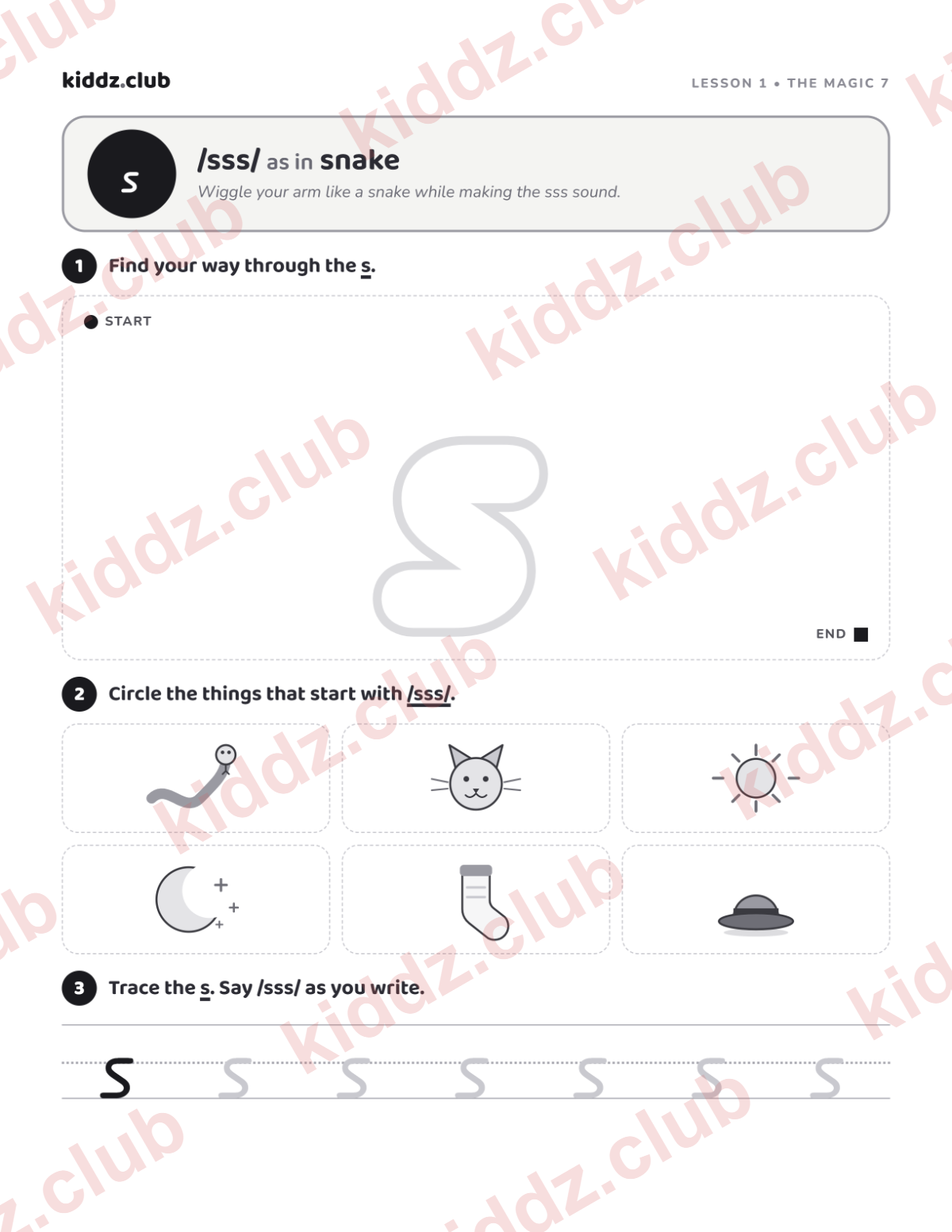
The Magic 7 Activity Pack covers seven sounds in one PDF. The Letter S page (the first lesson) has three activities:
Activity 1 — A letter-S-shaped maze. The letter S drawn as a maze, with a path from START at the top of the curve to END at the bottom. Kids navigate the path with a finger or pencil while saying /sss/. The maze shape reinforces visual letter recognition.
Activity 2 — Find and circle. Eight small icons on the page (sun, sock, star, snake, and four distractors). The child circles every one that starts with /s/.
Activity 3 — Letter tracing. A model lowercase s on the left, six light-gray practice letters on the right with dotted separators between cells. The child traces each one while saying /sss/ aloud.
How to teach the /s/ sound
A simple five-minute approach:
- Show the letter. Point at s. Say /sss/ — stretch it out. Have your child copy.
- Use the action. "Wiggle your arm like a snake while making the sss sound." Kids remember sounds tied to physical actions.
- Find five things in the room that start with /s/. Sun (through the window), sock, socks, sweater, soap. Anything.
- Read three S words together. sat, sit, sip.
- Stop while it's still fun.
That's a full session. Repeat tomorrow with a new pair of words. By the end of the week, /s/ is solid.
What comes after S
In the Magic 7 sequence, after S comes A. The two together let your child read as, sa (not a real word but a real blend). Then T arrives, and suddenly sat, at, as are readable. Each new sound adds dozens of newly-readable words.
The pack includes all seven in order: s, a, t, p, i, n, m. One lesson page per sound, plus a blending page, first sentences, and a parent solution key. About a month of phonics practice in 13 pages.
When this worksheet is the right level
Use this worksheet if:
- Your child is 4-5 years old
- They're just starting phonics
- They recognize a few letters but haven't yet blended sounds into words
Skip this worksheet if:
- Your child can already read three-letter words confidently
- They've completed the Magic 7 set already — try the CVC Word Pack next
Related resources
Part of the free phonics worksheets library. This page is linked from two grade-level hubs:
- Preschool phonics worksheets — for ages 4–5 tuning in to their very first sounds
- Kindergarten phonics worksheets collection
Companion materials for the letter S and the Magic 7 set:
- Magic 7 Phonics Flashcards — cut-out cards for each of the seven sounds
- CVC Word Pack — three-letter words using the Magic 7 sounds
- Decodable Sentences — first sentences using only the Magic 7
For the parent-facing background:
Common questions
What sound does S make?
The letter S makes a /s/ sound — voiceless and continuous. You can hold it (sssss). Kids sometimes confuse it with /z/, which is the voiced version of the same mouth position.
Why teach the sound /s/ before the letter name "ess"?
Names don't blend into words. ess-ay-tee doesn't say sat. Sounds do. Most kindergarten phonics programs teach sounds first, names later.
Why is S worksheet included in a multi-letter pack instead of its own sheet?
S is rarely taught in isolation in a real phonics program — it's part of a group. The first set (s, a, t, p, i, n, m) is taught together because the letters work together to make words. A standalone S worksheet would be a phonics decoration, not a phonics teaching tool.
Should my child trace uppercase S too?
Eventually, but not yet. In the very early stages of phonics, lowercase letters are what your child will see in books. Uppercase comes later, after lowercase letter-sound knowledge is rock solid.
Are these worksheets really free?
Yes. Free for personal, classroom, and tutor use. Print as many copies as you like.
Ready for More Than Worksheets?
Picture This! teaches visualization step-by-step so children can genuinely understand—and enjoy—what they read.