
Phonics blends worksheets — 30 free printables
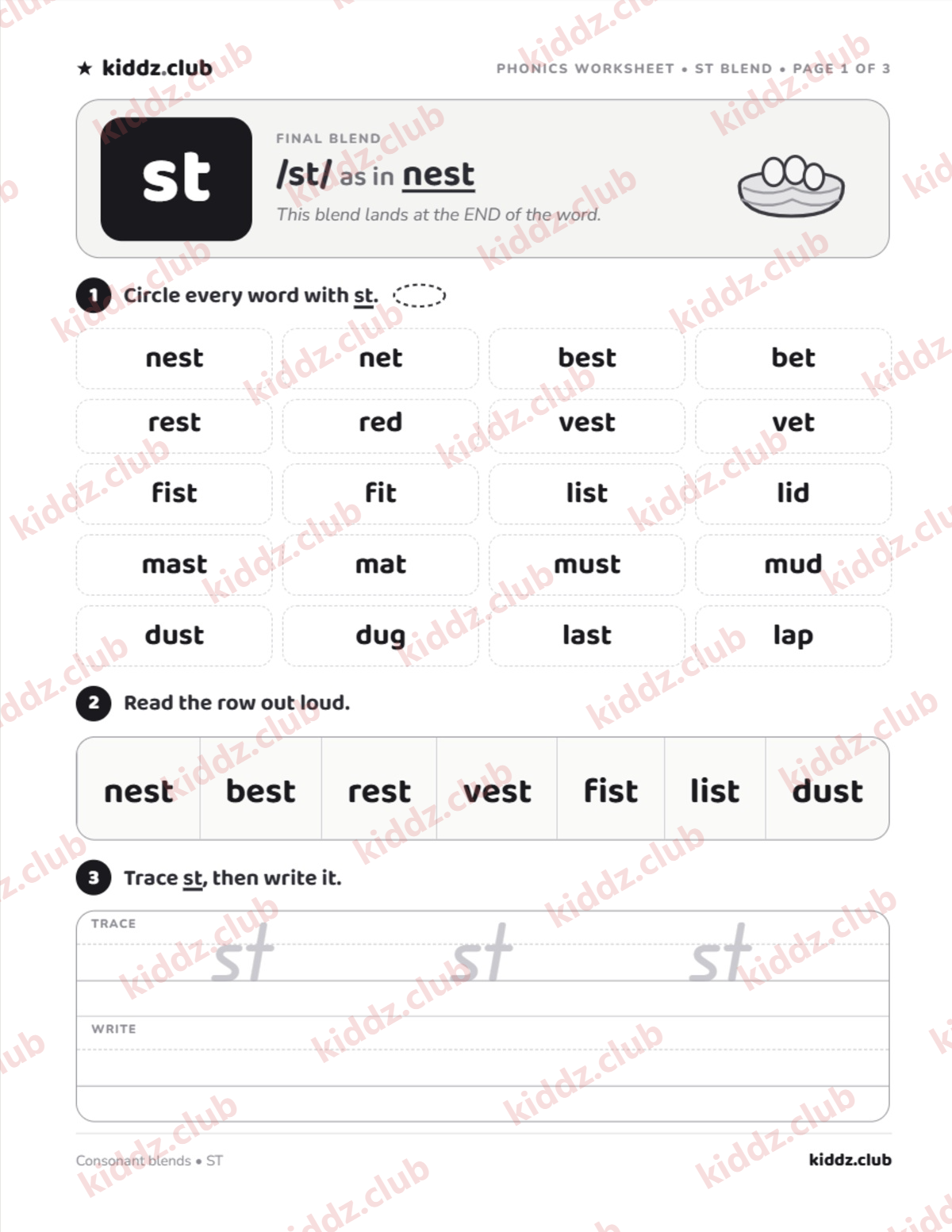
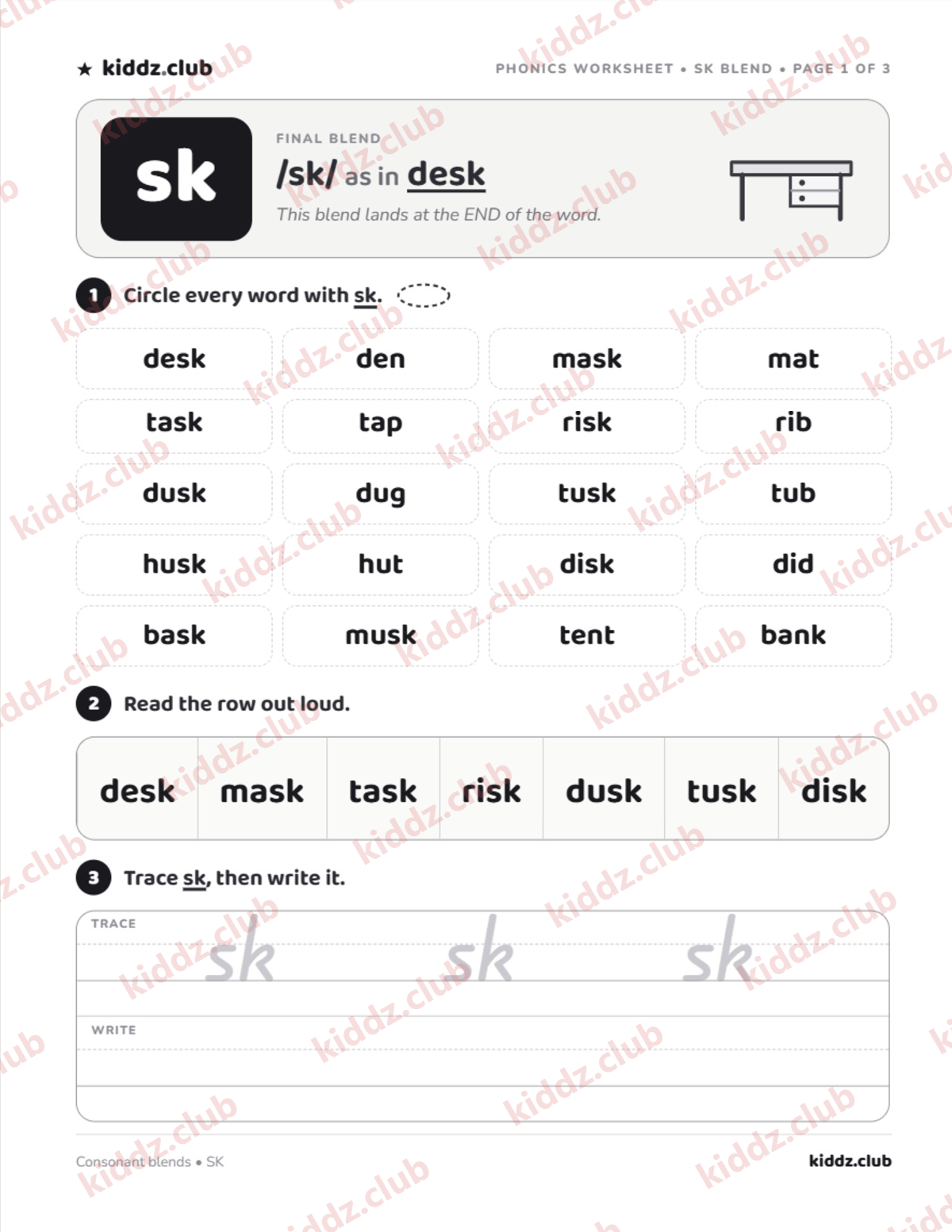
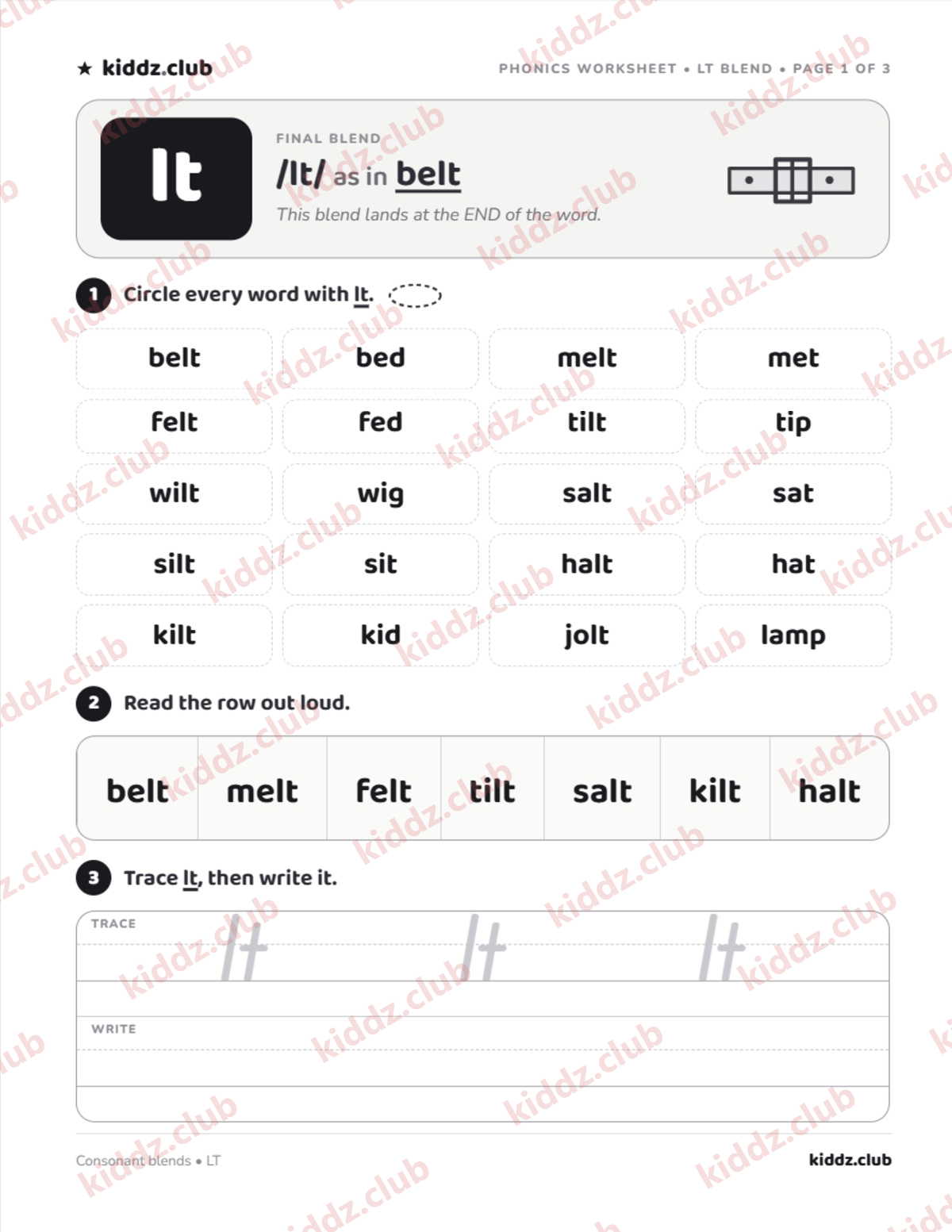
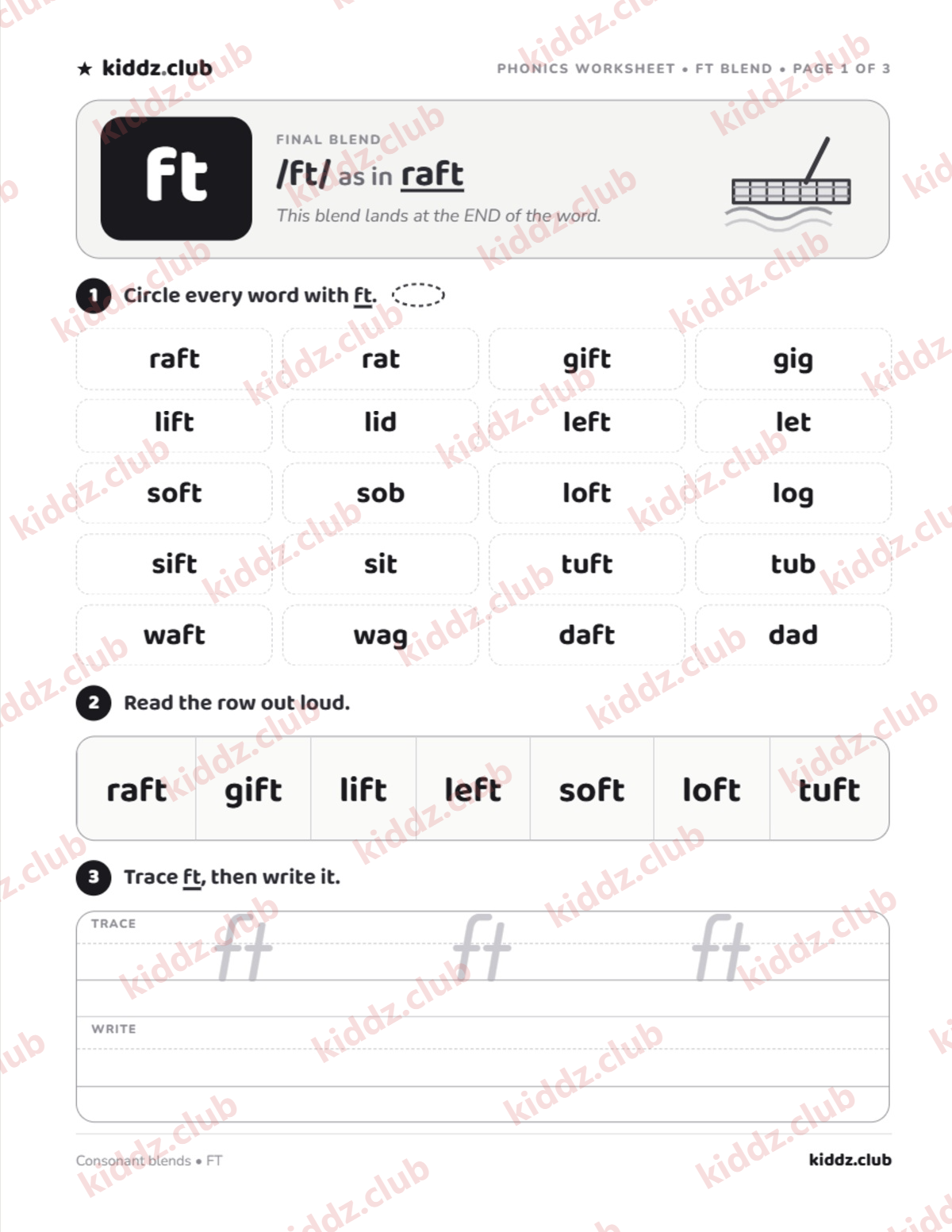
Thirty free printable phonics worksheets covering every common consonant blend in English — 20 initial blends (where the blend starts a word: stop, blue, frog) and 10 final blends (where the blend ends a word: hand, lamp, nest).
Each worksheet is three pages focused on one specific blend, with six activities that build from circling and tracing to sentence work — and finish with a full-page blend maze, walked from START to FINISH one blend word at a time. All free as PDF downloads, all on-brand and consistently designed.
What's a phonics blend?
A consonant blend is two consonants said quickly together where you can hear both sounds. Stop starts with /s/ and /t/ blended fast — you hear each one. Frog starts with /f/ and /r/, also both audible.
This is different from a consonant digraph (sh, ch, th, ng) where two letters make one new sound. The /sh/ in ship isn't /s/ + /h/ — it's a completely different sound.
The distinction matters because it changes how you teach the sound. Digraphs need to be memorized as a new sound. Blends need to be blended — said slowly at first, then faster, until the two sounds merge.
The 30 blend worksheets
Every sheet below is a free three-page PDF. Click a thumbnail to preview page 1, or the title to download. Note that st and sk appear twice — once as initial blends and once as final blends — and those are four genuinely different worksheets with different word sets and different mazes.
Initial blends (the blend starts the word)
All 20, with teaching notes, also live on the initial consonant blend worksheets page.
L-blends — second letter is l:
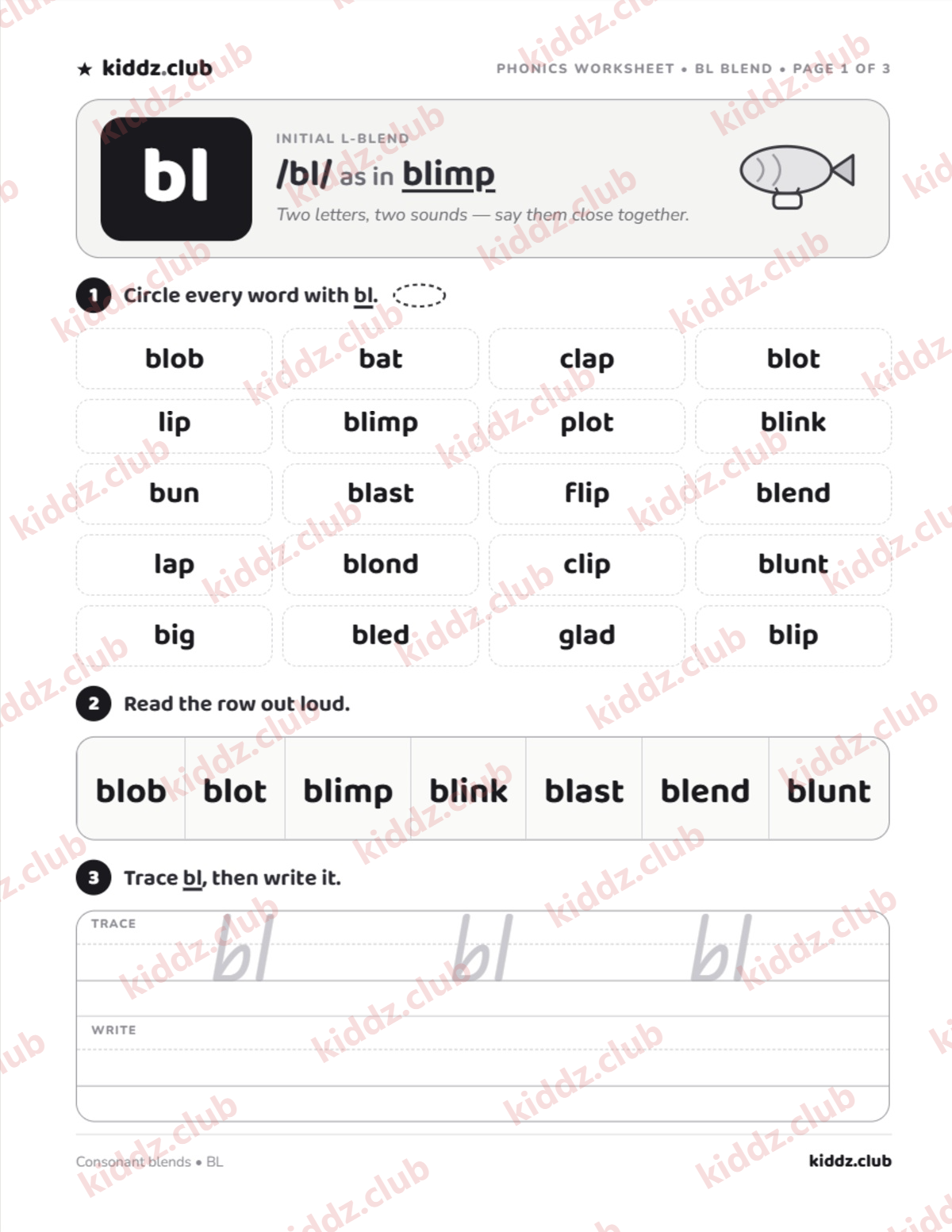
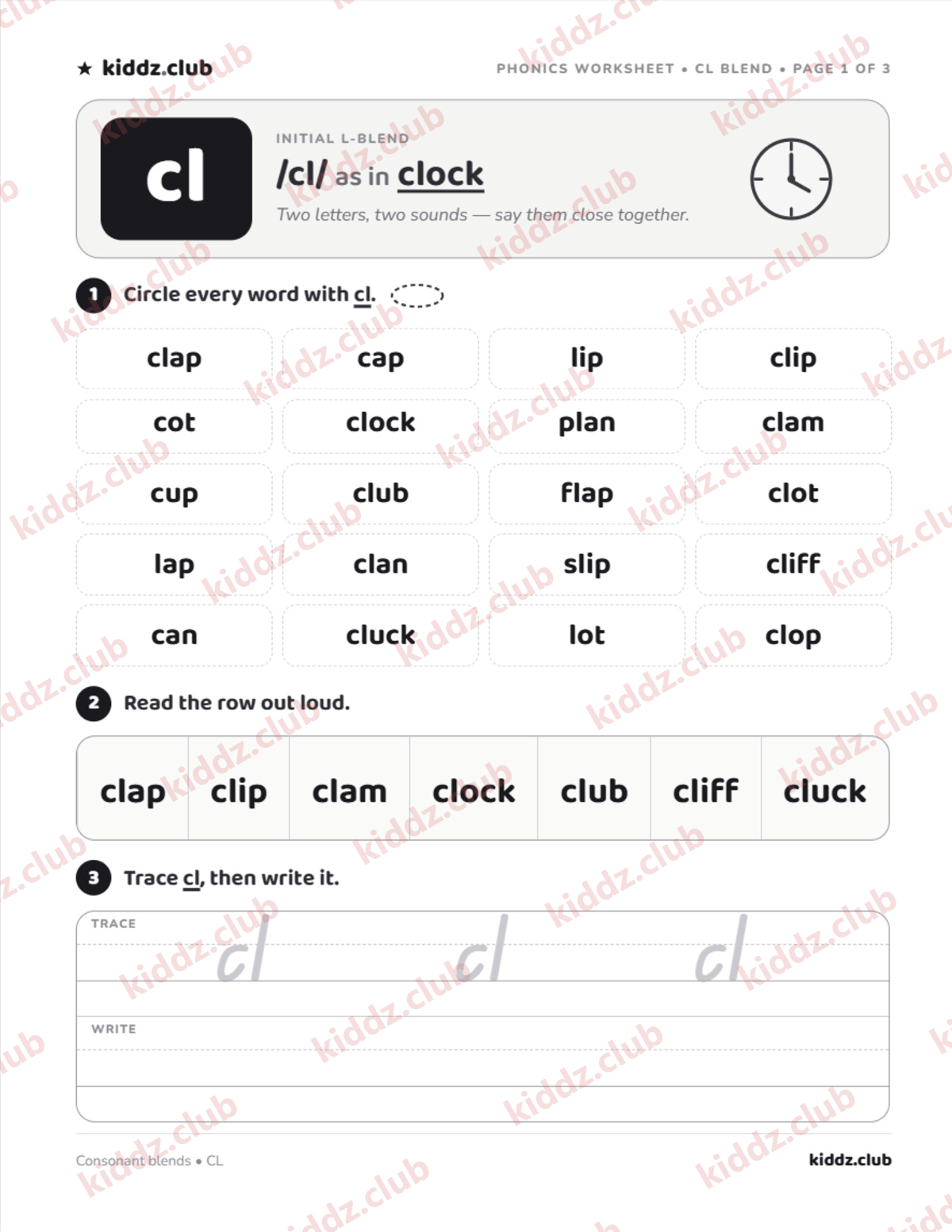
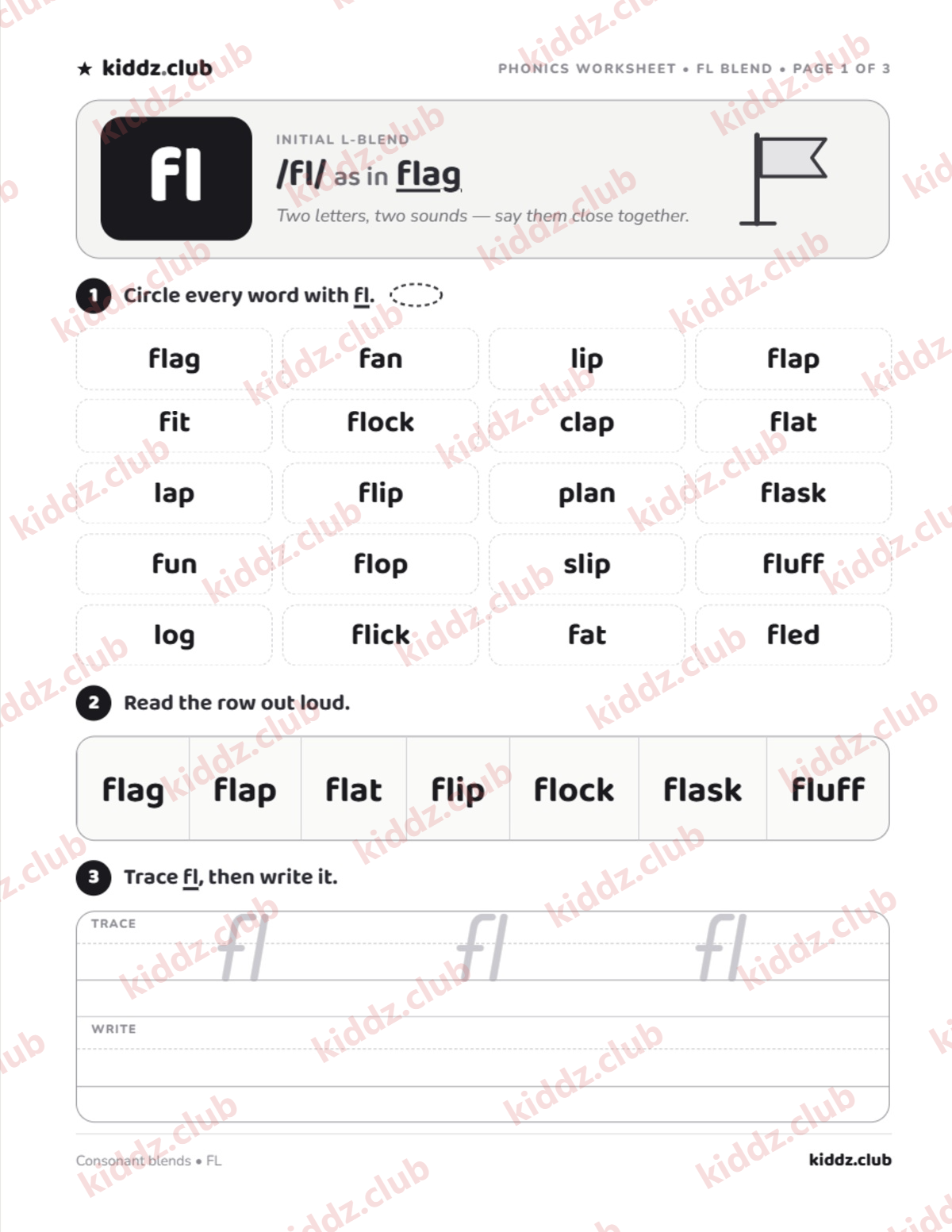
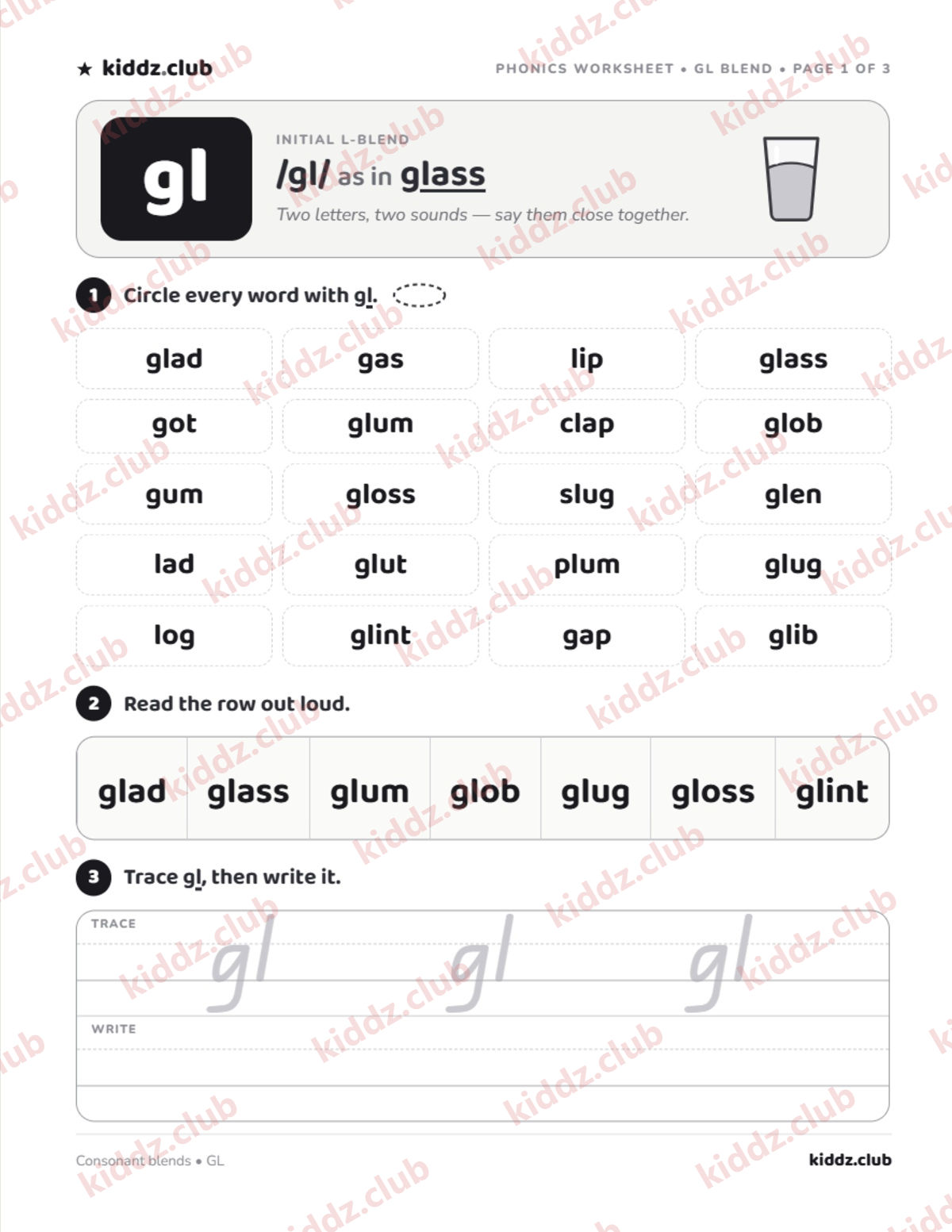
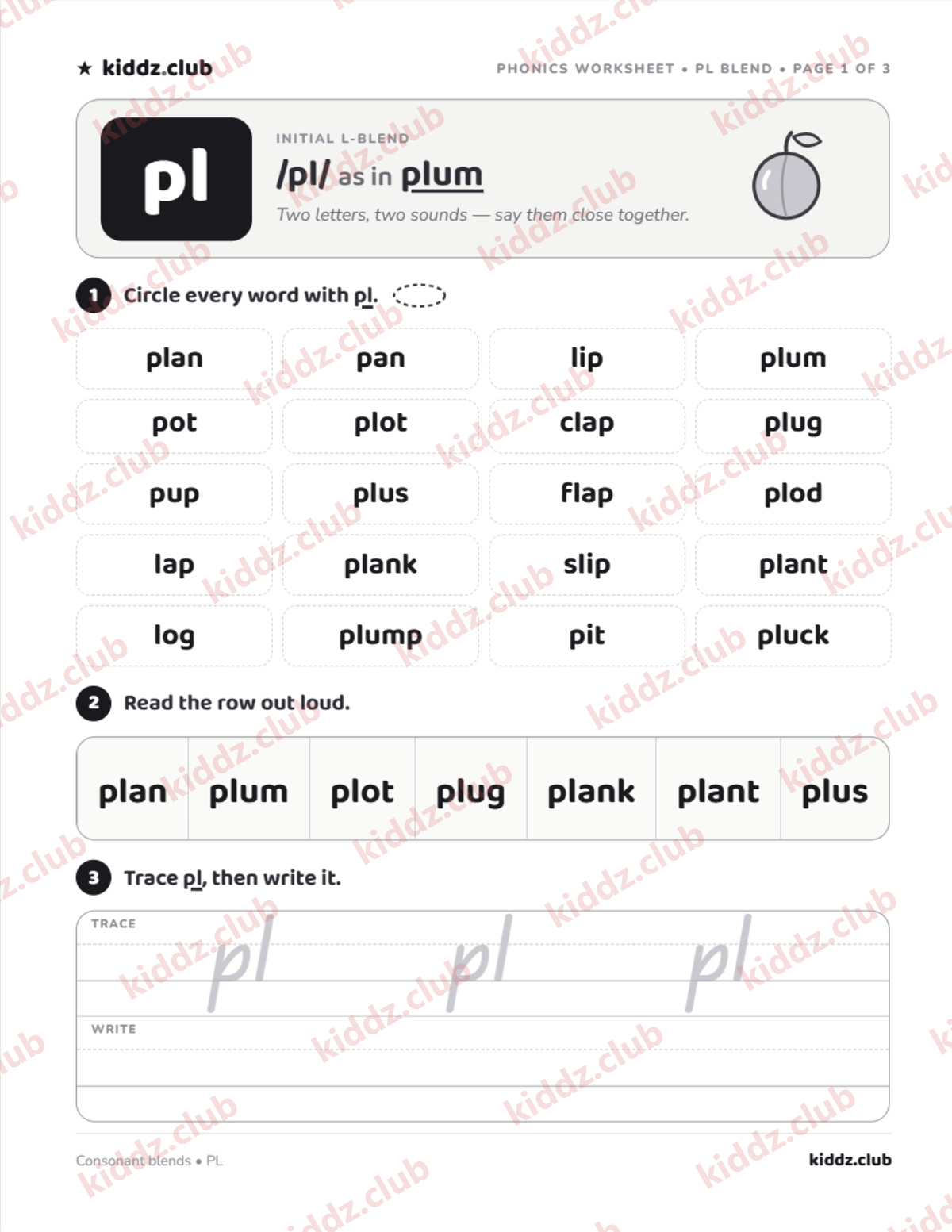
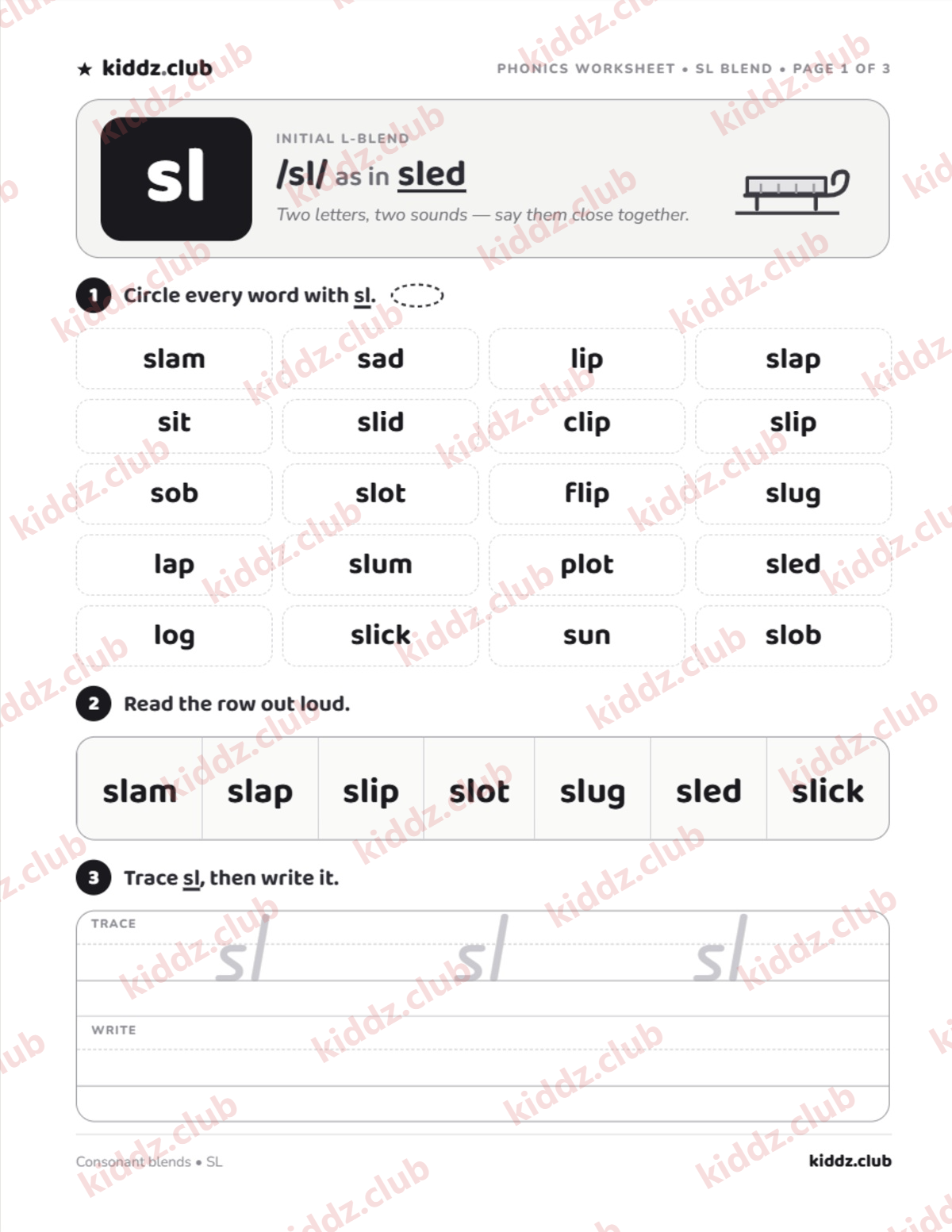
R-blends — second letter is r:
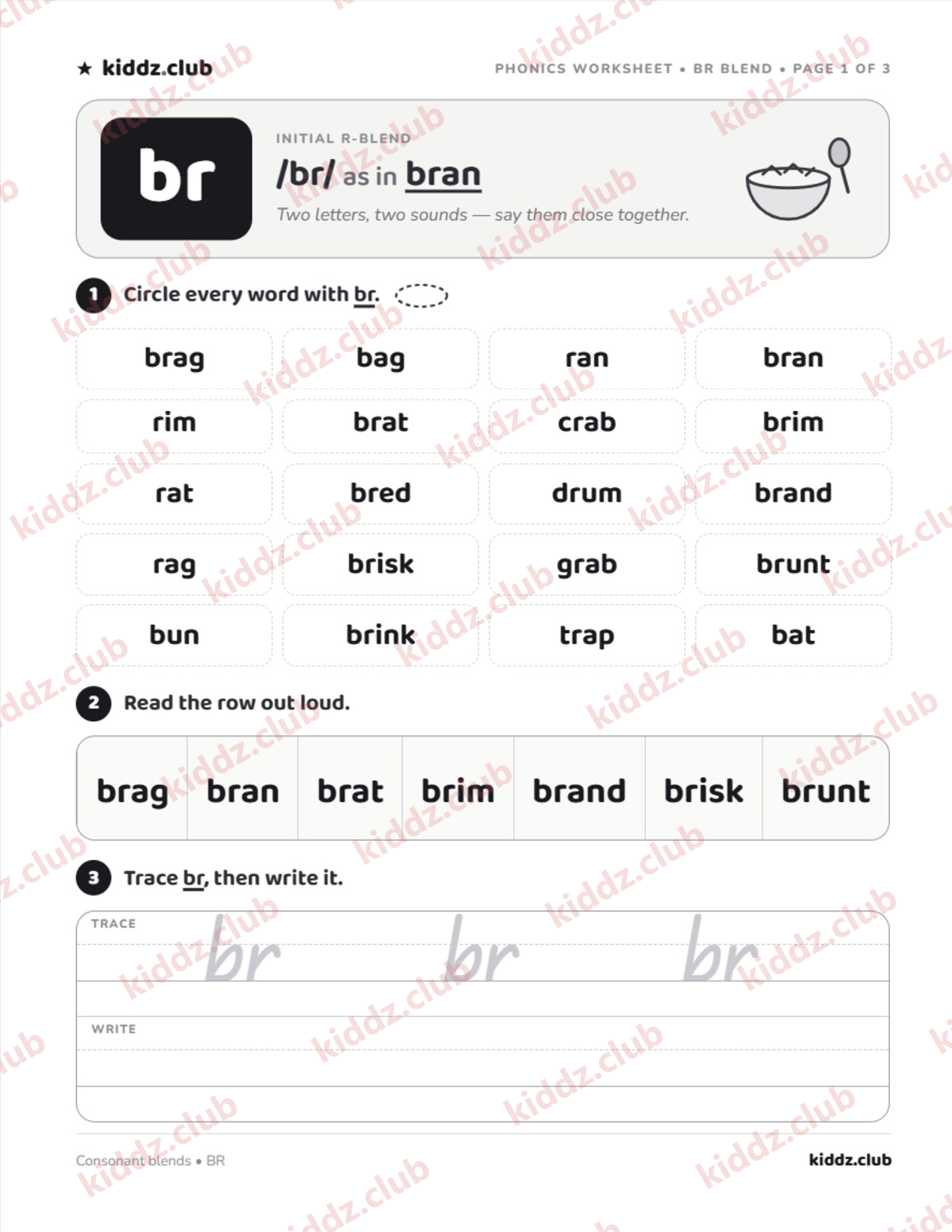
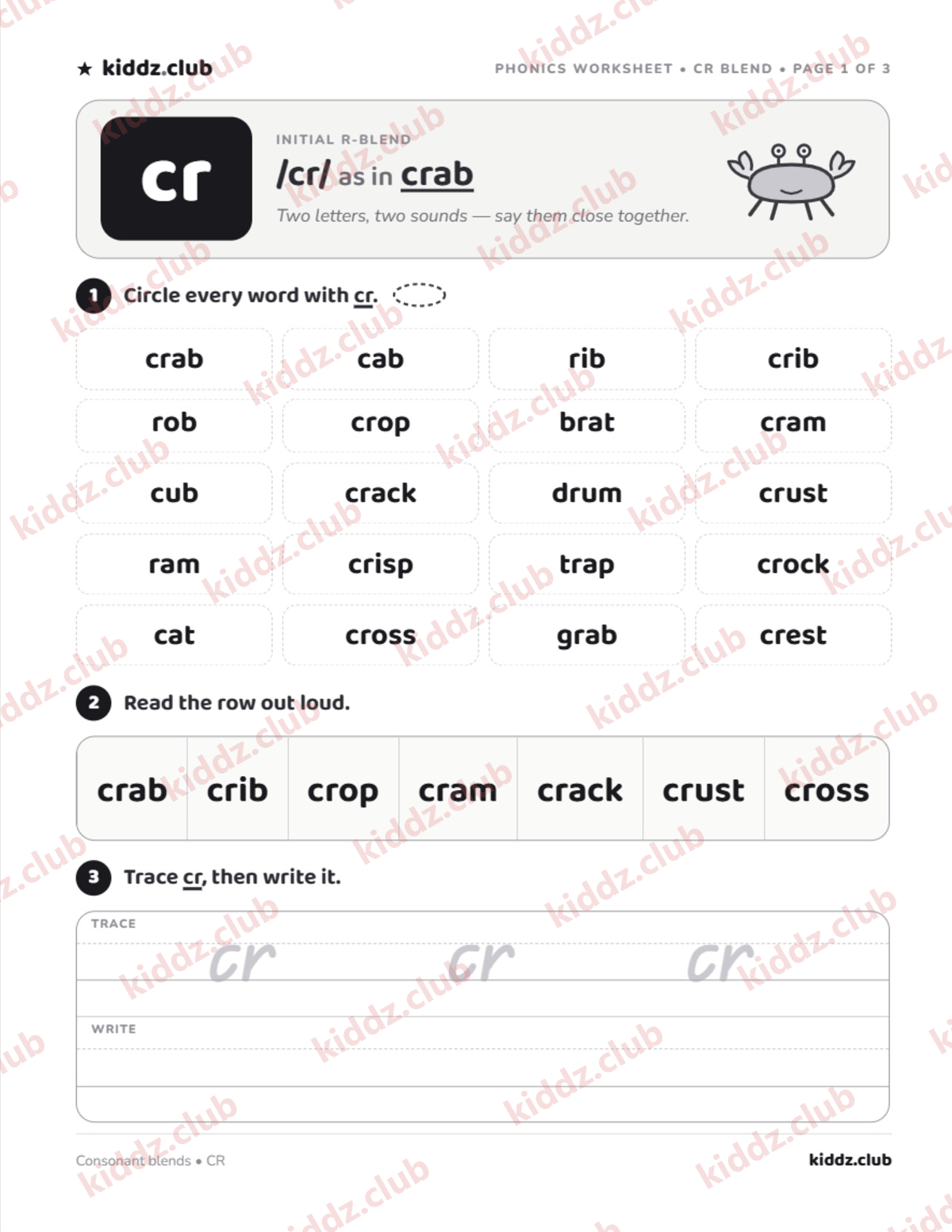
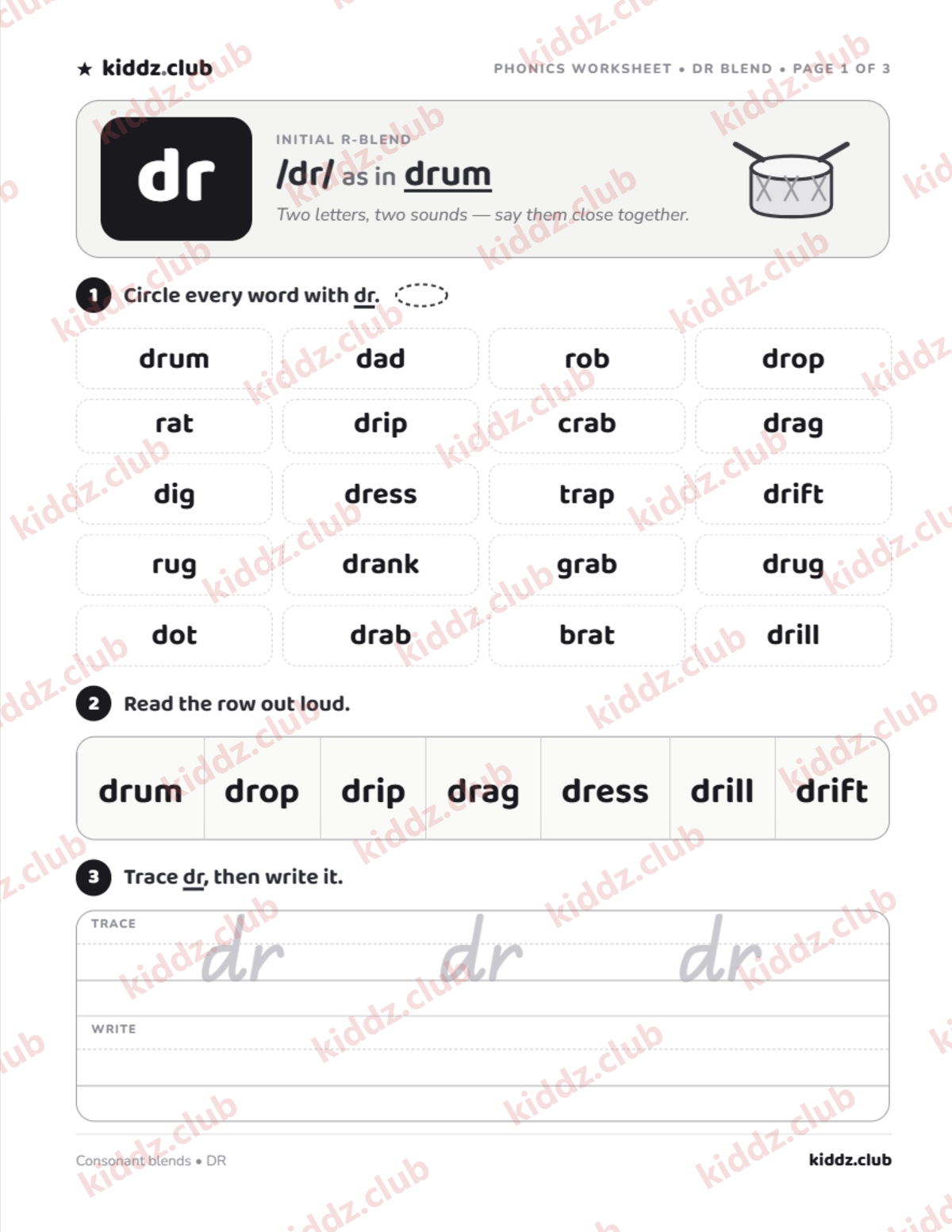
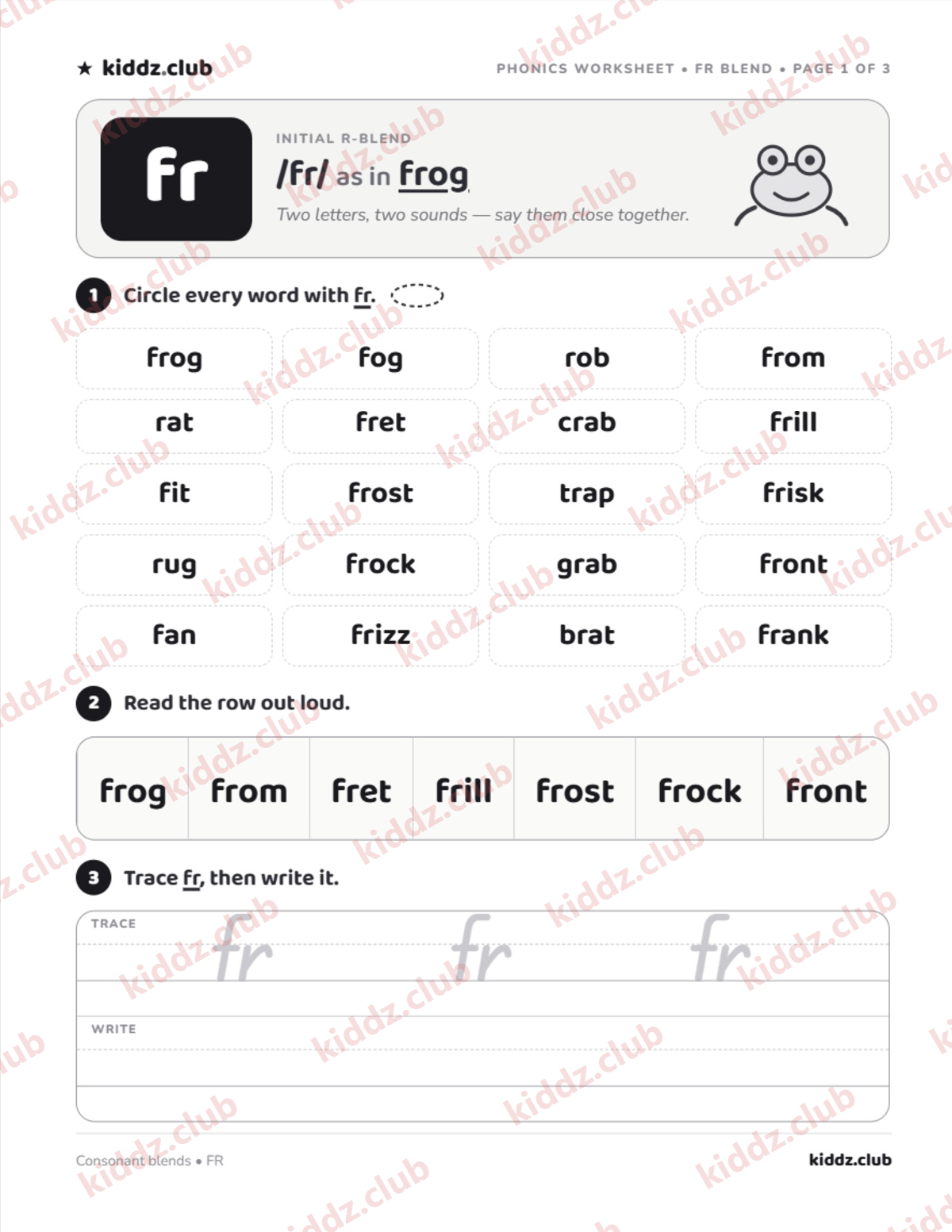
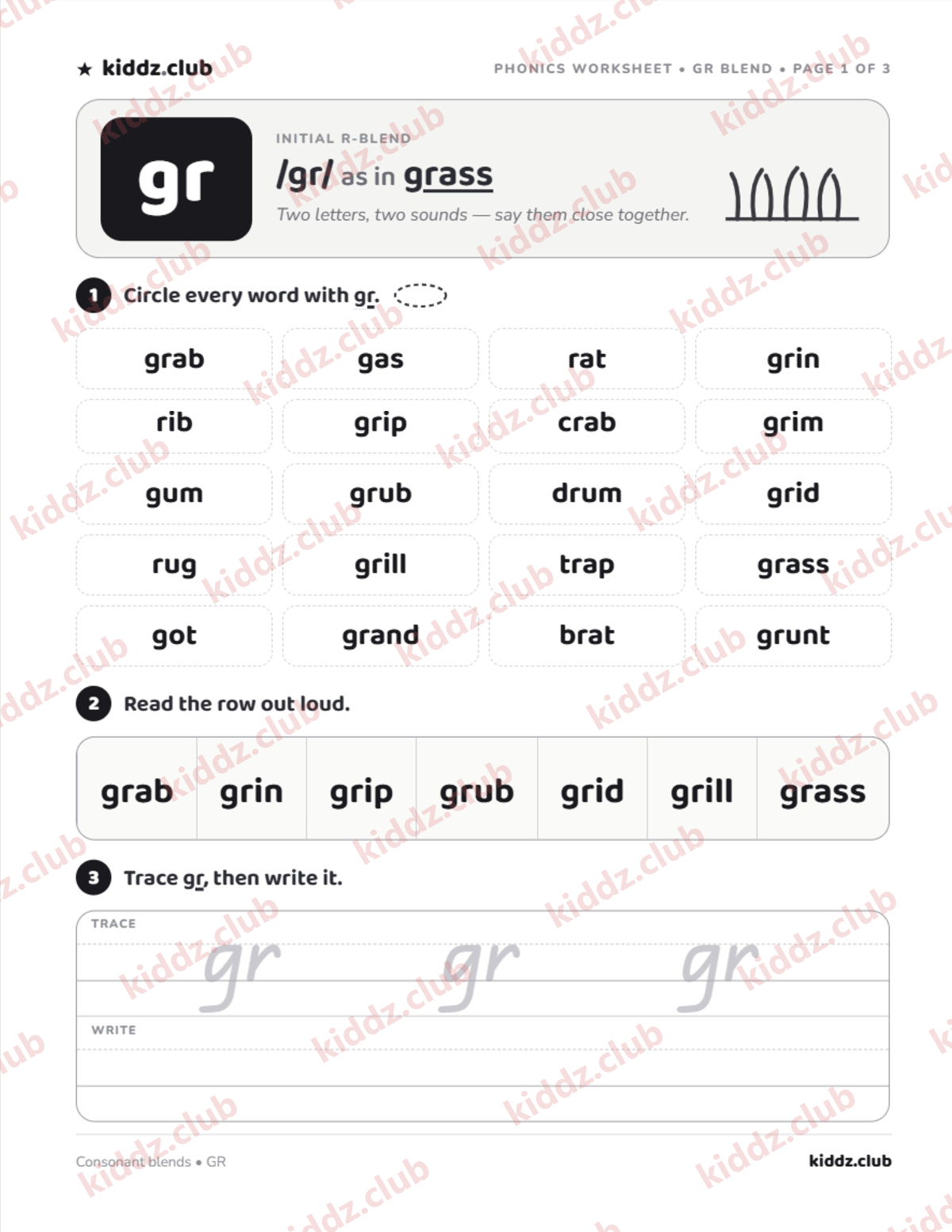
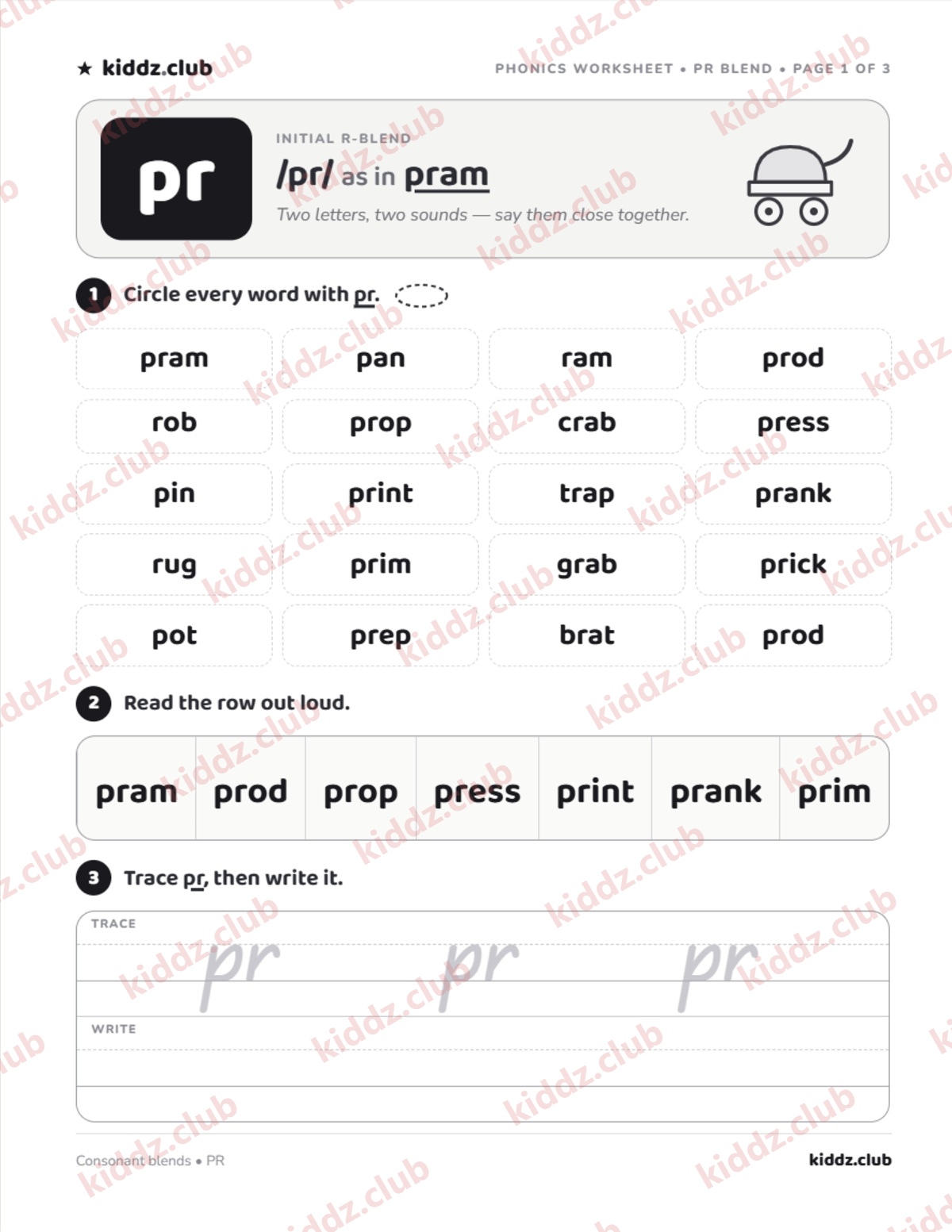
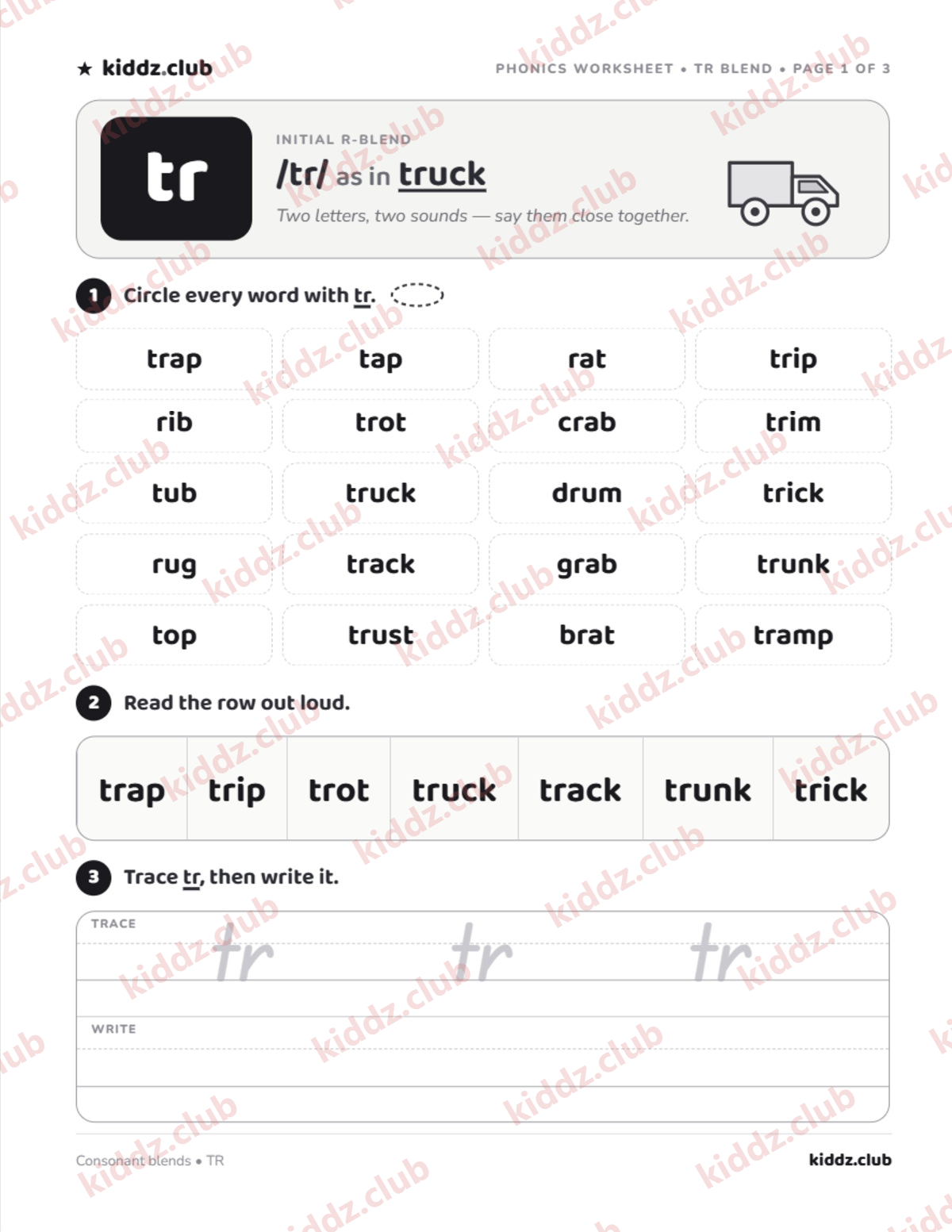
S-blends — first letter is s:
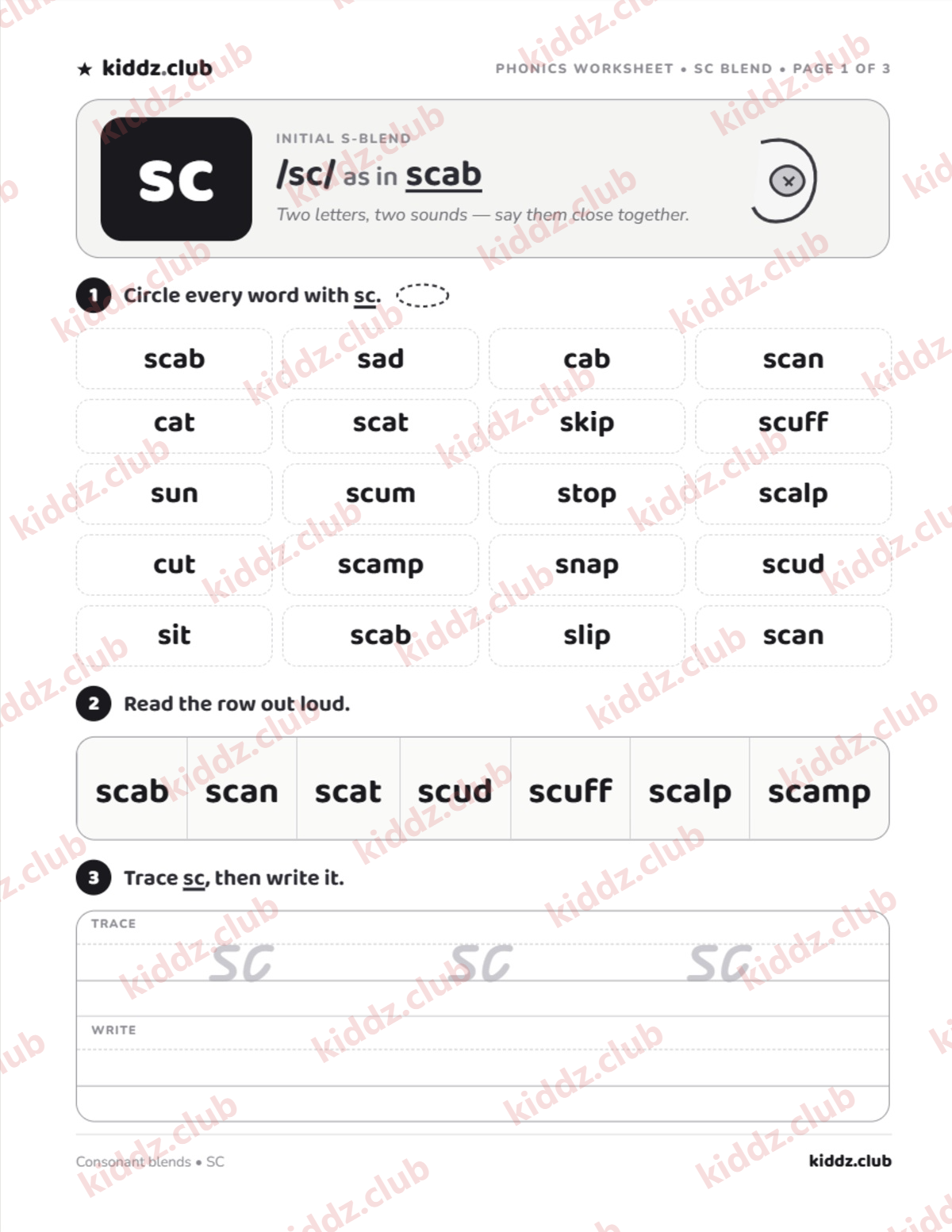
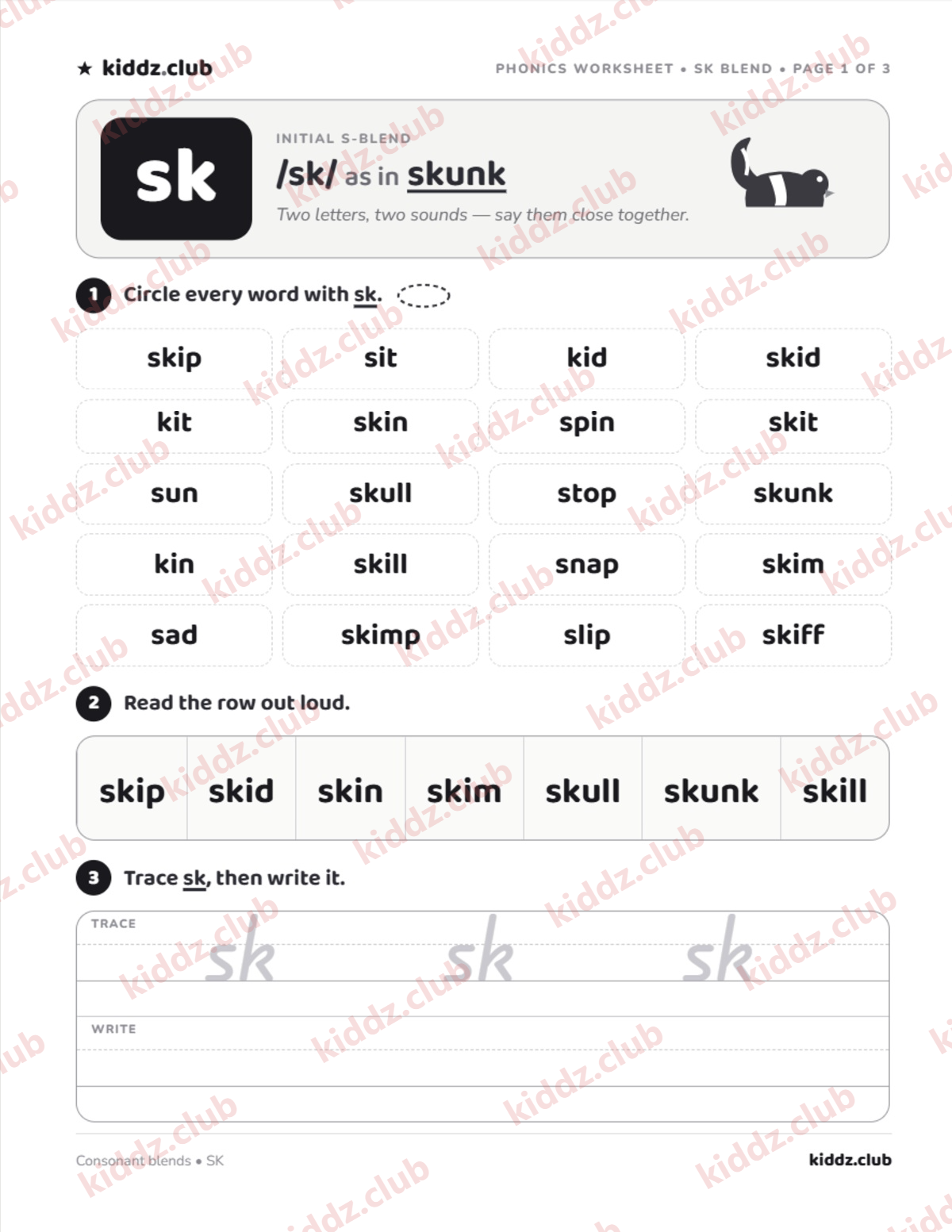
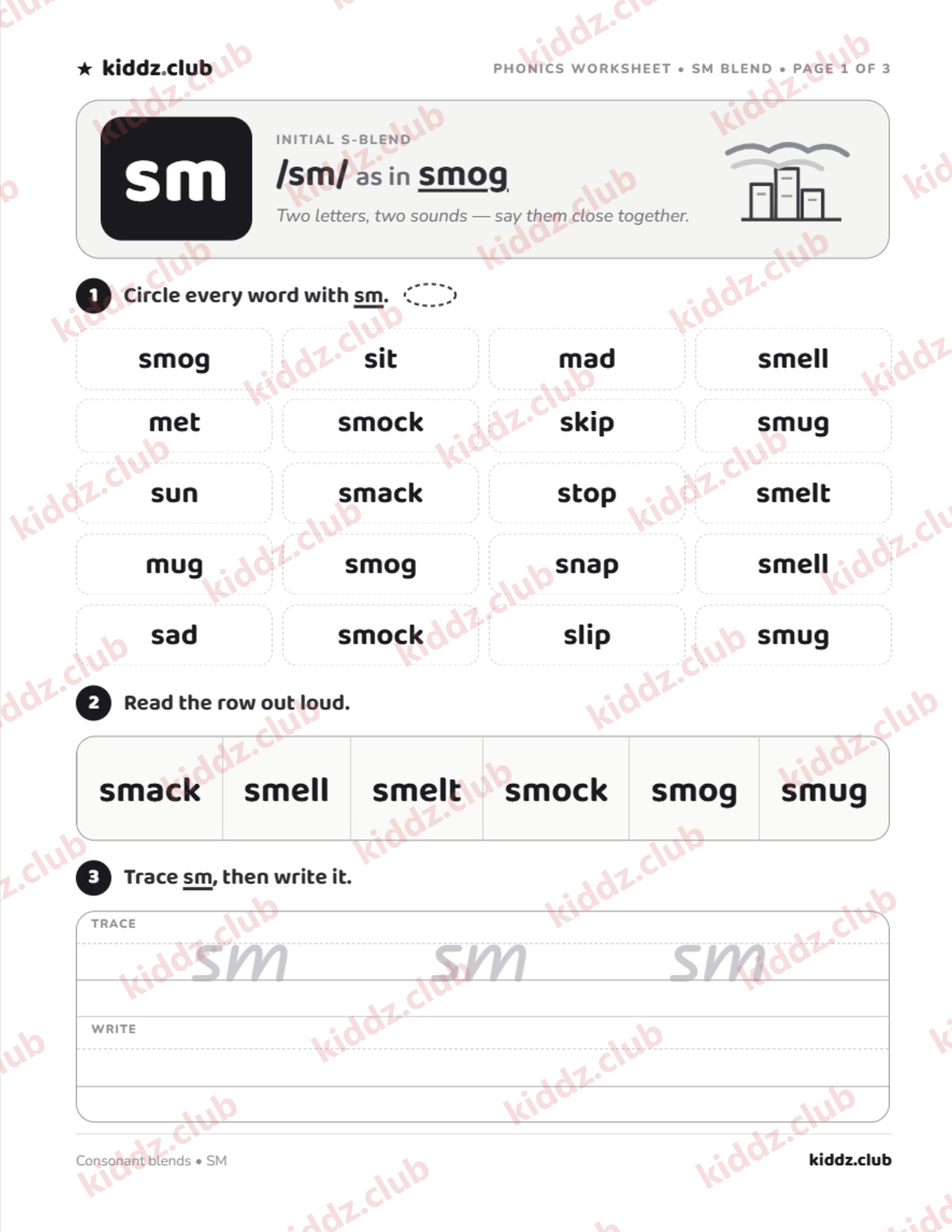
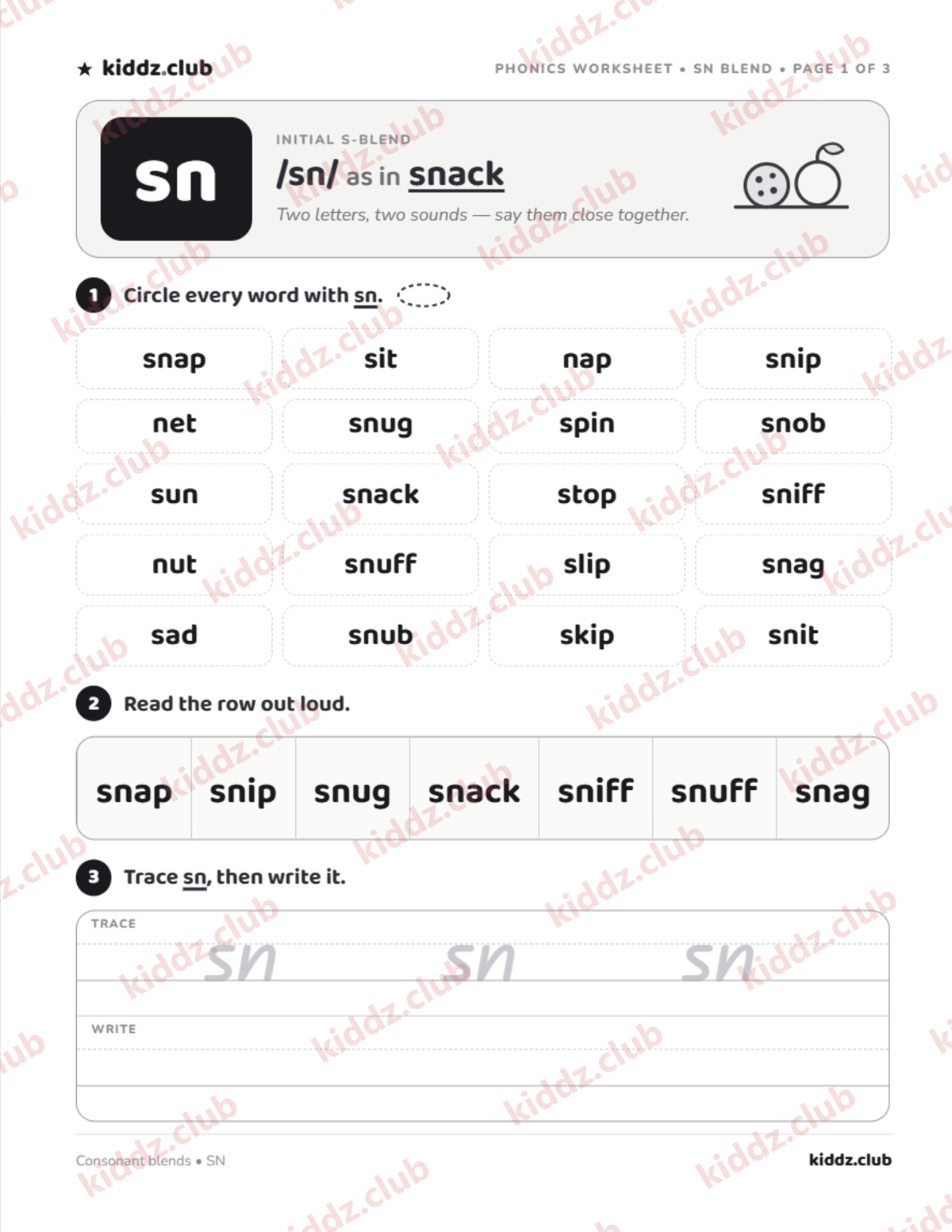
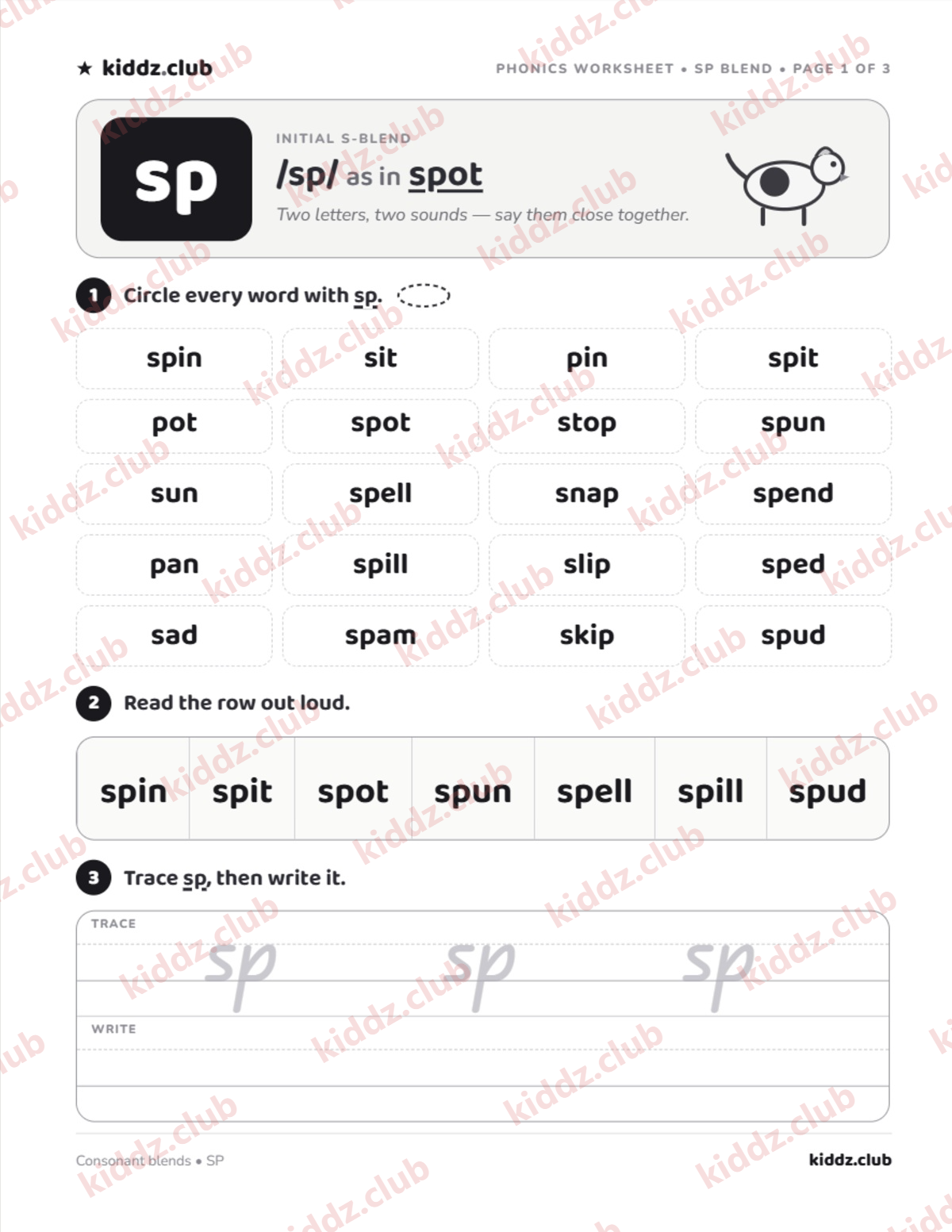
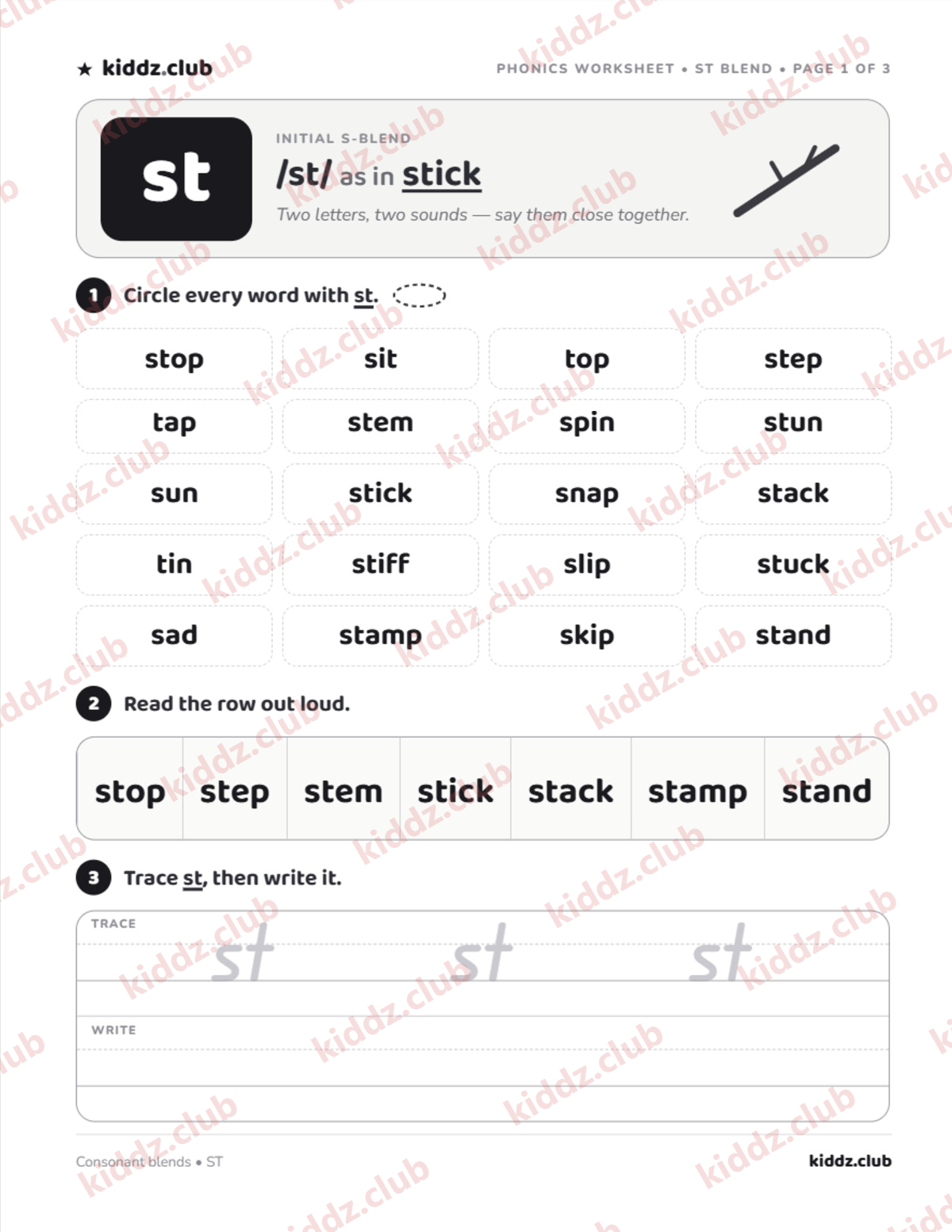
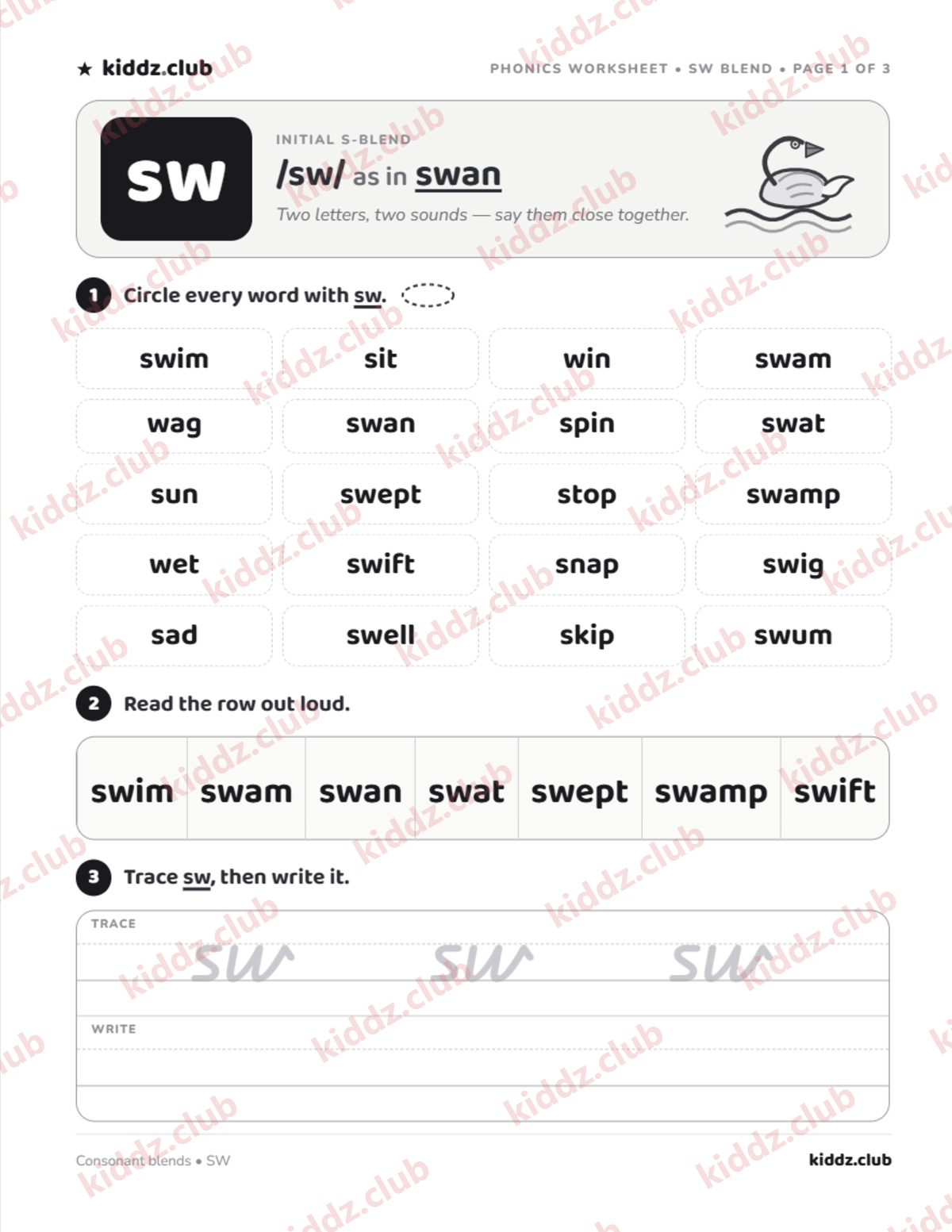
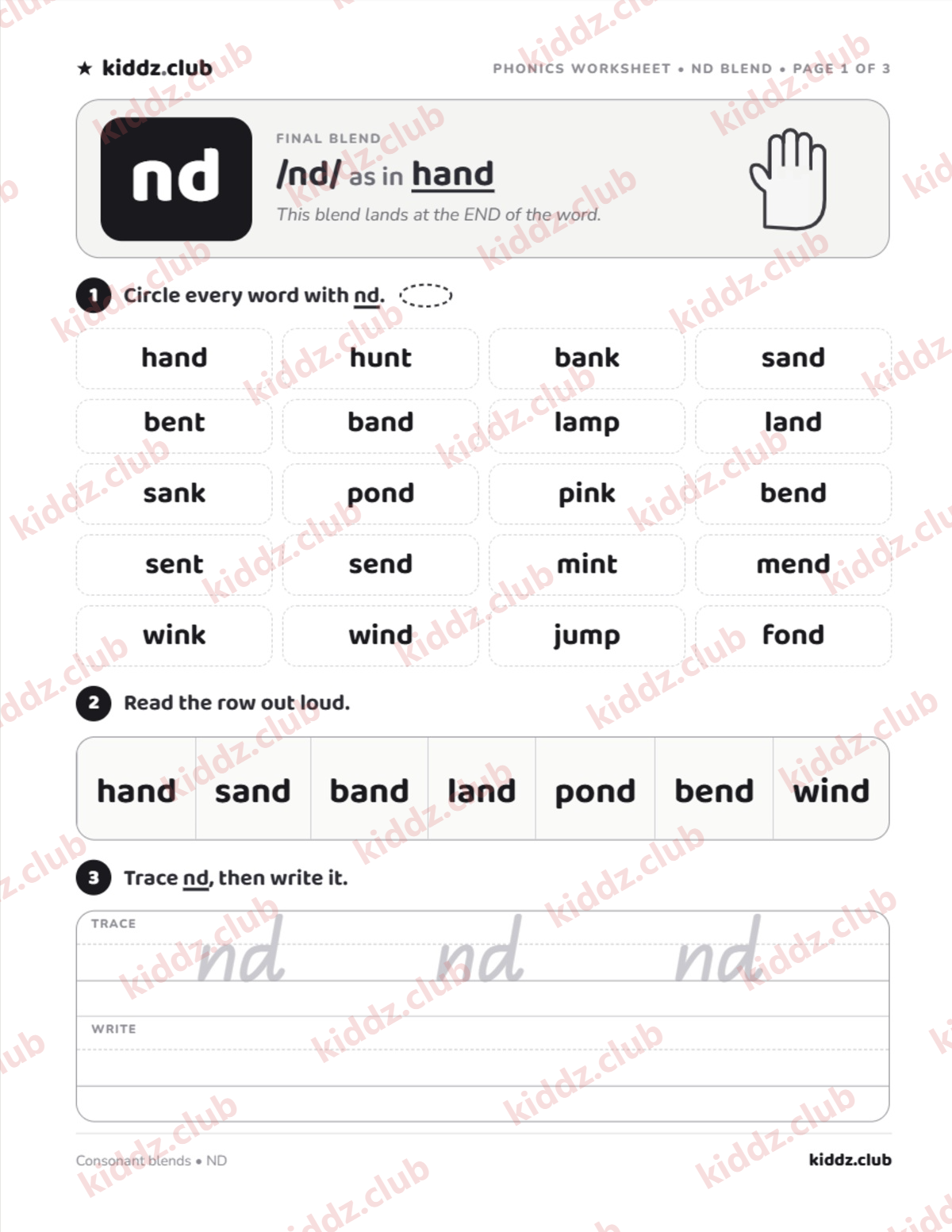
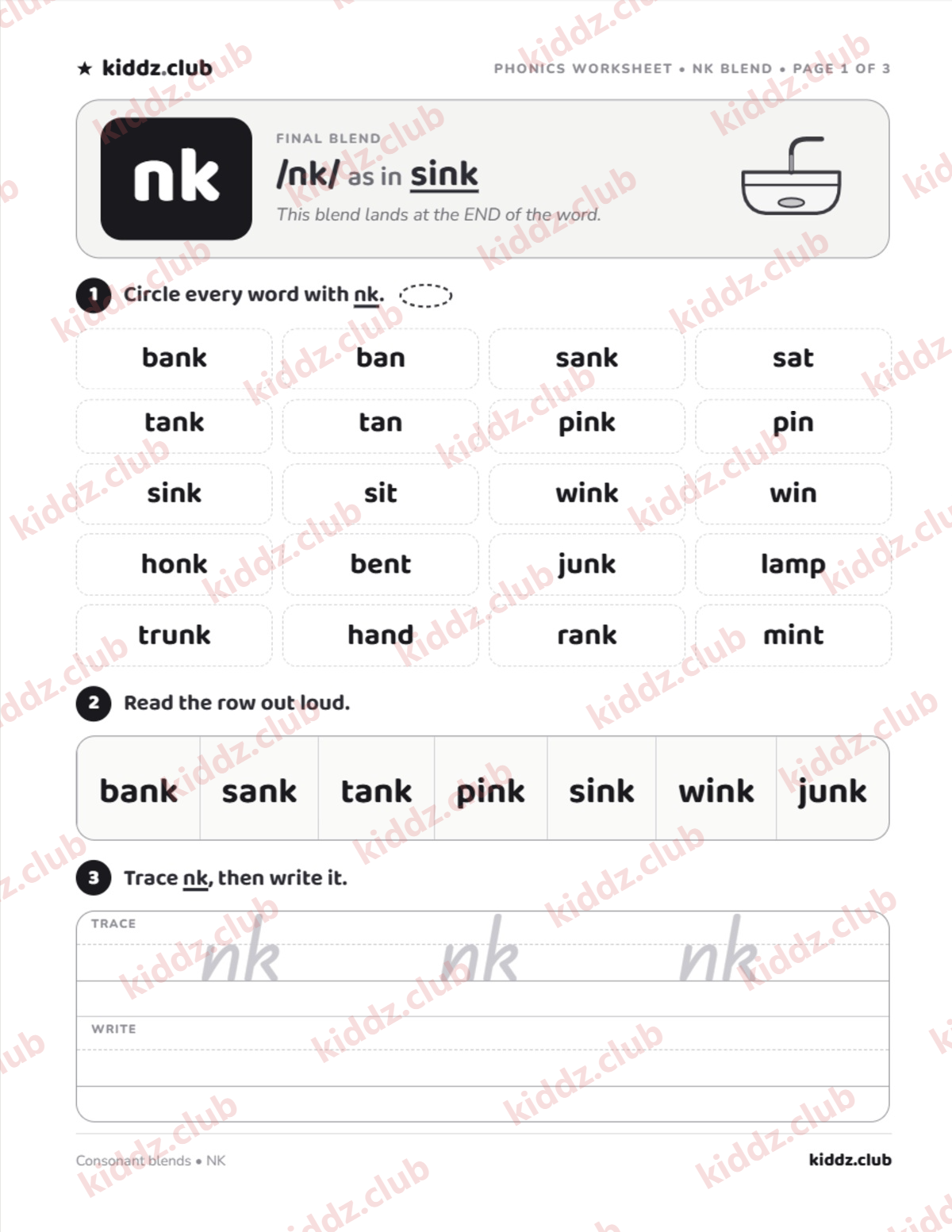
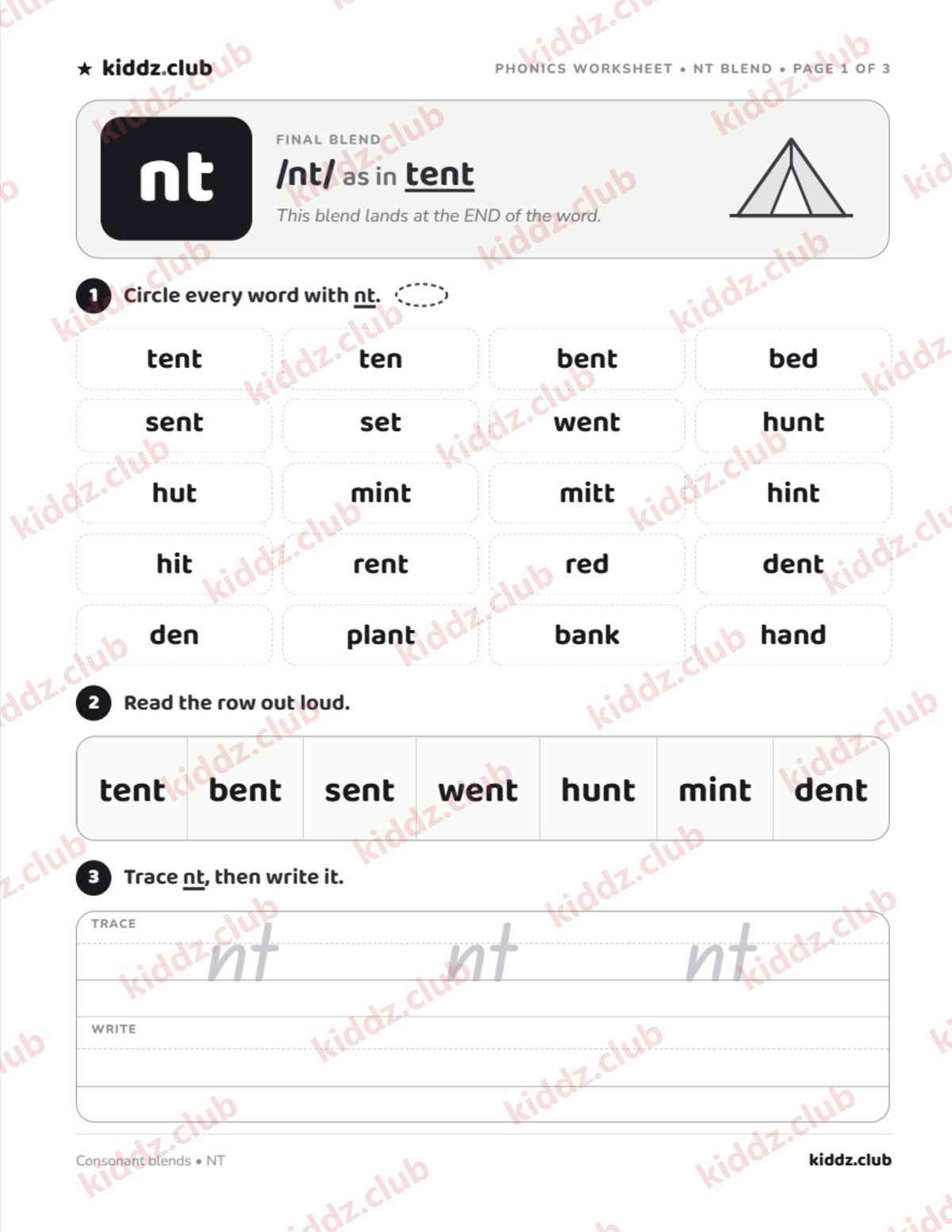
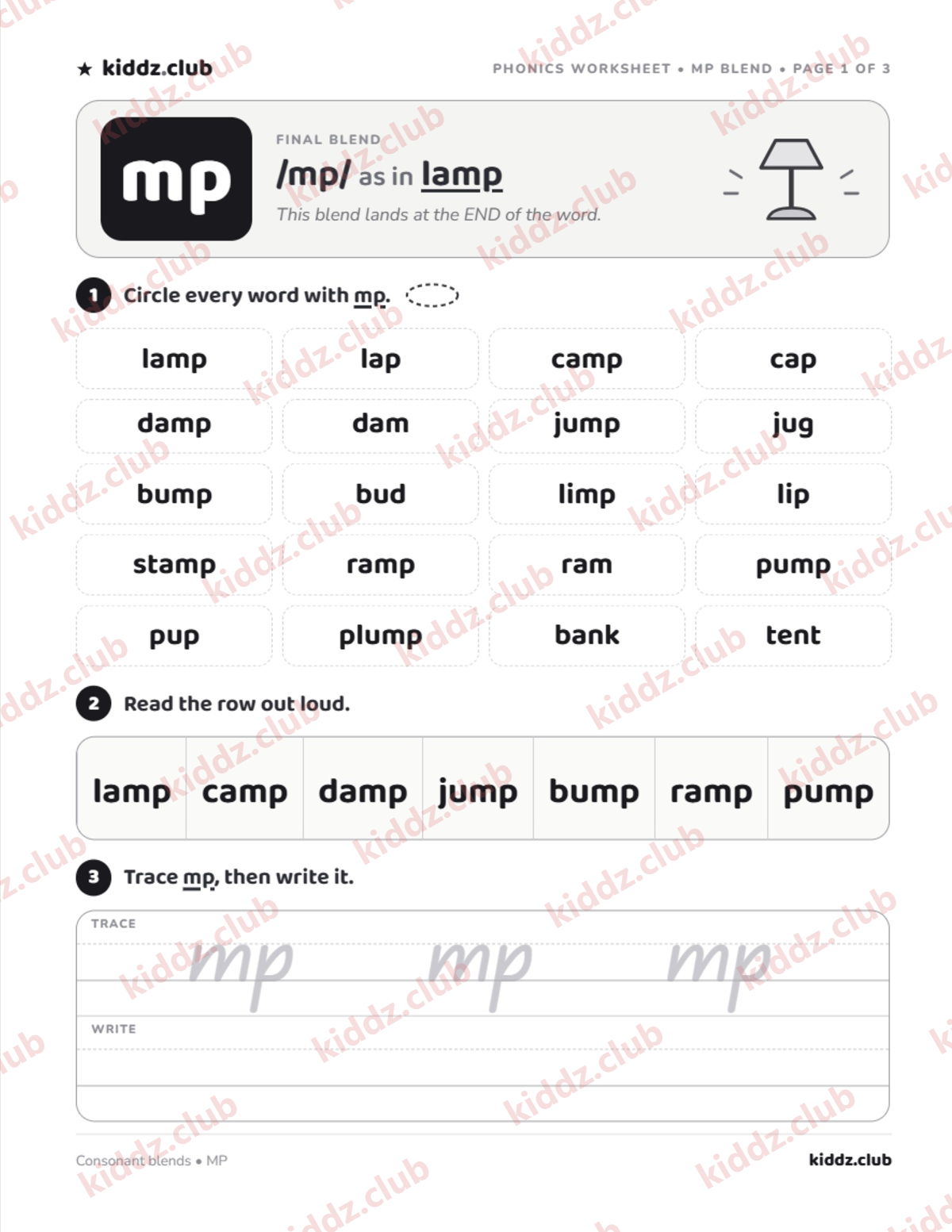
Final blends (the blend ends the word)
All 10, with teaching notes, also live on the final consonant blend worksheets page.
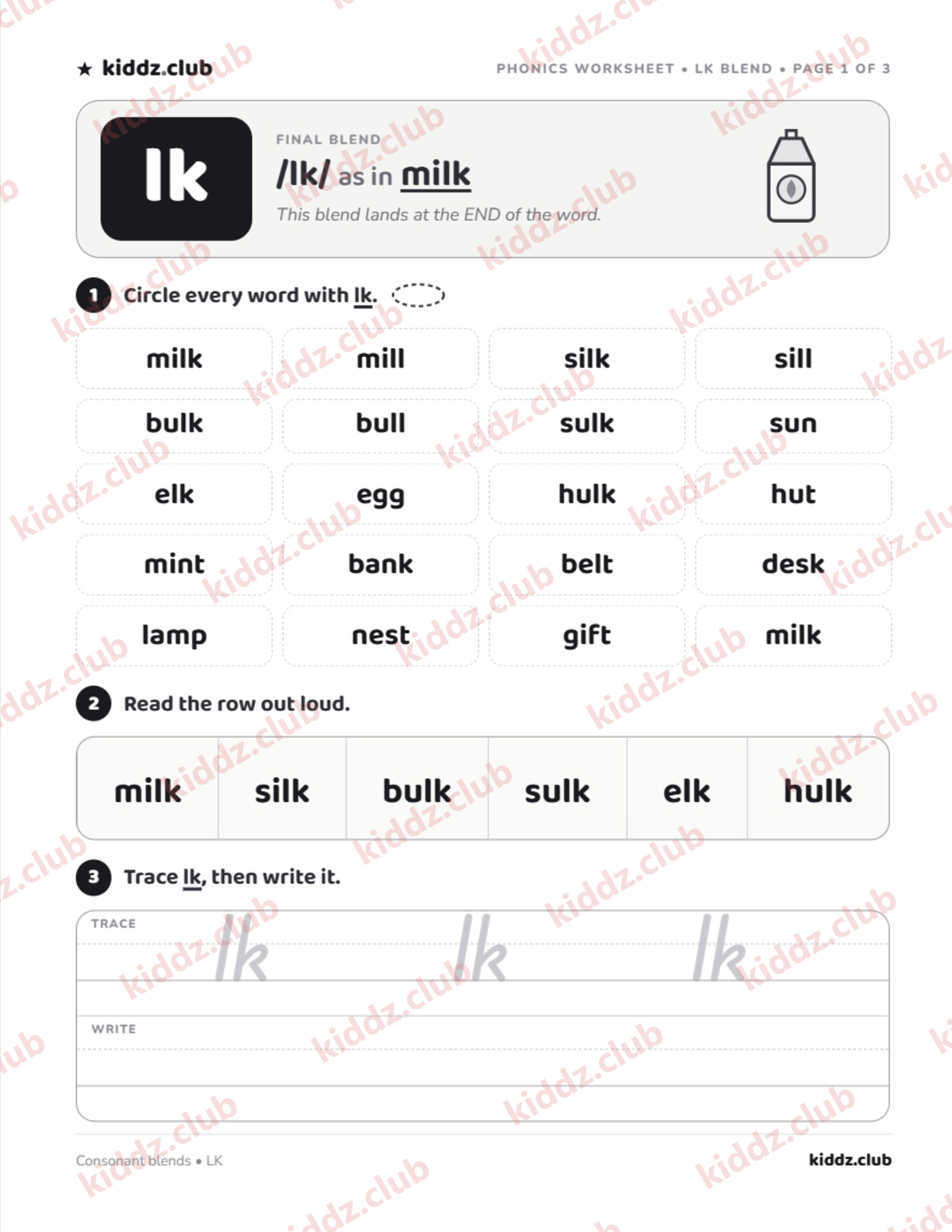
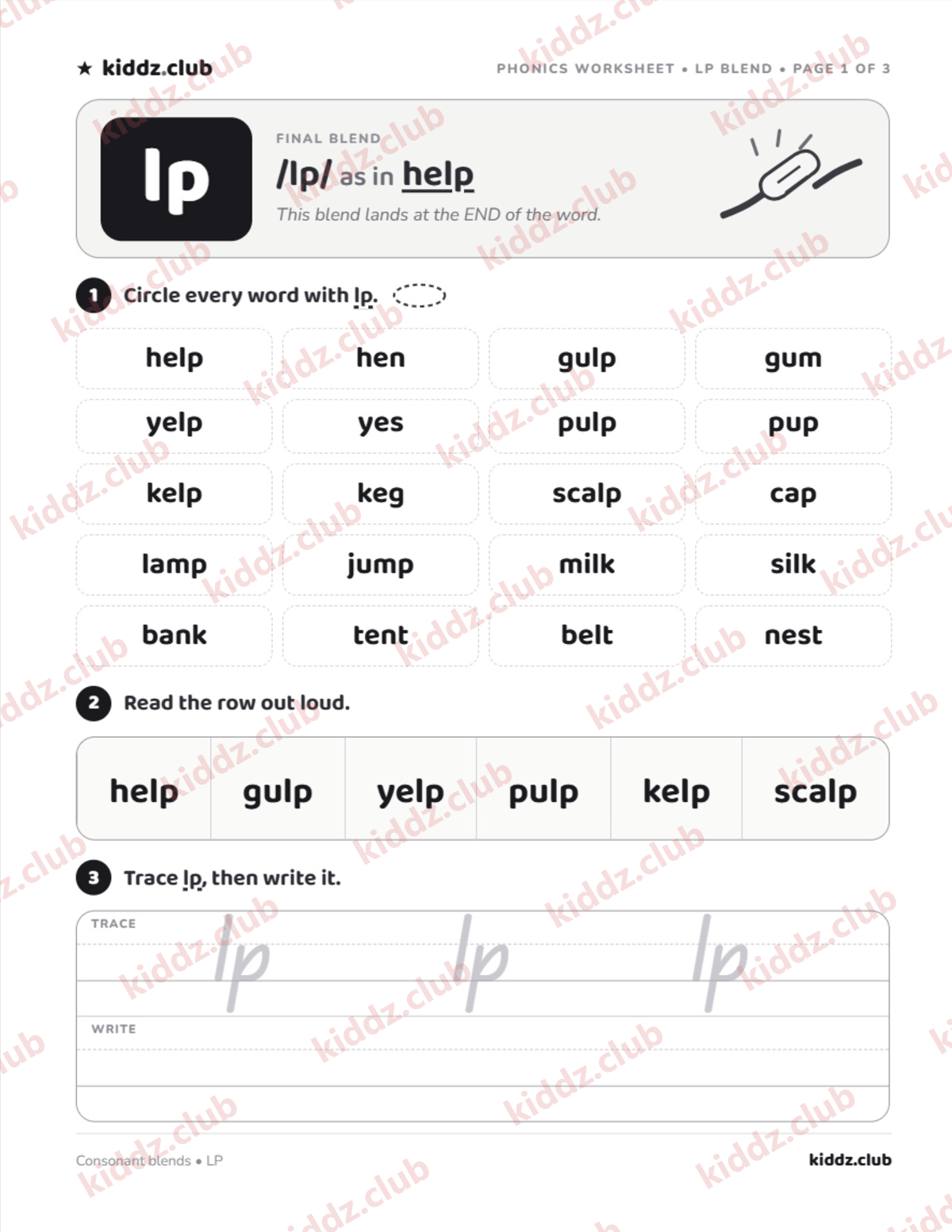
What's on each worksheet
Every worksheet runs three pages with the same six-activity structure:
Activity 1 — Circle the blend words. A grid of twenty words; the child circles every word with the target blend and skips the near-misses.
Activity 2 — Fluency row. Seven blend words in a row, read out loud.
Activity 3 — Trace and write. Trace the blend, then write it from scratch on the line below.
Activity 4 — Word-to-picture match. Draw a line from each blend word to its picture.
Activity 5 — Sentence completion. Write the missing blend word into four sentences, choosing from a small word bank.
Activity 6 — The blend maze. Page 3, a full page of its own: walk from START to FINISH, stepping only on words with the blend and skipping every other word.
How to teach blends
Blends are typically taught after CVC words are solid, around ages 5-7. Most kindergarten and Year 1 / 1st Grade programs introduce them in a specific sequence:
- L-blends first. bl, cl, fl, gl, pl, sl — usually in early Year 1.
- R-blends next. br, cr, dr, fr, gr, pr, tr — mid Year 1.
- S-blends. st, sp, sk, sl, sm, sn, sw, sc — late Year 1.
- Final blends. nd, nk, nt, mp, st, sk, lt, ft, lk, lp — alongside the initial blends or just after.
You don't have to follow this order exactly. Many programs teach blends in the order they appear in the curriculum's vocabulary, or in family groups (st-, sn-, sp-).
The key teaching technique: stretch then blend. Say each sound slowly first, then say them faster until they merge. fff-rrr-oggg... fff-rrr-og... frog. The child hears the two sounds, then the word emerges from them.
When to use blend worksheets
Use these worksheets if:
- Your child can read CVC words (cat, sun, big) confidently
- They've started meeting blends in their reading
- They're 5-7 years old
- You want focused practice on one blend at a time
Skip these worksheets if:
- Your child is still learning individual letter sounds — start with the Magic 7 Activity Pack
- Your child reads multi-syllable words easily — move on to Phase 5 / advanced phonics
How much practice does each blend need
Most kids need to meet a blend several times before it sticks:
- Day 1: Introduce the blend. Read words containing it together. Print and work through the relevant worksheet.
- Day 2-3: Re-read the words. Use them in conversation. "Can you find something at home that starts with bl?" Re-run the maze page — kids rarely object.
- Day 4-7: Mix with other blends in reading practice. The blend should now feel familiar.
You don't need to do every single blend before moving to harder phonics. Two or three blends per family group, learned solidly, is enough for most kids to generalize to the others.
Related resources
These worksheets are part of the free phonics worksheets library, specifically the consonant-blends collection. Also part of the 1st grade phonics pathway →
Dedicated pages with teaching notes:
- Initial consonant blend worksheets — the 20 blends at the start of words
- Final consonant blend worksheets — the 10 blends at the end of words
Ready for digraphs? Try the consonant digraph phonics worksheets for sh, ch, th, ng, and ck.
For earlier phonics:
- Magic 7 Phonics Flashcards — the first seven sounds
- Magic 7 Activity Pack — multi-activity practice
- CVC Word Pack — three-letter words
For after blends:
- Long vowel phonics worksheets — when blends are solid, move into Phase 5
- Magic E Pack — split digraphs
For parents:
Common questions
What's the difference between a blend and a digraph?
A blend has two letters where you hear both sounds (stop = /s/ + /t/ + /o/ + /p/). A digraph has two letters that make one new sound (ship = /sh/ + /i/ + /p/). Blends are blended; digraphs are memorized as a single sound.
How does the blend maze work?
Every sheet ends with a full-page maze of word squares. The child walks from START to FINISH, moving one square at a time — up, down, left, or right — and may only step on squares whose word has the sheet's blend; every other word is a near-miss to skip. On the st (initial) sheet that means stepping on stop and stuck while walking around snap and slip. Reaching FINISH takes a dozen or so correct spot-the-blend decisions in a row, so it practices the same sound discrimination as the drills — but as a game.
What order should I teach blends in?
Most programs teach L-blends first, then R-blends, then S-blends, then final blends. But the right order is whatever order your child's reading materials use. Don't fight your child's curriculum.
How many blend worksheets does my child need?
Probably 5-8, not all 30. Once a child has worked through a couple of L-blends, a couple of R-blends, and a couple of S-blends, they generalize to the others through reading exposure. Use the full set for thorough teaching, or just the trickiest ones for targeted help.
Are these worksheets really free?
Yes. All 30 are free for personal, classroom, and tutor use. Print as many copies as you need.
Can I use these for a child with dyslexia?
Yes. Blend practice is part of every dyslexia intervention program (Orton-Gillingham, Wilson, Barton). The systematic approach — one blend at a time, moving from recognition through reading and writing to the maze — is exactly what dyslexic learners need. Pair with multi-sensory practice for best results.
Are these aligned with my school's phonics program?
The materials follow synthetic phonics — compatible with Letters and Sounds, Jolly Phonics, Read Write Inc., Saxon, and most others. The sequence of blends may differ between programs; use them in whatever order your school follows.
Ready for More Than Worksheets?
Picture This! teaches visualization step-by-step so children can genuinely understand—and enjoy—what they read.