
Long vowel phonics worksheets — 8 free printables
Eight free printable phonics worksheets covering the common vowel-team spellings of the long vowel sounds. Each sheet is a single page focused on one vowel digraph or trigraph, with three activities: find-and-circle, read aloud, and tracing.
These are Phase 5 worksheets — designed for children who already know basic CVC words and the magic e pattern, and are now meeting the vowel team spellings that handle the long vowel sounds in the middle of words.
What "long vowel" means
A long vowel says its name. Long a is the sound in cake — it's ay, the same as the letter A's name. Long e is the sound in tree — ee, the letter E's name. And so on for i, o, u.
In English, long vowels are spelled in several different ways. The same /ay/ sound shows up as ai (rain), ay (play), a-e (cake), and a few rarer spellings. Same for /ee/, /oa/, /yoo/.
These worksheets give kids practice with each spelling individually, so they can recognize the pattern in reading and spell it correctly when writing.
The 8 worksheets
Long /ay/ sound
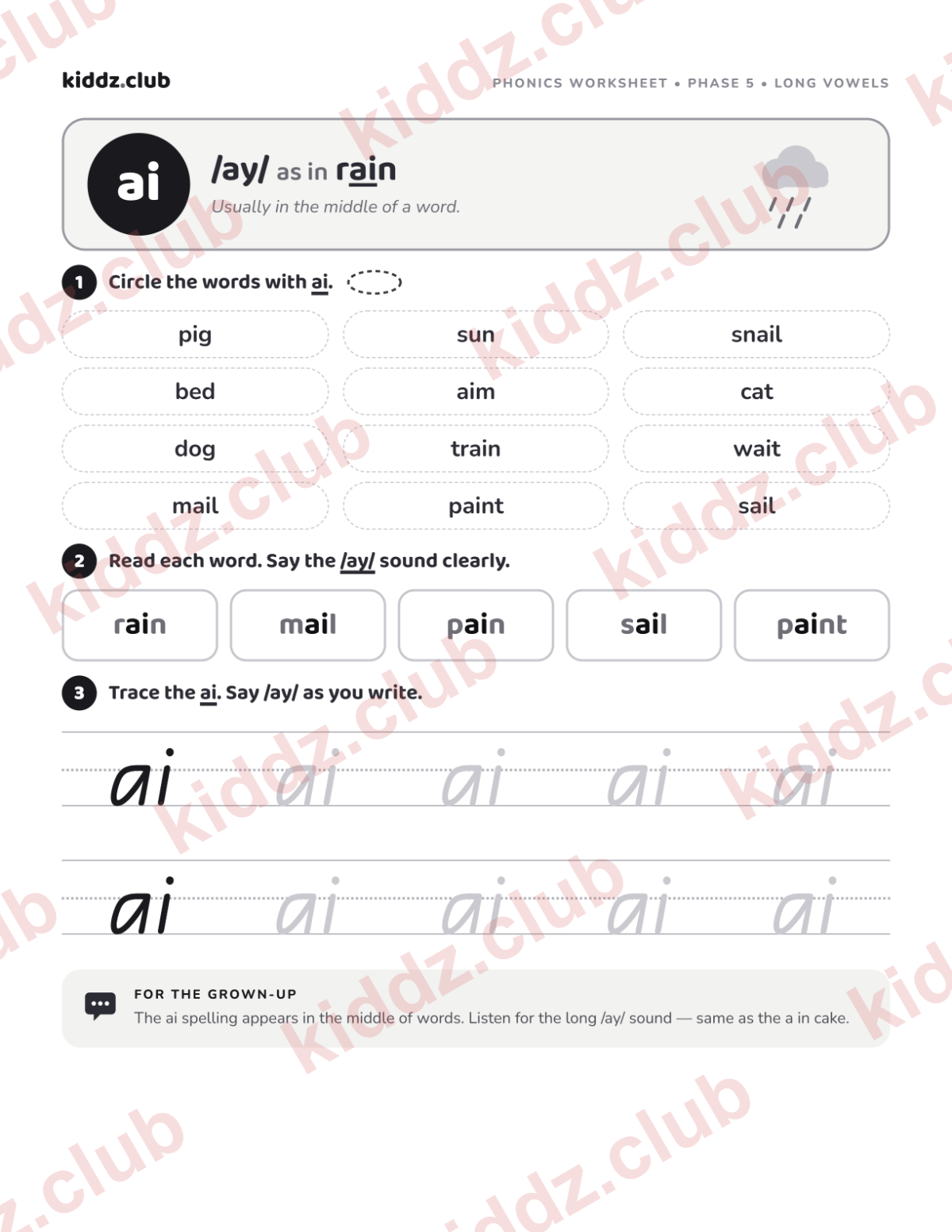
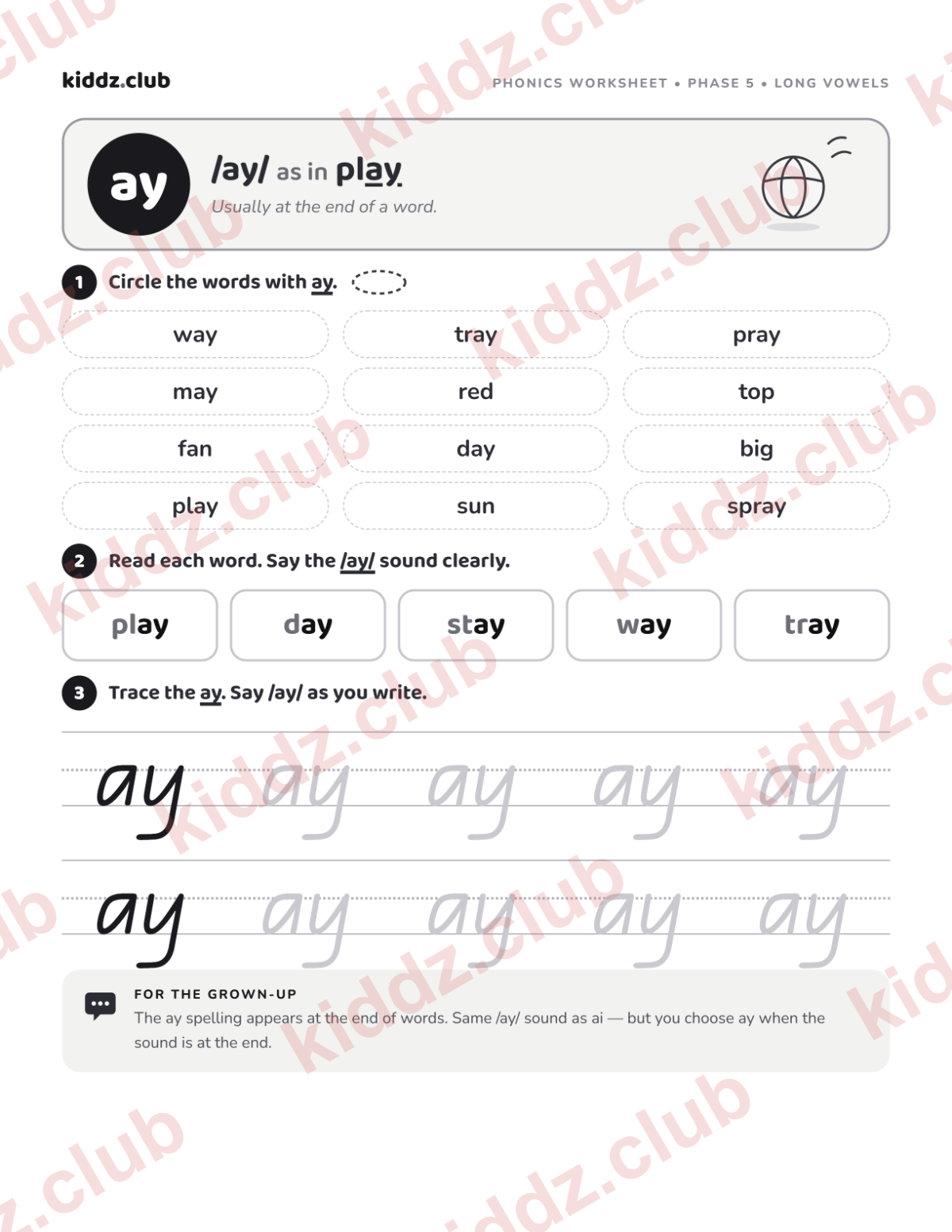
The position rule: ai in the middle, ay at the end.
For the a-e (magic e) version of the /ay/ sound, see the Magic E Pack.
Long /ee/ sound
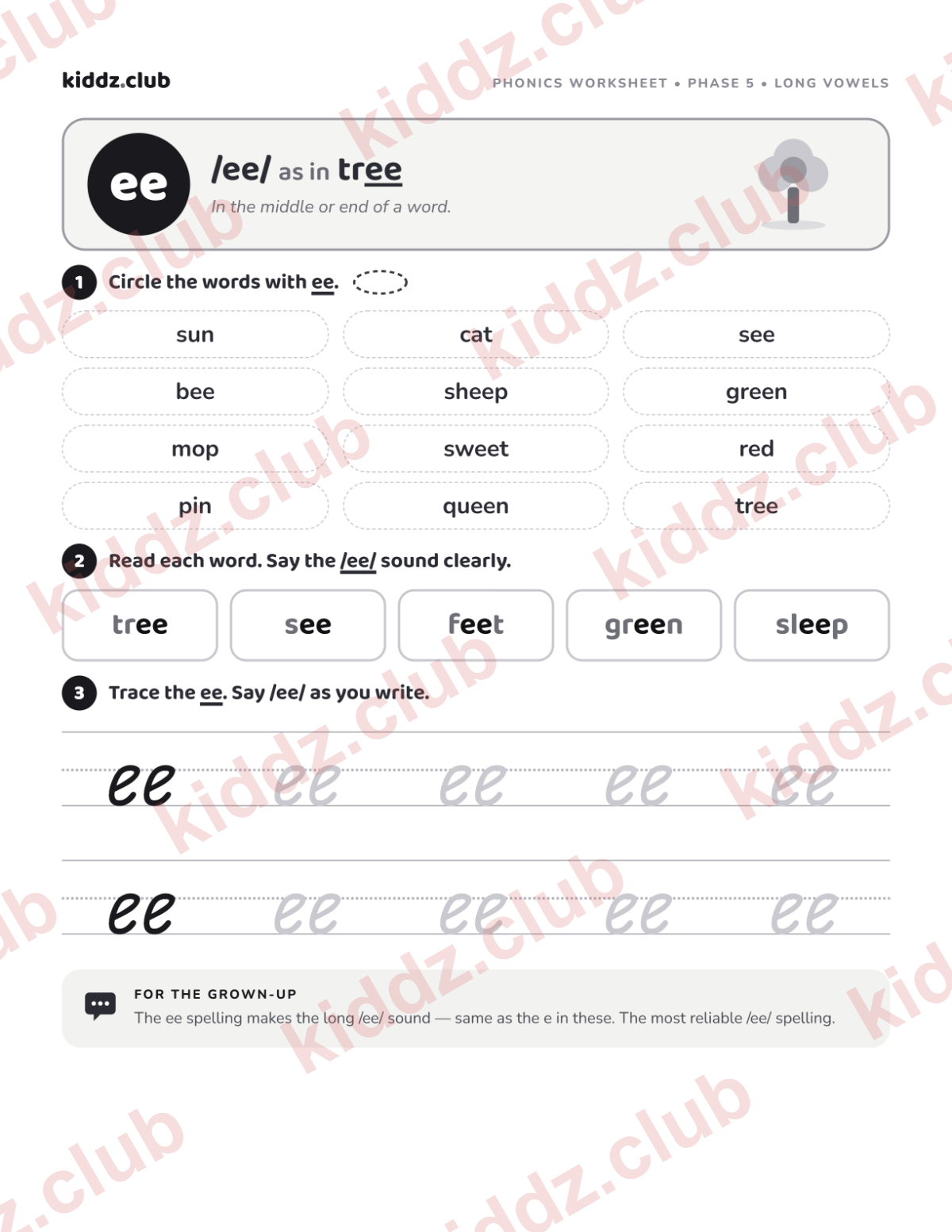
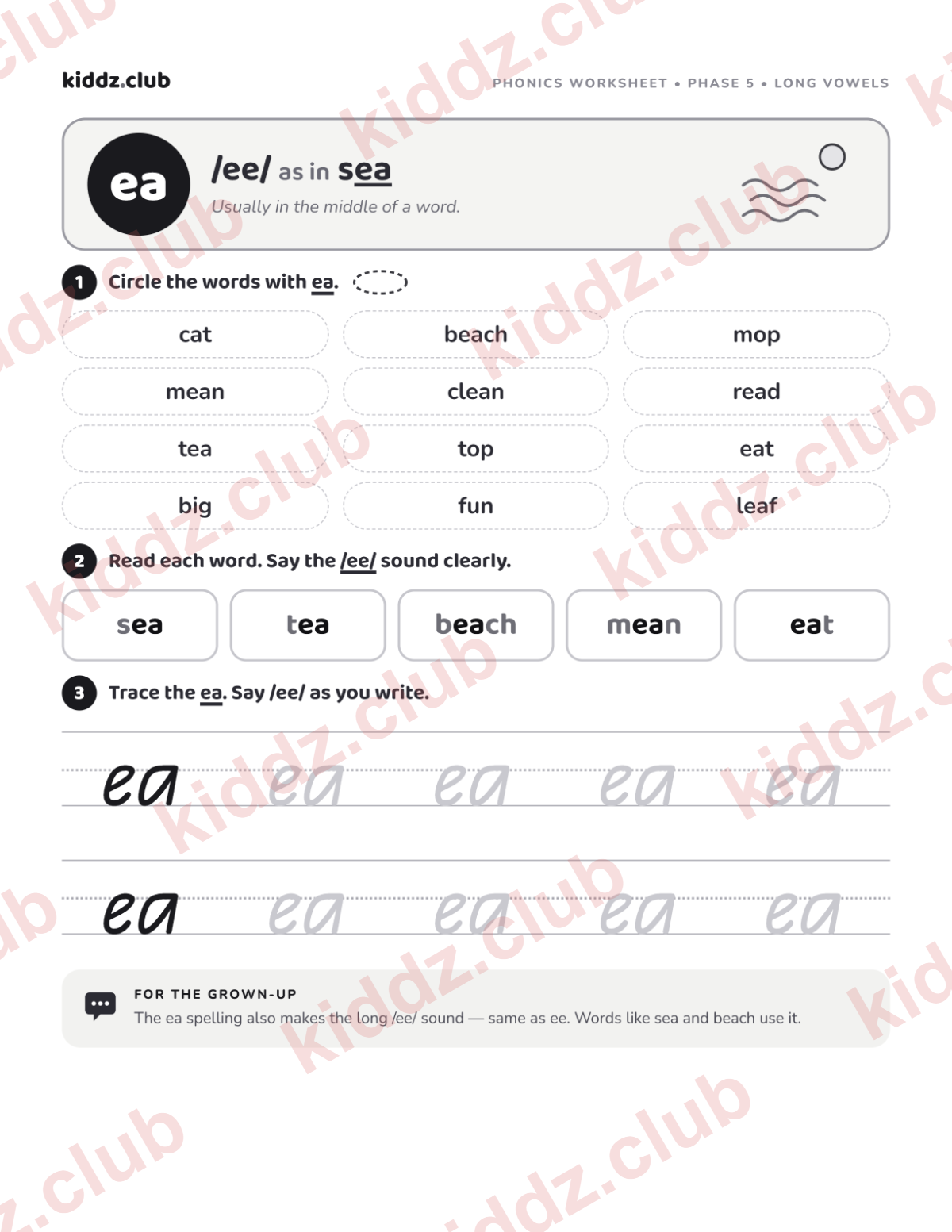
Both spellings make the same /ee/ sound. ee is the most reliable spelling; ea sometimes makes a short /e/ sound instead (head, bread) so it's trickier.
Long /oa/ sound
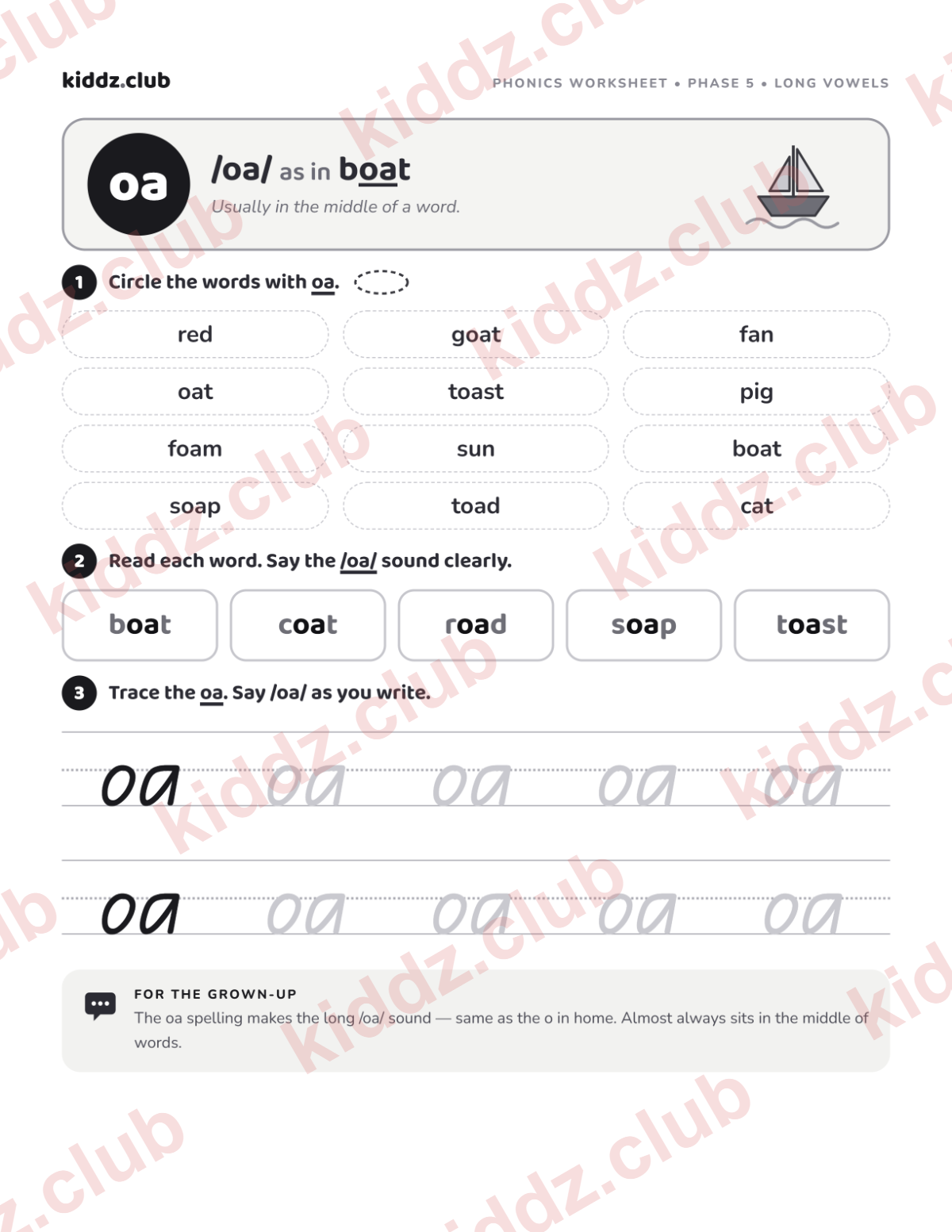
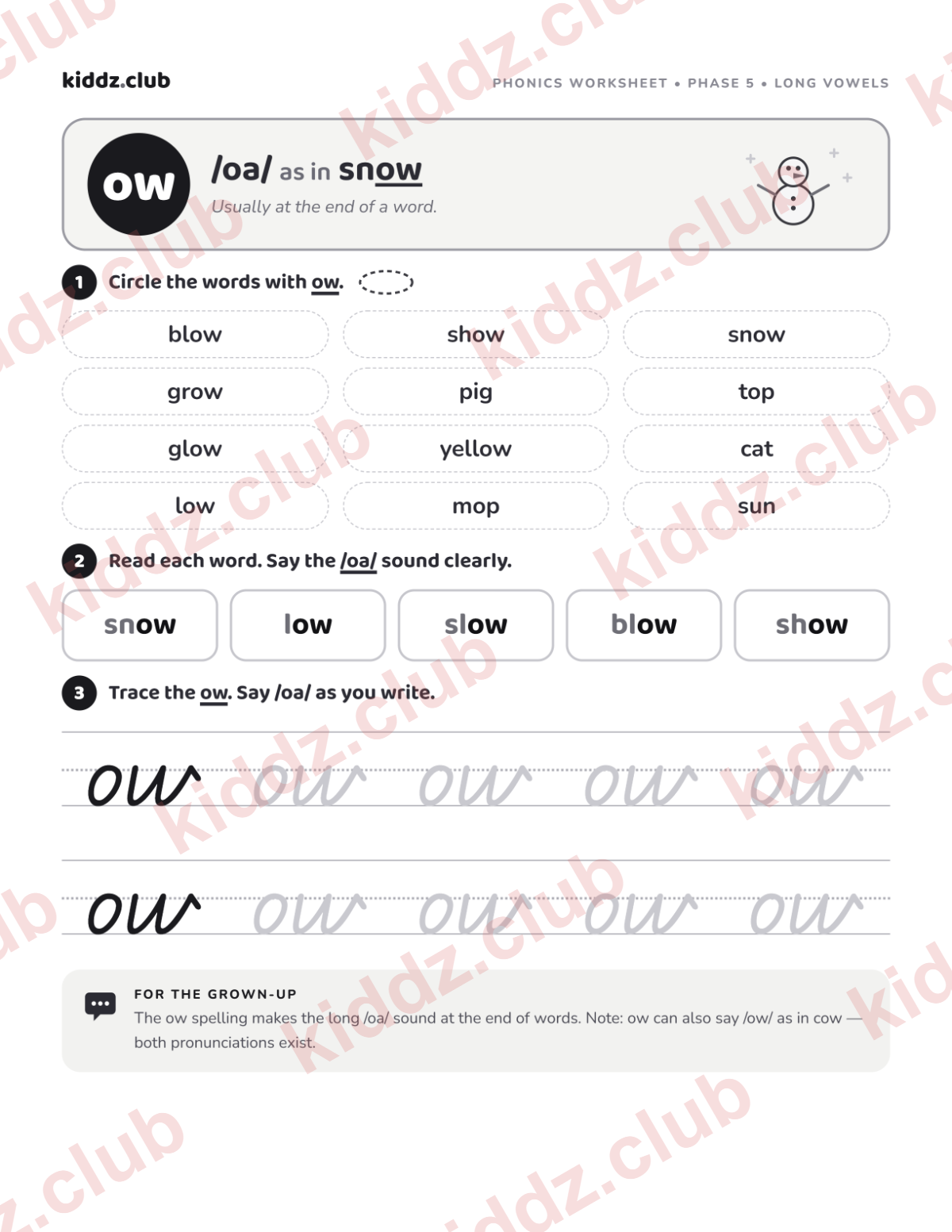
Position rule: oa in the middle, ow at the end. Note: ow can also say /ow/ as in cow, how — context determines which.
For the o-e (magic e) version, see the Magic E Pack.
Long /oo/ sound
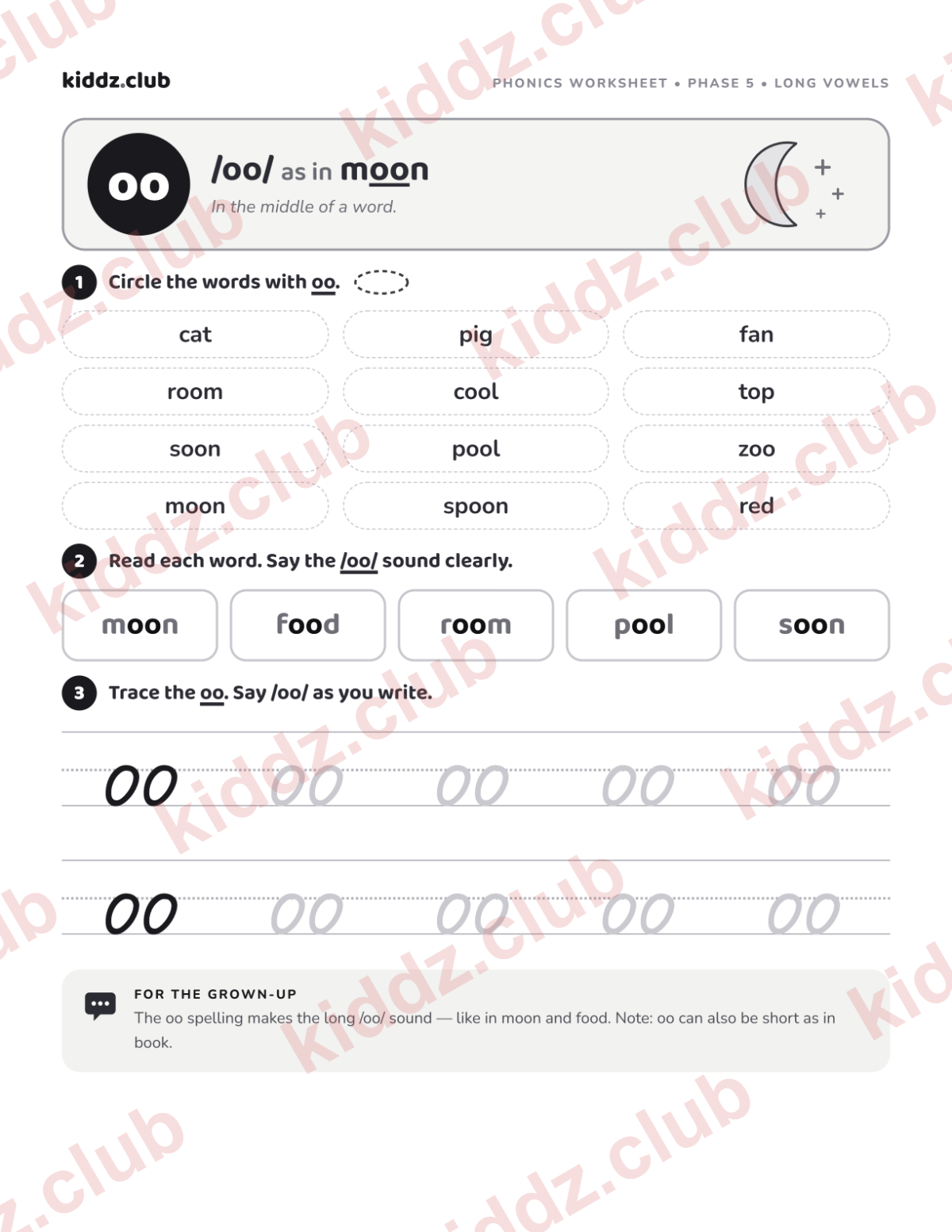
Note: oo can also be short (book, look). The featured sheet focuses on the long version.
Long /aw/ sound
- au phonics worksheet — sauce, haunt, August, pause (middle of word) (new edition coming soon)
- aw phonics worksheet — paw, claw, draw, jaw (end of word) (new edition coming soon)
Position rule: au in the middle, aw at the end. The /aw/ sound is sometimes grouped with long vowels and sometimes with other vowel pairs, depending on the program.
Long /oo/ alternative spellings
- ew phonics worksheet — new, grew, flew, few (new edition coming soon)
- ue phonics worksheet — blue, true, glue, clue (new edition coming soon)
Both make the long /oo/ sound (or /yoo/ in some words). These typically appear at the end of words.
Long /eye/ sound
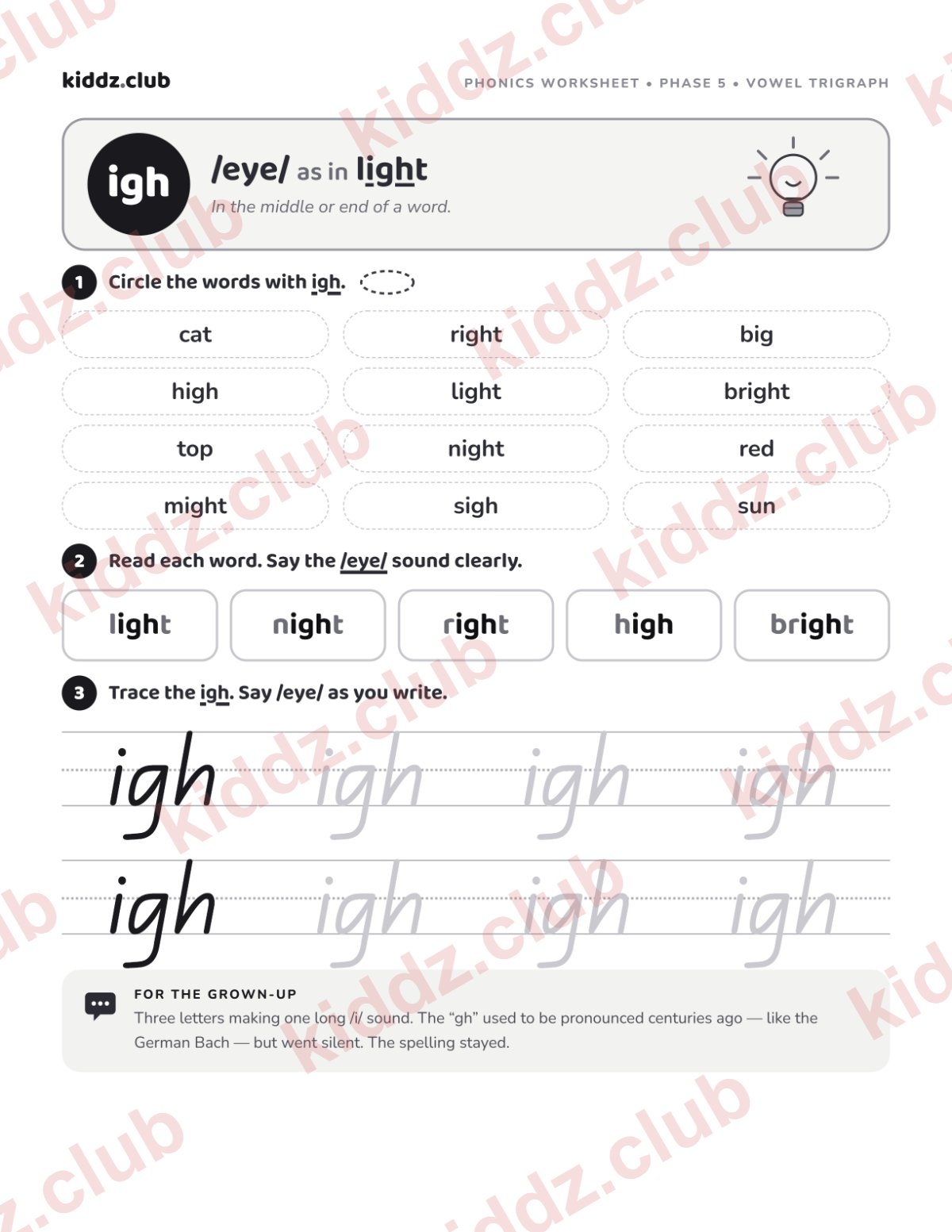
A trigraph — three letters making one sound. The "gh" used to be pronounced centuries ago but went silent; the spelling stayed.
What's on each worksheet
Every worksheet follows the same structure:
Activity 1 — Find and circle. Twelve words shown in a grid. Some contain the target vowel pattern, some don't. The child circles every word with the pattern.
Activity 2 — Read aloud. Five featured words featuring the pattern, each with a colorable dot beneath. Read, color, repeat.
Activity 3 — Trace. Six traces of the vowel pattern — first solid, the rest in light gray. Dotted separators between cells.
Parent note. A small note explaining the pattern, often with a teaching insight (positional rule, common exception, etymological note).
How to teach long vowel spellings
Long vowel spellings are typically taught in Year 1 / 1st Grade and Year 2 / 2nd Grade, after magic e is solid. A reasonable sequence:
- Long /ay/ — ai, ay. With the positional rule (ai in middle, ay at end).
- Long /ee/ — ee, then ea. Acknowledge that ee is more reliable.
- Long /oa/ — oa, ow. With positional rule.
- Long /oo/ — oo. Then alternative spellings ew, ue later.
- Long /eye/ via igh — as a small named group of words.
- Long /aw/ — au and aw. With positional rule.
The single most useful teaching technique: positional rules. Telling a child "ai in the middle, ay at the end" gives them a reasoning process when they're spelling. They stop guessing and start choosing.
For a deeper dive on this, see the parent article Why English spells the same sound so many ways.
When to use these worksheets
Use these worksheets if:
- Your child reads CVC words confidently
- They've worked through magic e (the Magic E Pack)
- They're meeting longer words in books with vowel digraphs
- They're 6-8 years old
Skip these worksheets if:
- Your child is still learning individual letter sounds — start with the Magic 7 set
- They haven't yet met magic e — work through that pack first
Related resources
Part of the free phonics worksheets library — the Phase 5 collection. Also part of the 1st grade phonics pathway →
Ready for vowel teams? Five-page activity packs for the six most common teams — ai/ay, ee/ea, oa/ow, oo, oi/oy and au/aw — each ending in a phonics game: vowel team phonics worksheets →
Earlier-stage materials:
- Magic 7 Phonics Flashcards
- CVC Word Pack
- Magic E Pack — split digraph spellings
Same-stage materials:
- Consonant digraph phonics worksheets — sh, ch, th, ng
- R-controlled vowel worksheets — ar, or, ur, ir, er
For parents:
- Every way to spell the long /a/ sound
- The /ee/ sound — every spelling, with word lists
- The /oa/ sound — every spelling, with word lists
- How to help a child choose the right spelling
Common questions
What age are these long vowel worksheets for?
Best for ages 6-8. Some advanced 5-year-olds can manage them; some Year 3 / 3rd Grade kids still benefit from them. Match to your child's level, not their age.
Do my child need all 12 sheets?
Probably not. Most kids do well with one sheet per spelling pattern, taught when they meet that pattern in their reading. The full 12 is for systematic, thorough coverage — useful for homeschoolers, tutors, and parents working through phonics in order.
Are these worksheets really free?
Yes. All 12 are free for personal, classroom, and tutor use. Print as many as you like.
What if my child reads "rain" as "rin"?
That's normal early. They've correctly applied the short-a sound but haven't yet learned the ai digraph. Walk through it together: "When two vowels are together, the first one often says its name. r-AI-n, rain." Use the worksheet's tracing activity to reinforce the pattern.
Ready for More Than Worksheets?
Picture This! teaches visualization step-by-step so children can genuinely understand—and enjoy—what they read.