
Consonant digraph phonics worksheets — 5 free printables
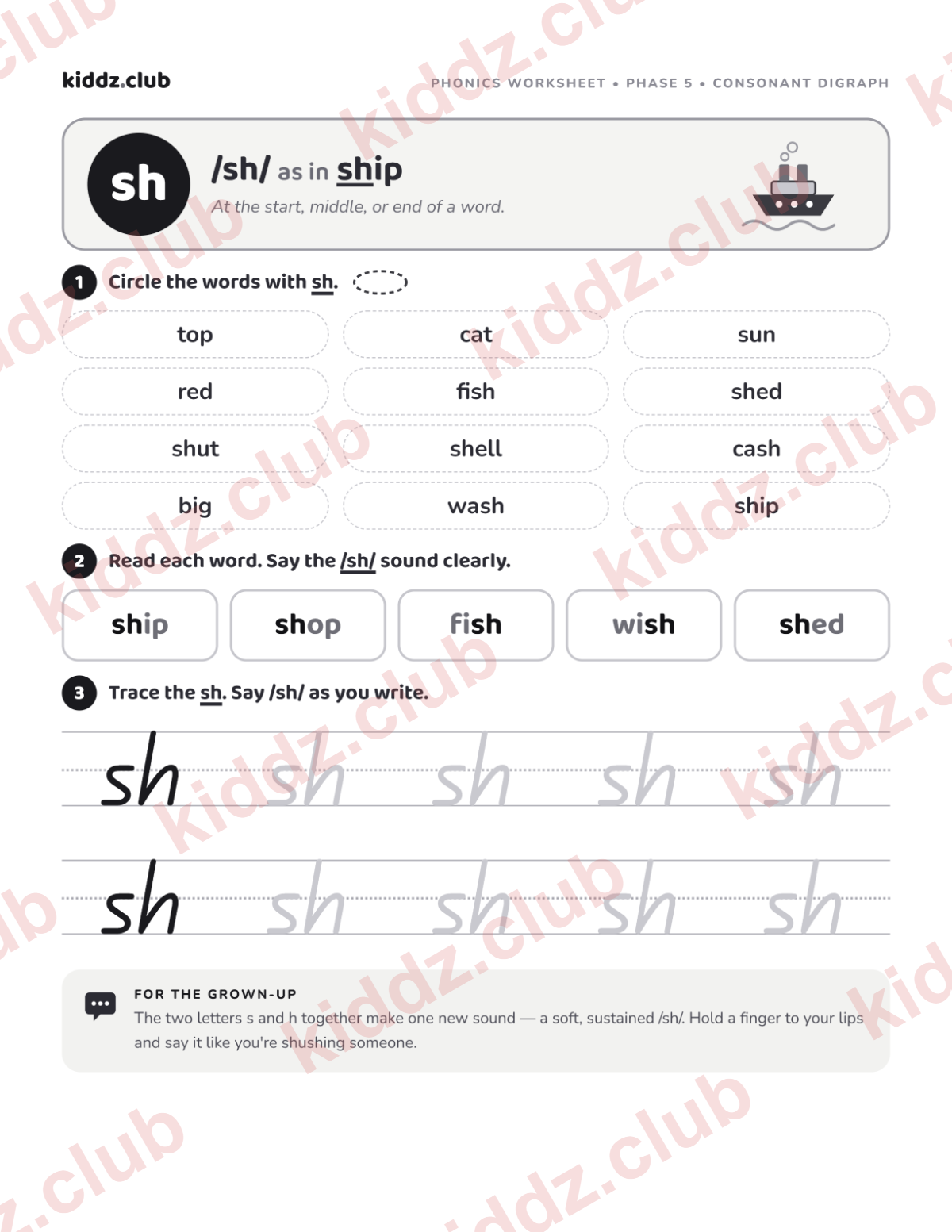
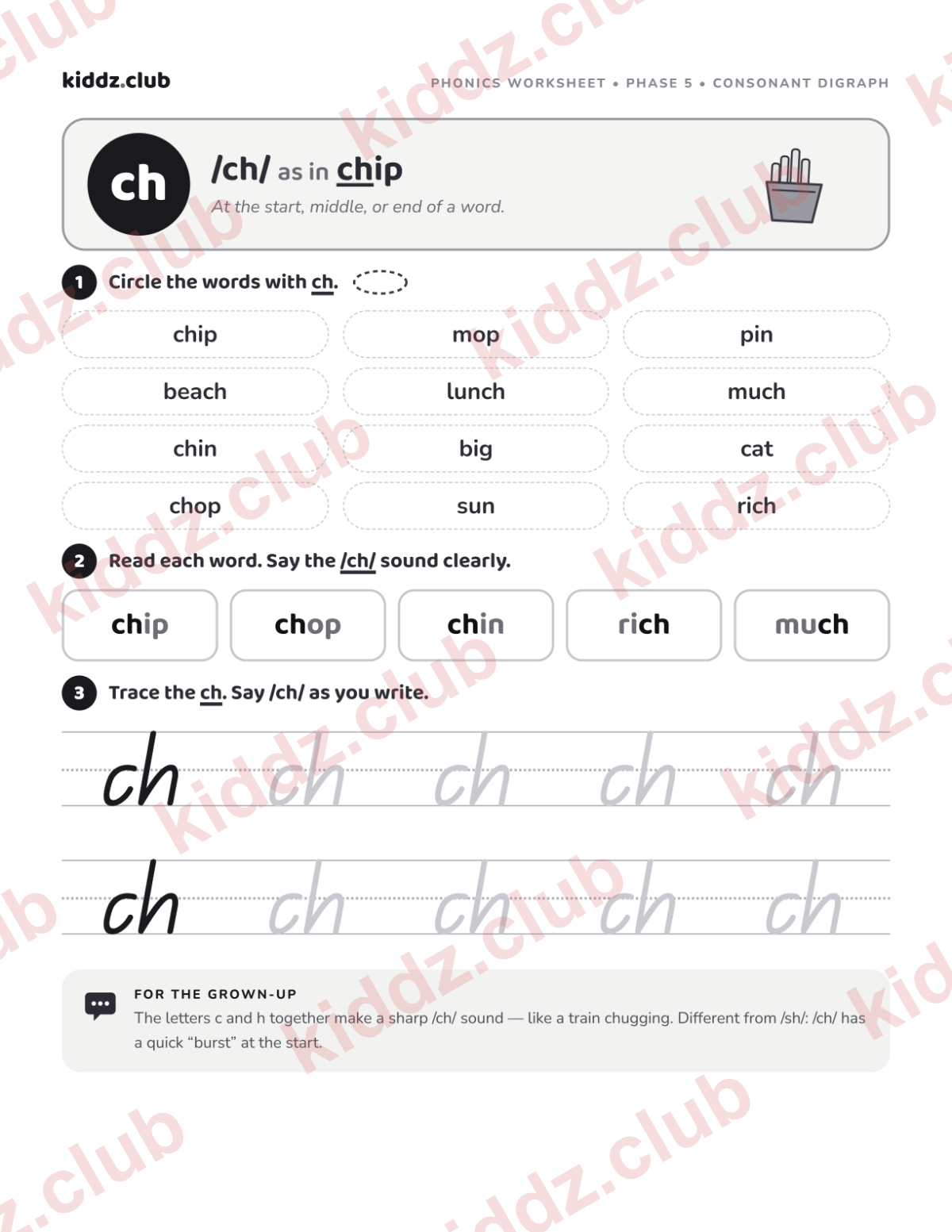
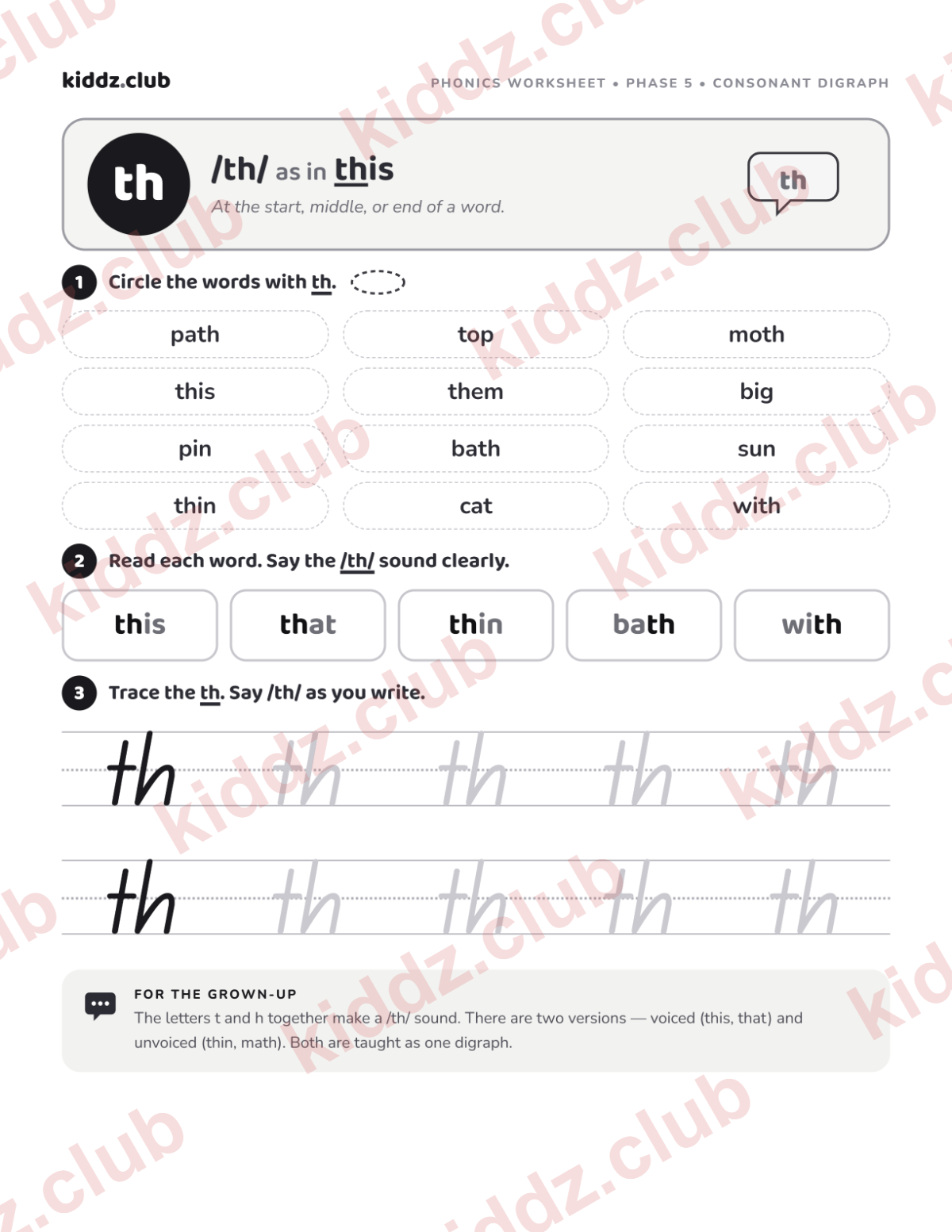
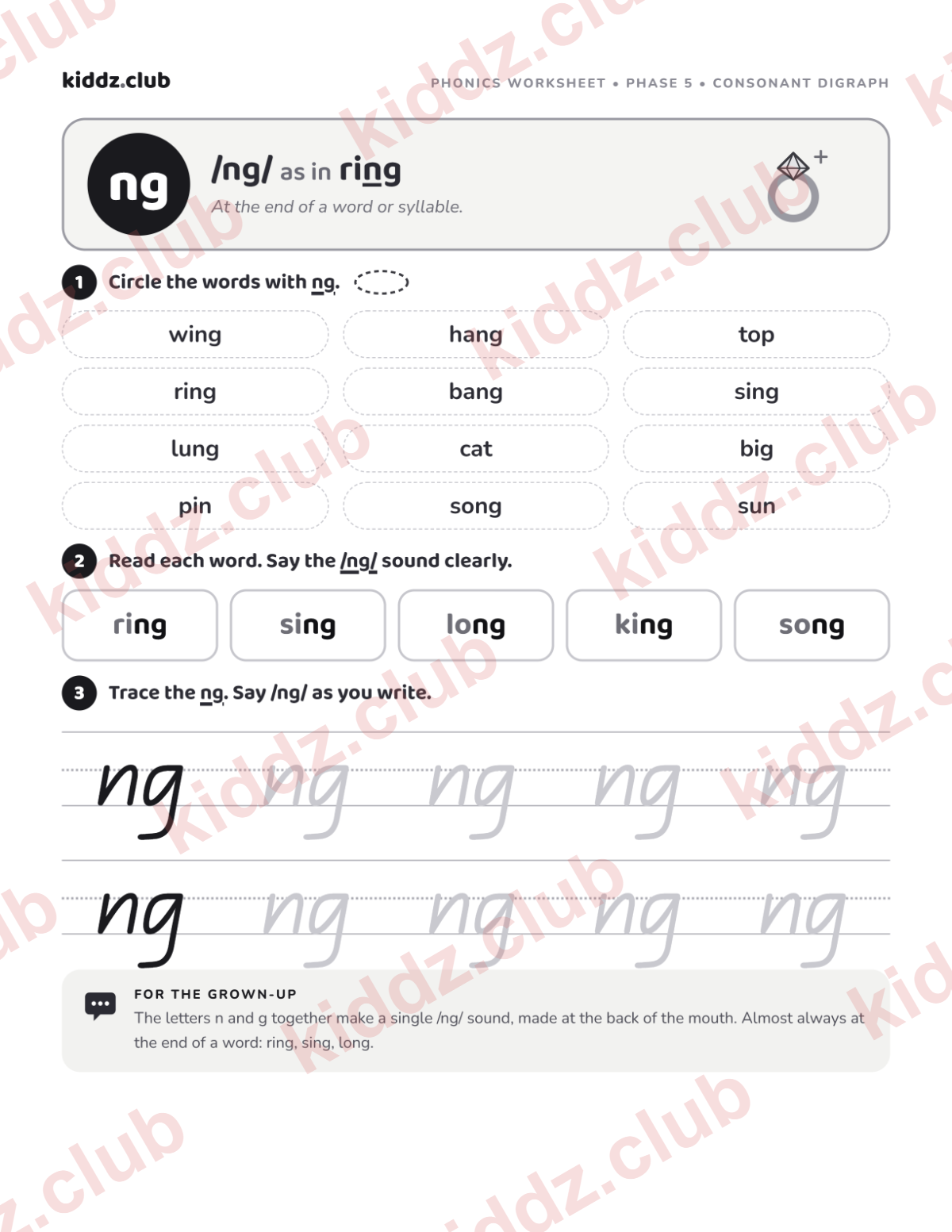
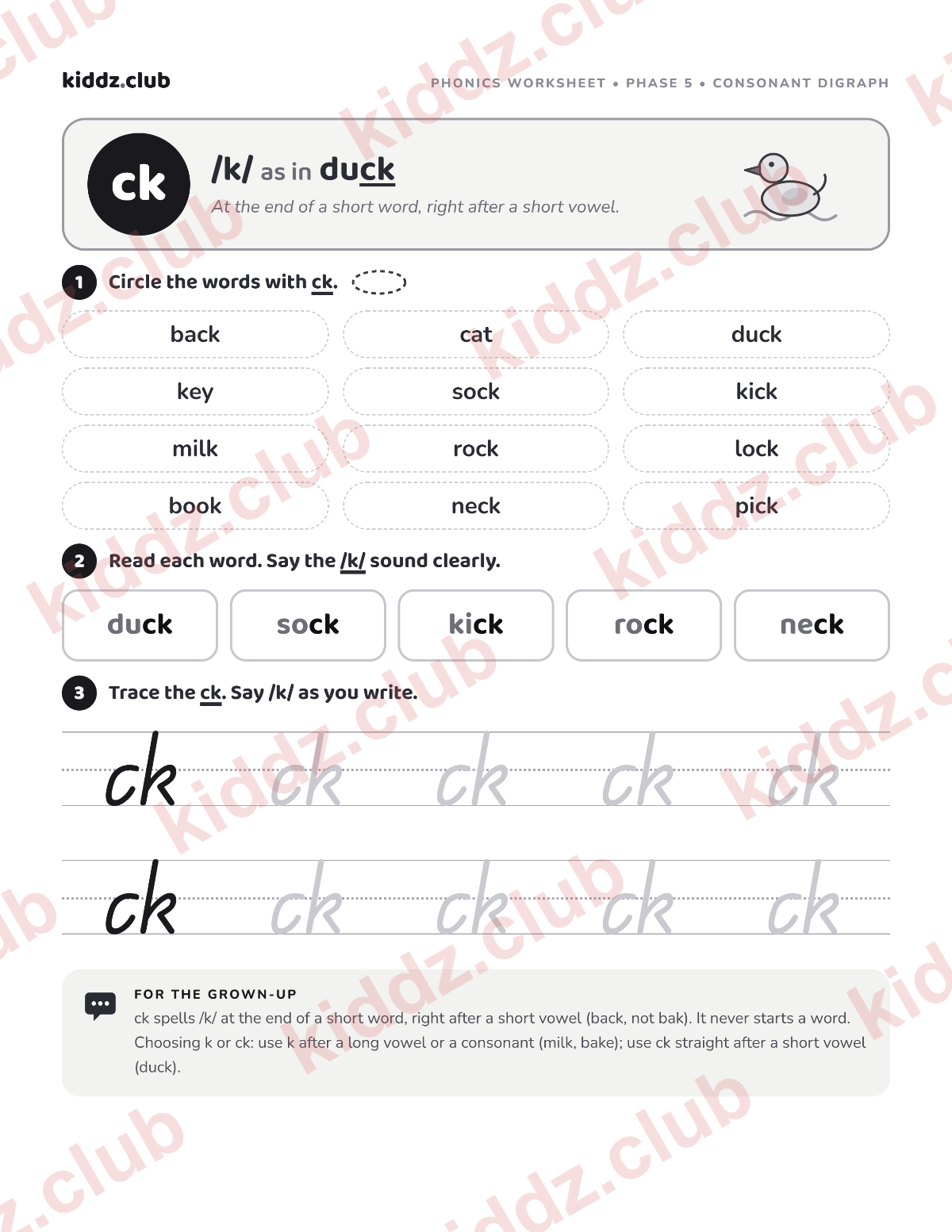
Five free printable phonics worksheets covering the four core English consonant digraphs sh, ch, th, ng — plus the ck spelling of /k/. Each is a single page focused on one pattern, with three activities — find-and-circle, read aloud, and tracing.
These are essential Phase 5 sounds. Every kindergartner and Year 1 reader needs to recognize these five patterns to read fluently.
What's a consonant digraph?
A consonant digraph is two consonants that together make one new sound — not the two letters' individual sounds. The sh in ship isn't /s/ + /h/, it's a completely new sound: /sh/.
This is different from a consonant blend (st, bl, fr), where both letters' sounds are heard. Stop still has /s/ and /t/. Ship doesn't have /s/ and /h/ — it has /sh/.
Kids often mix these up at first. The teaching key: digraphs need to be memorized as a new sound. Don't try to blend a digraph — it's not two sounds, it's one.
The 5 digraph worksheets
Each worksheet below has its own dedicated page with full teaching notes and a download.
How to teach consonant digraphs
Consonant digraphs are typically taught in Year 1 / 1st Grade, after the alphabet's basic sounds are solid. A reasonable order:
- sh first. It's the easiest — kids already know the shushing gesture.
- ch second. Pair with sh to highlight the difference (one stops, one flows).
- th third. Acknowledge that th has two slightly different sounds, but treat them as one digraph.
- ng last. Comes at the end of words rather than the start, so it's an "end-of-word" exercise.
For each, the teaching technique is: show, say, find. Show the letters together. Say the sound. Find words that contain it. Repeat over a week. Each digraph usually takes 3–5 days to solidify.
When to use these worksheets
Use these worksheets if:
- Your child can read CVC words (cat, sun, big) confidently
- They've learned individual letter sounds
- They're meeting words with digraphs in their reading
- They're 5–7 years old
Skip these worksheets if:
- Your child is still learning individual letter sounds — start with the Magic 7 set
- Your child reads multi-syllable words confidently — move to long vowel work
Related resources
Part of the free phonics worksheets library — the Phase 5 collection. Also part of the 1st grade phonics pathway →
Companion materials:
- Phonics blends worksheets — the consonant blends collection
- Long vowel phonics worksheets — vowel digraphs and trigraphs
- R-controlled vowel worksheets
Earlier-stage materials:
For parents:
Common questions
What's the difference between a blend and a digraph?
A blend is two letters where you hear both sounds (stop, frog, blue). A digraph is two letters that make one new sound (ship, chip, thin). Don't try to blend a digraph — it's not two sounds, it's one.
My child reads "ship" as "sip" — what's happening?
They're missing the digraph. They've correctly read /s/ /i/ /p/ but ignored the h. Help them see the sh as one unit: cover the rest of the word with your finger, point at sh, say /sh/. Then reveal the rest: sh-ip.
Are these worksheets really free?
Yes. Free for personal, classroom, and tutor use. Print as many copies as you like.
Why isn't "wh" included?
wh used to be a clear digraph (whale, when, where) but in most modern American and British speech, wh sounds identical to /w/. It's still taught in some programs but it's no longer phonetically distinct for most learners. We may add it later if there's demand.
Ready for More Than Worksheets?
Picture This! teaches visualization step-by-step so children can genuinely understand—and enjoy—what they read.