
Initial consonant blend worksheets — 20 free printables
Twenty free printable phonics worksheets for initial consonant blends — the blends that appear at the start of words. Each sheet is three pages focused on one blend, with six activities that build from circling and tracing to sentence work — and finish with a full-page blend maze the child walks from START to FINISH, stepping only on words with the blend.
This collection covers the three main families of initial blends: L-blends (bl, cl, fl, gl, pl, sl), R-blends (br, cr, dr, fr, gr, pr, tr), and S-blends (sc, sk, sm, sn, sp, st, sw).
For the final blends (the blends at the end of words: -nd, -nk, -mp), see Final consonant blend worksheets.
For an overview of all 30 blends (initial + final), see Phonics blends worksheets.
What's an initial blend?
An initial consonant blend is two consonants at the start of a word where you can hear both sounds. Stop starts with /s/ and /t/ blended fast. Frog starts with /f/ and /r/.
This is different from a consonant digraph (sh, ch, th, ng) where two letters make one new sound. The /st/ in stop keeps both sounds; the /sh/ in ship is a new sound altogether.
The 20 worksheets
Every sheet below is a free three-page PDF. Click a thumbnail to preview page 1, or the title to download.
L-blends (6 sheets) — second letter is l
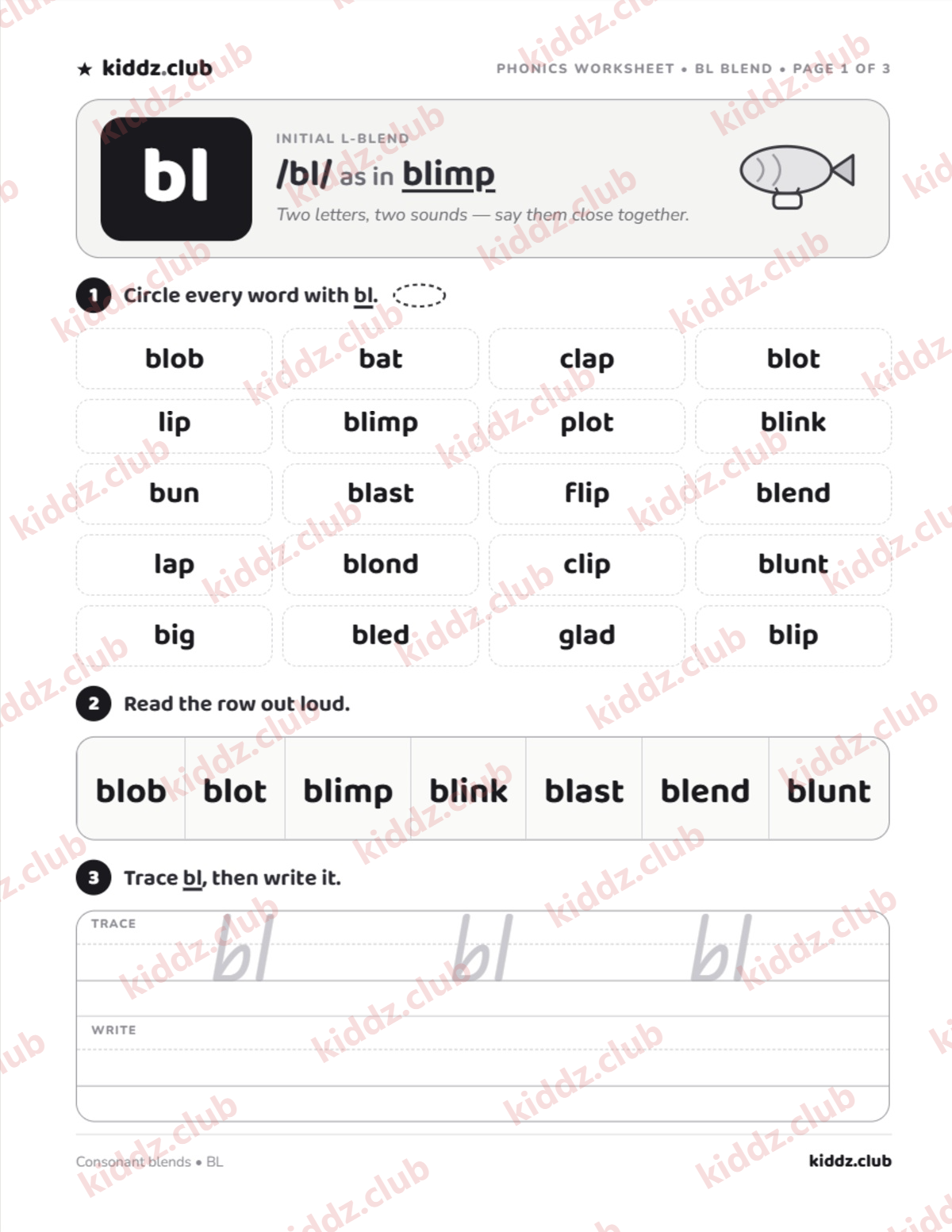
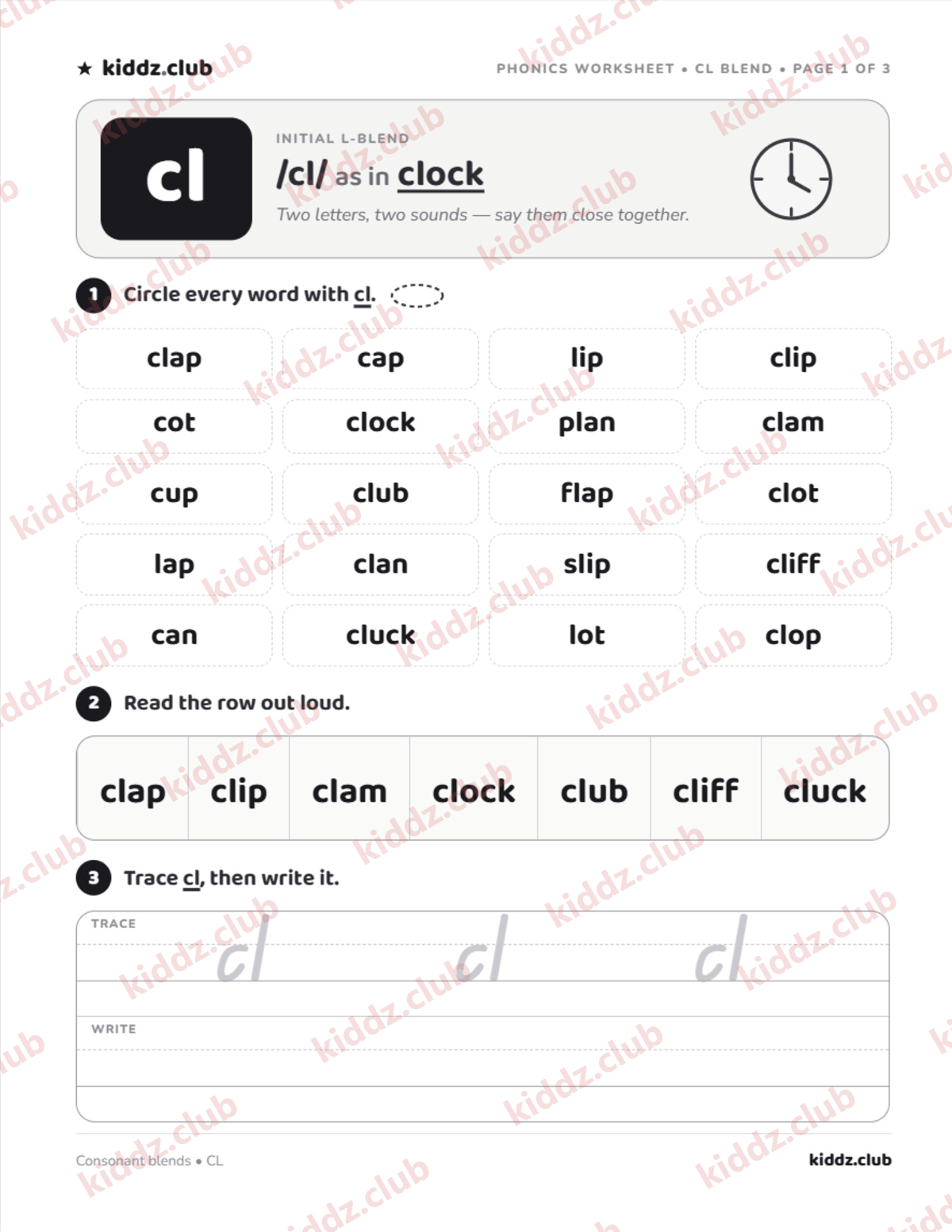
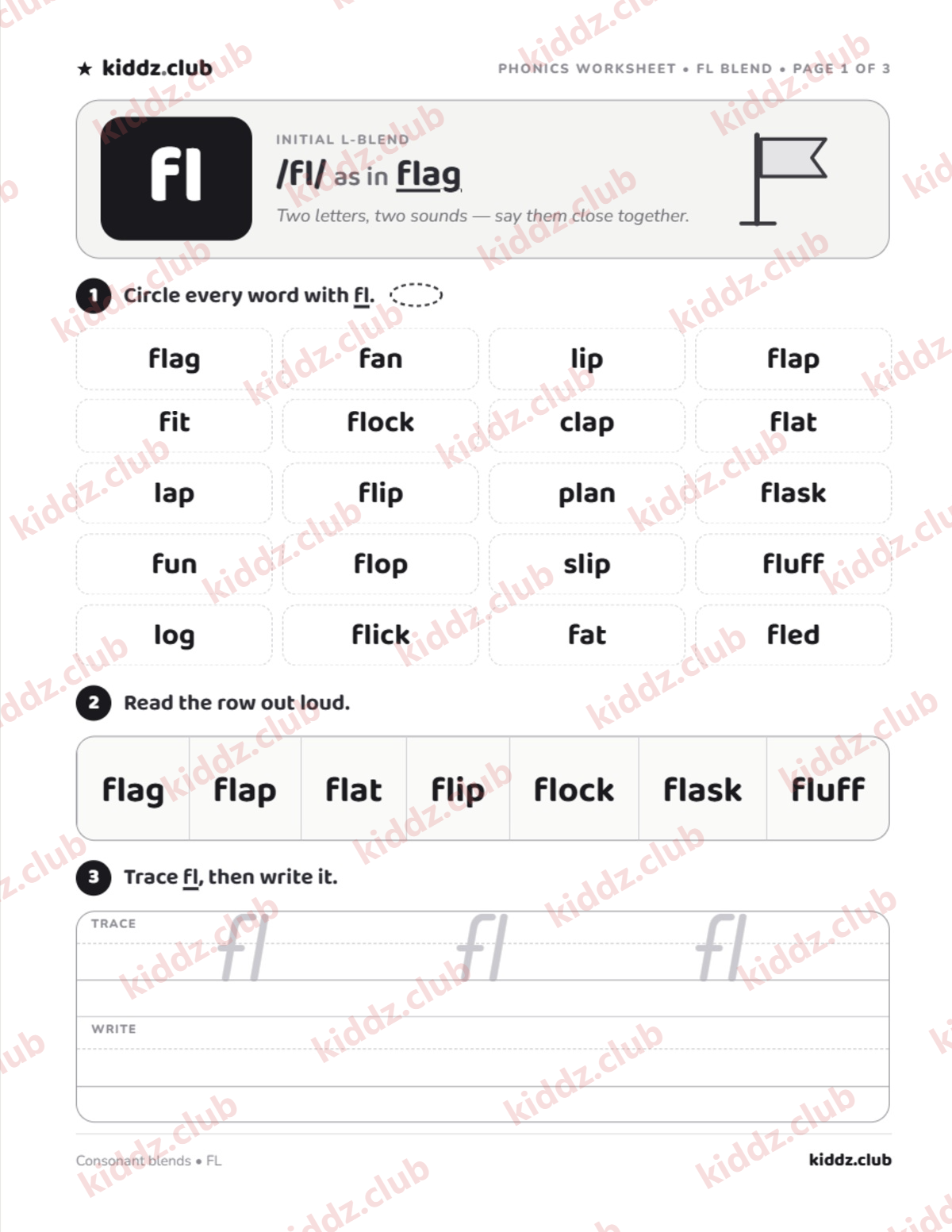
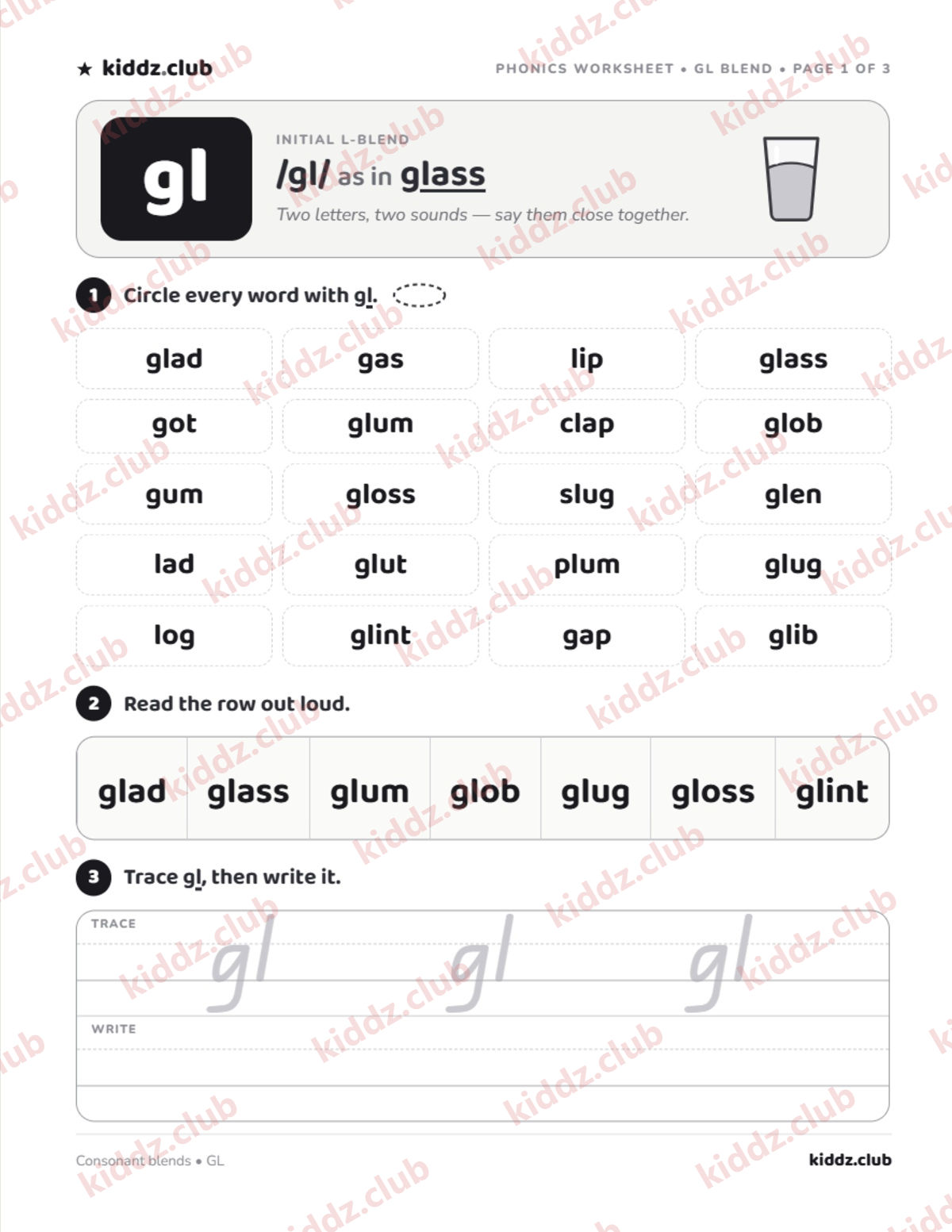
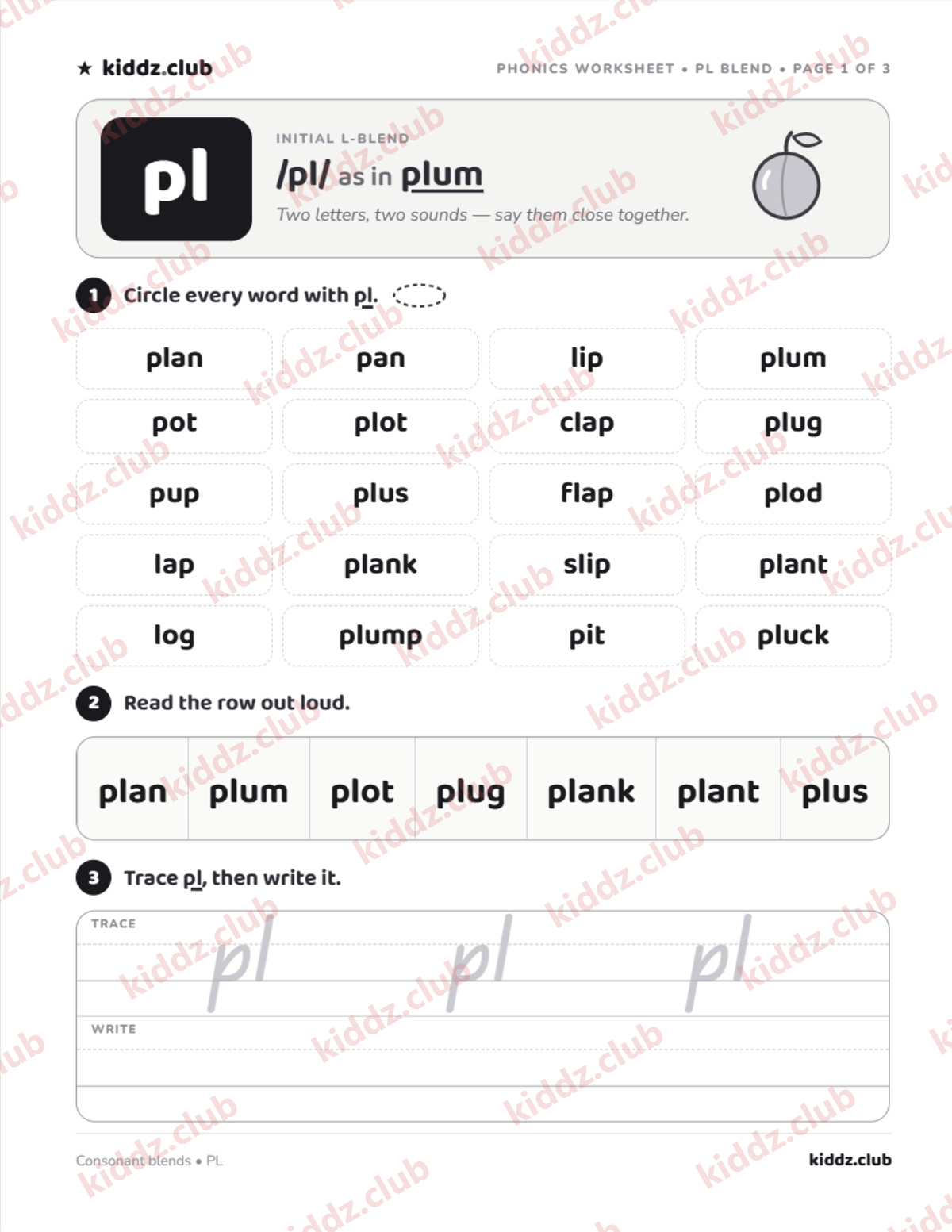
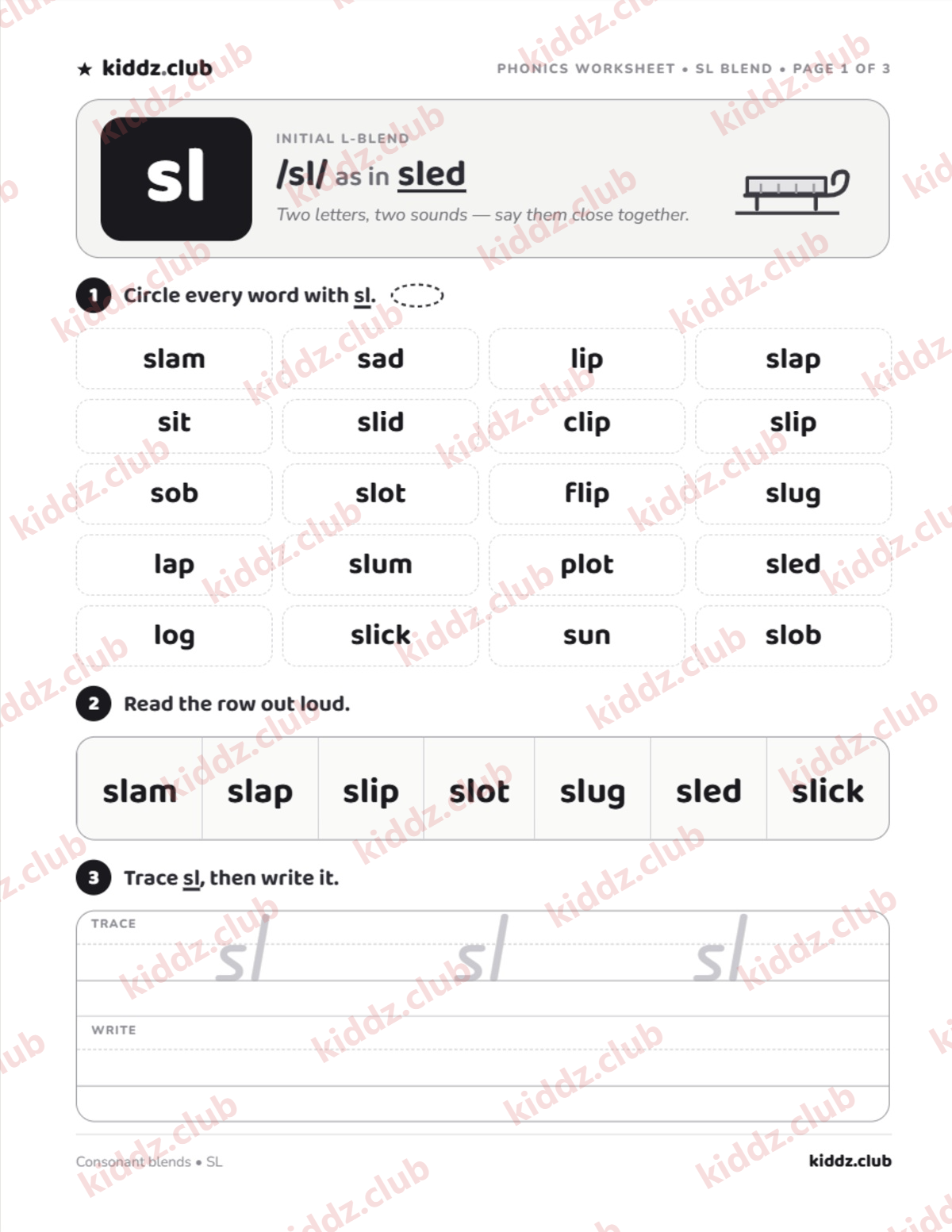
R-blends (7 sheets) — second letter is r
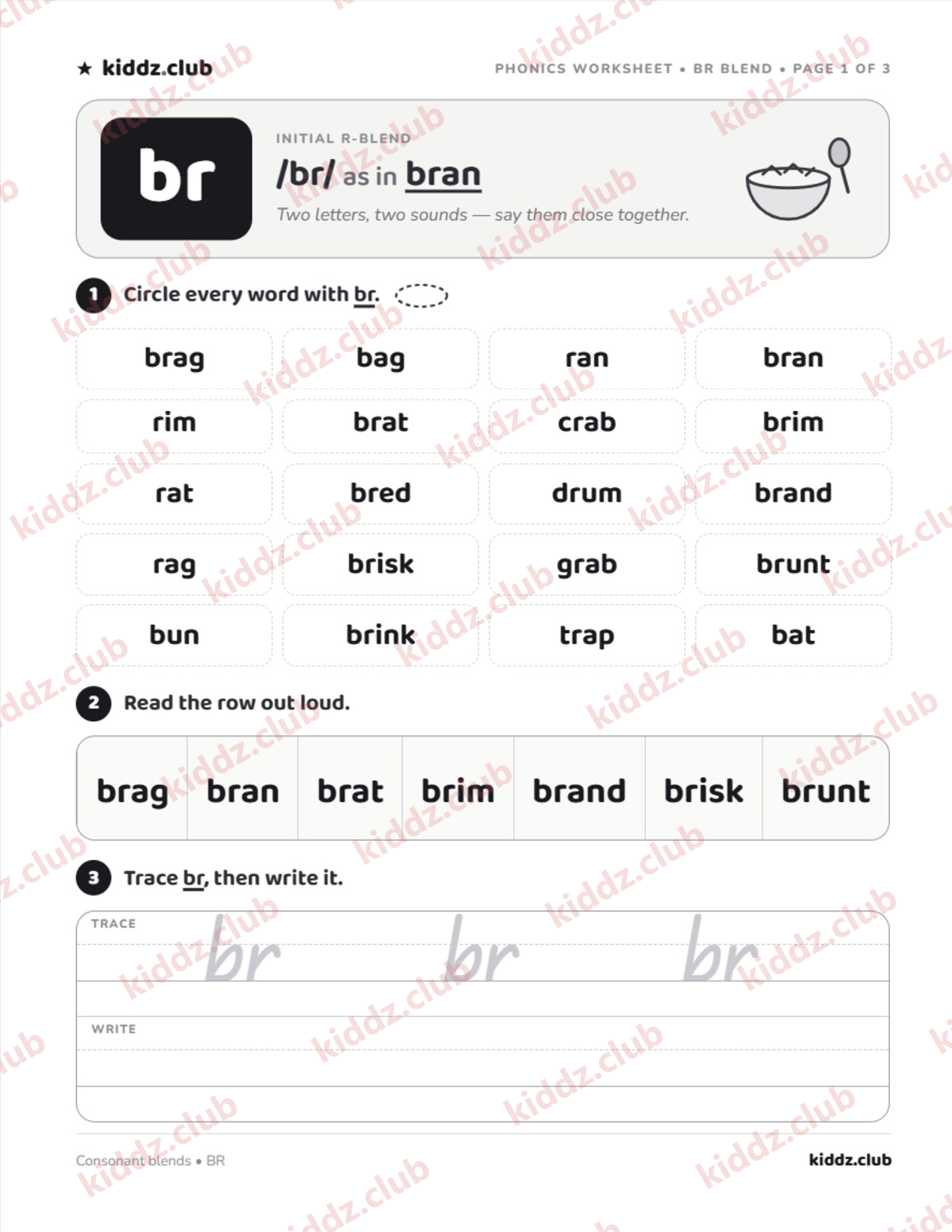
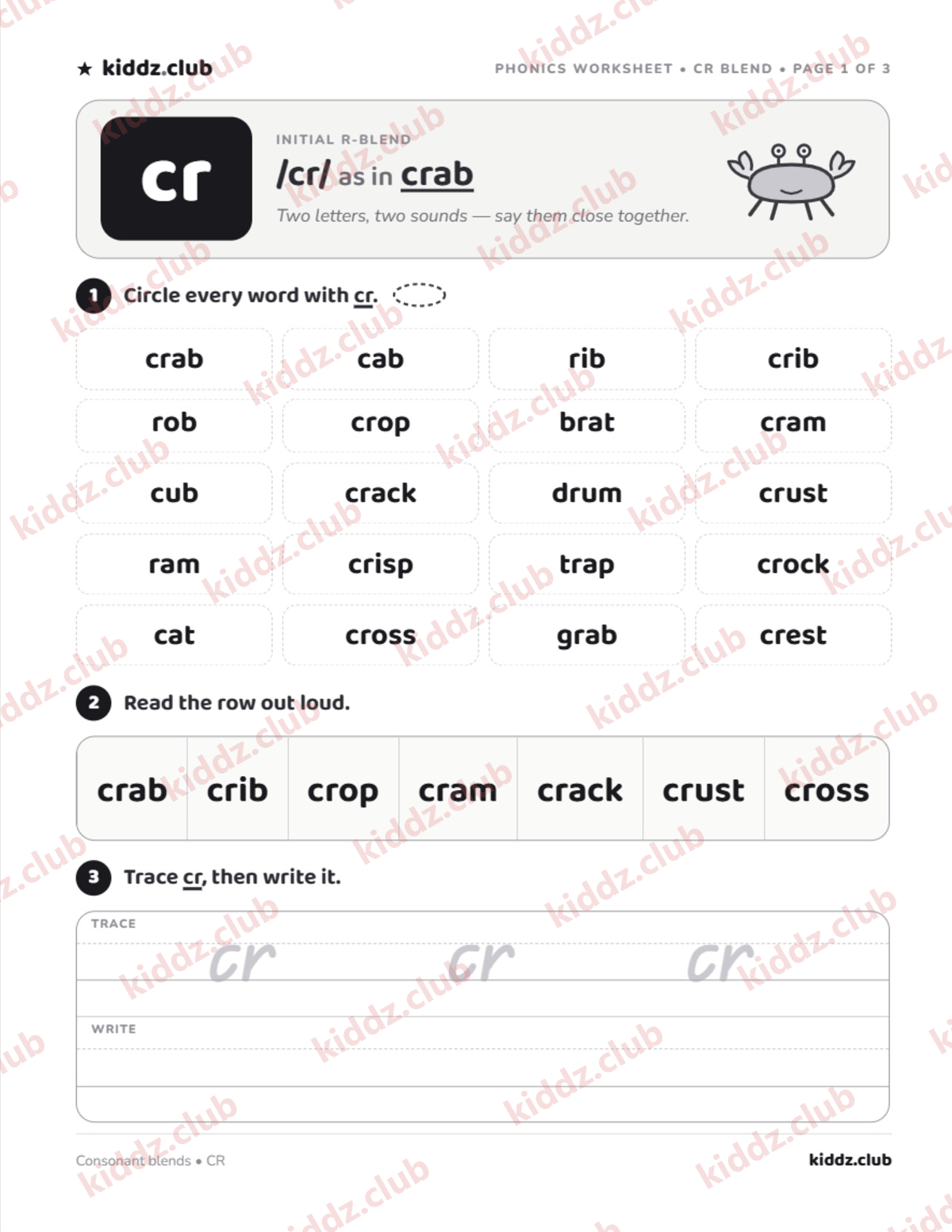
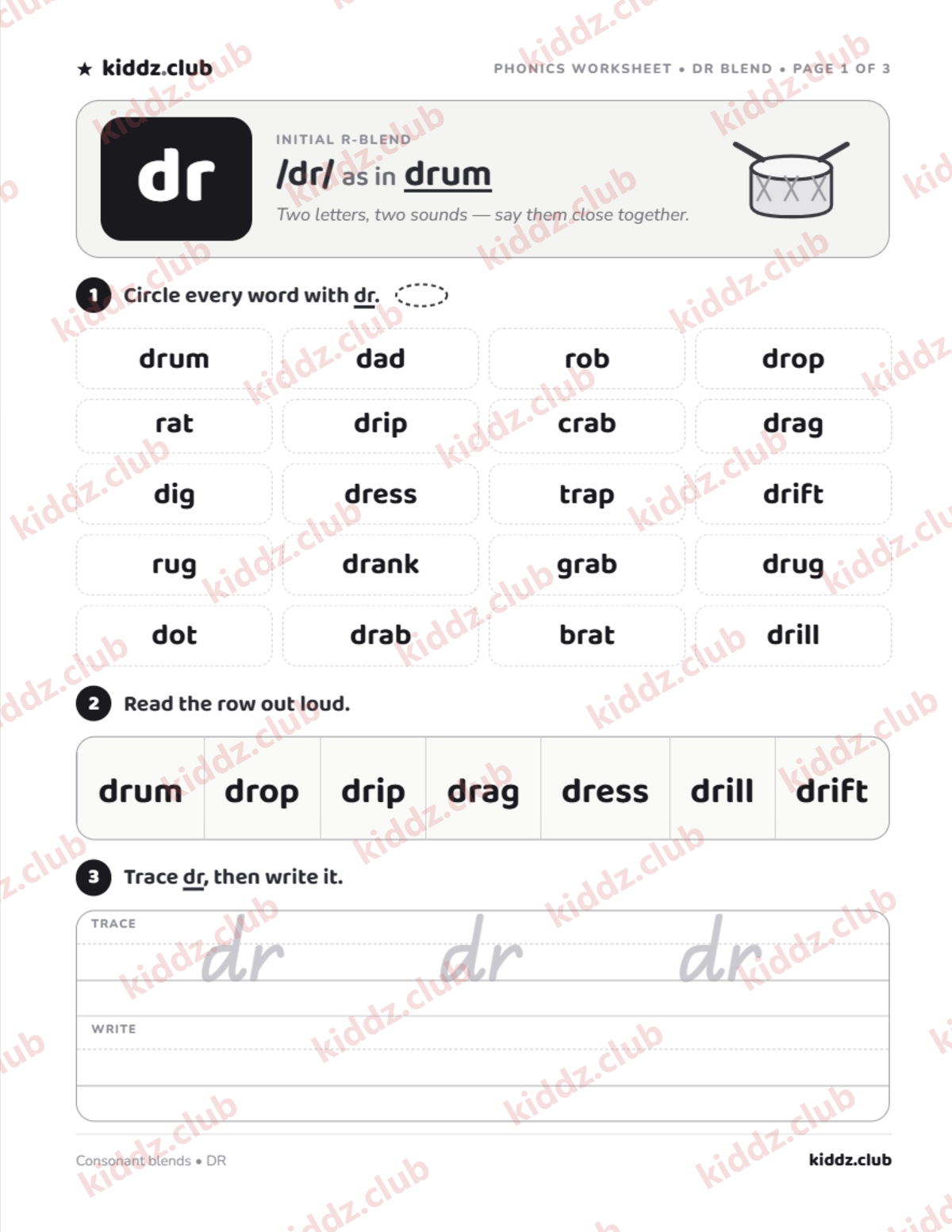
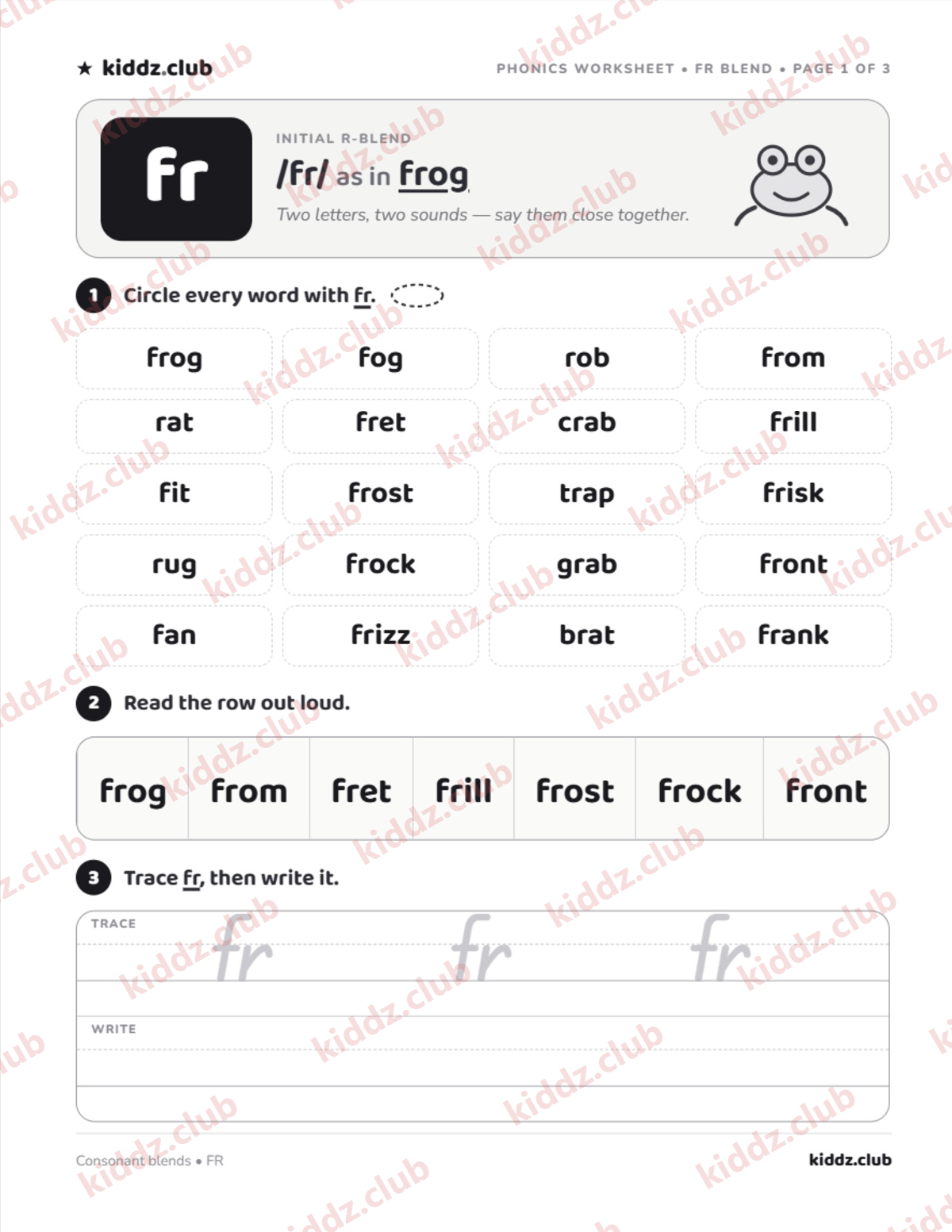
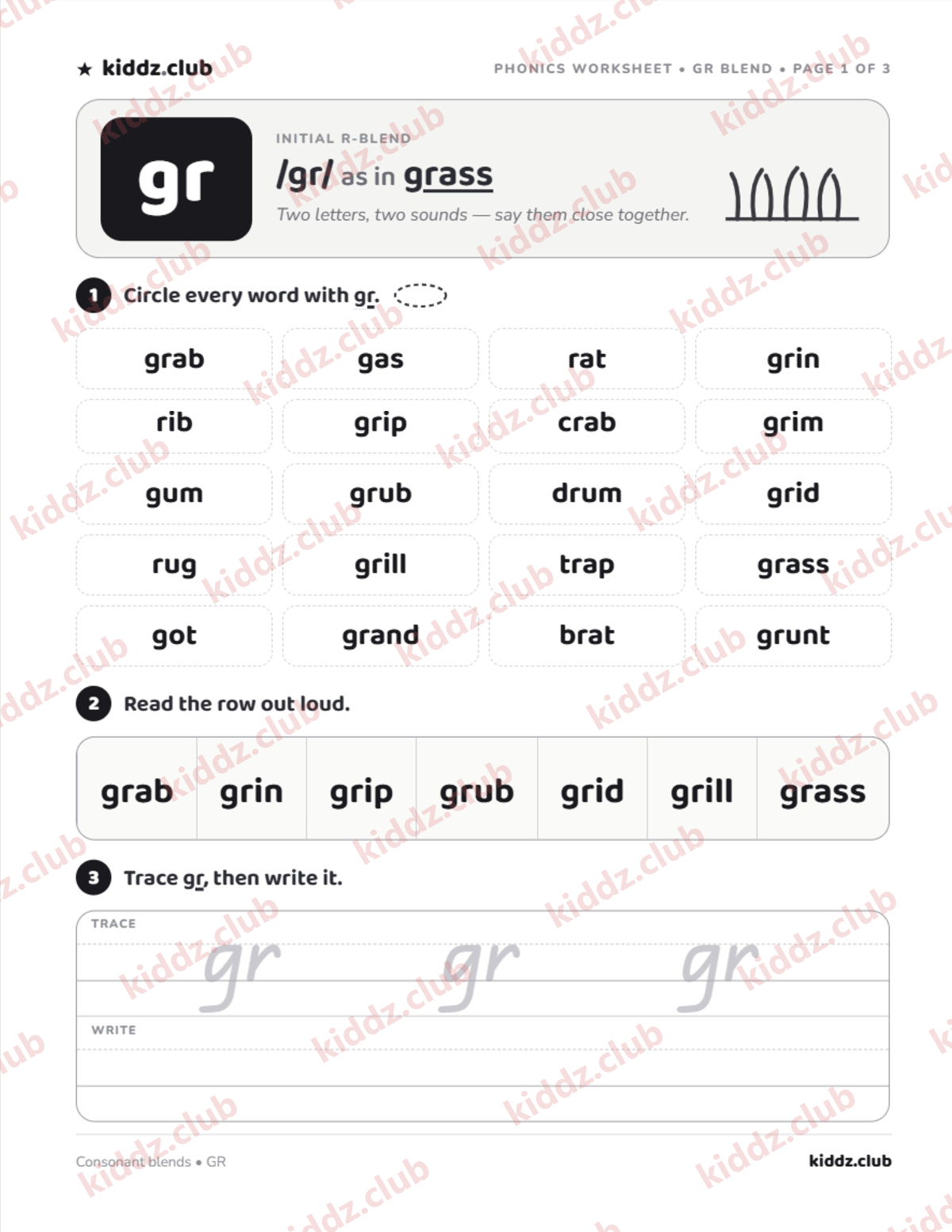
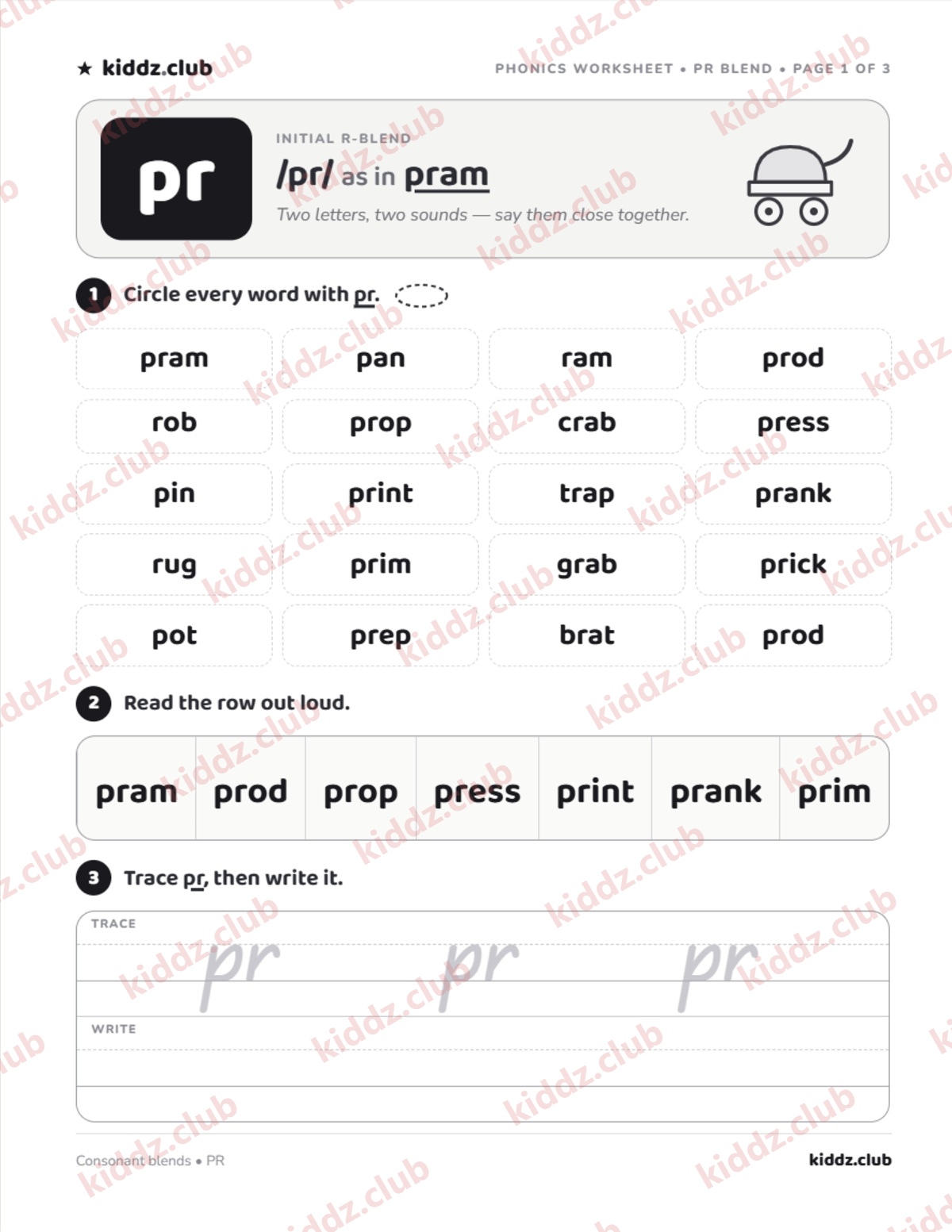
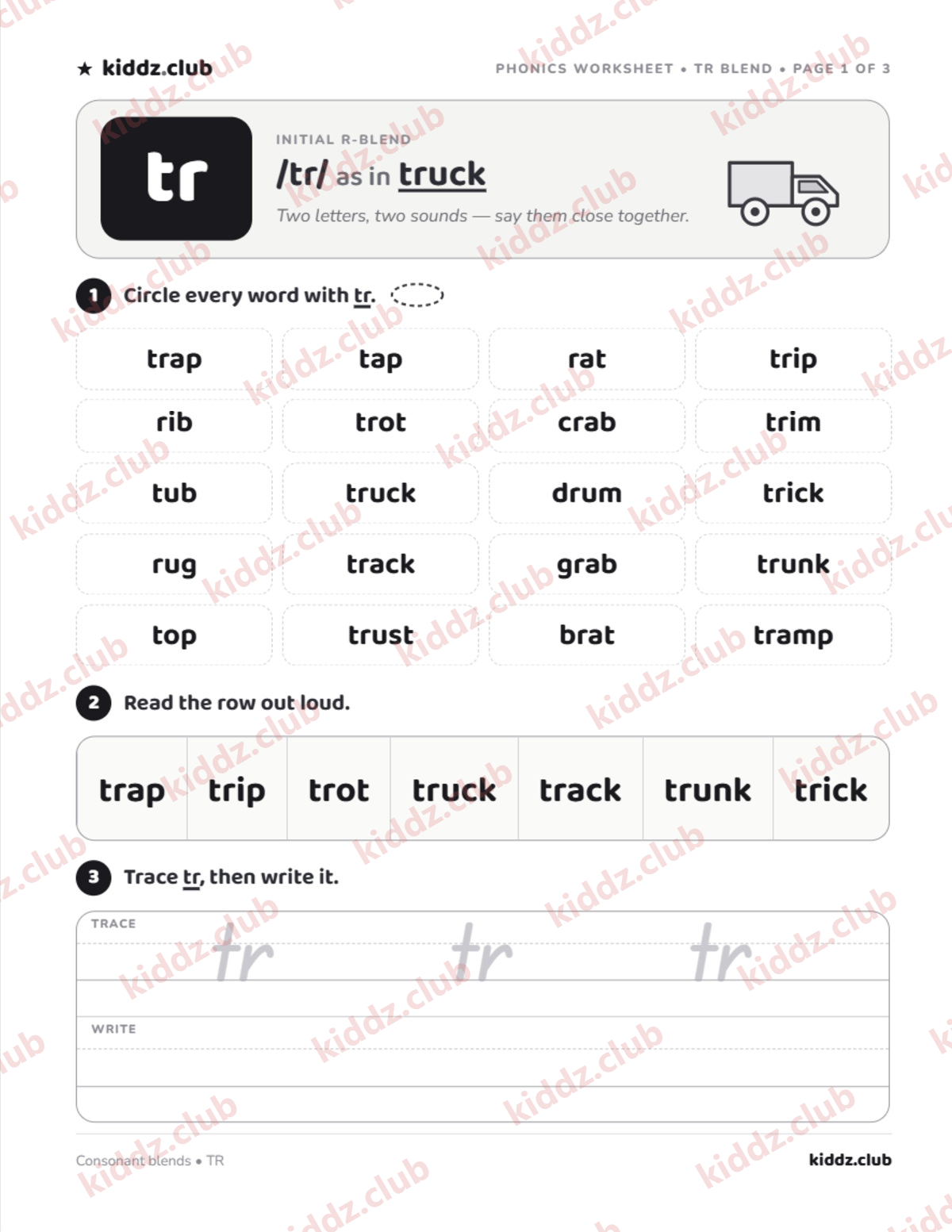
S-blends (7 sheets) — first letter is s
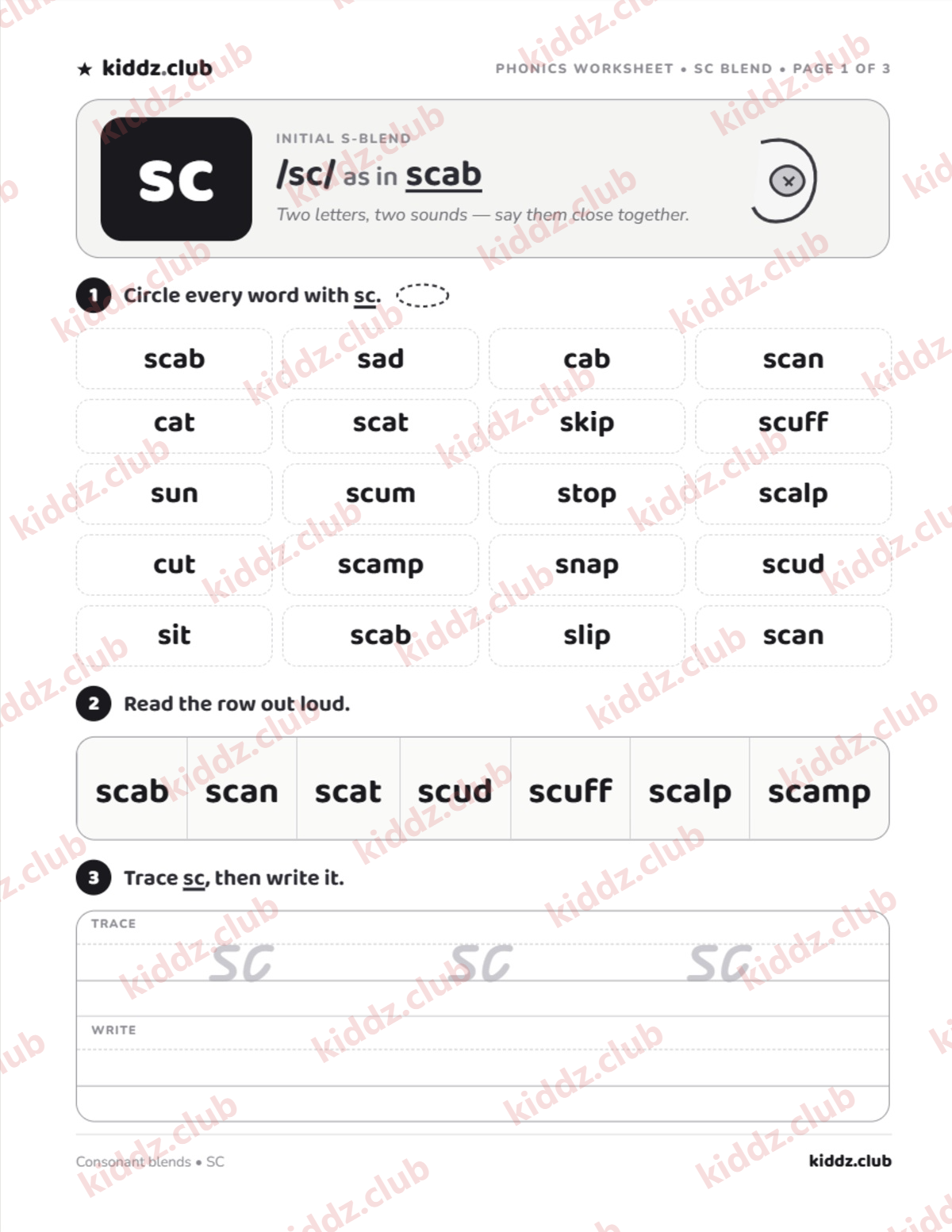
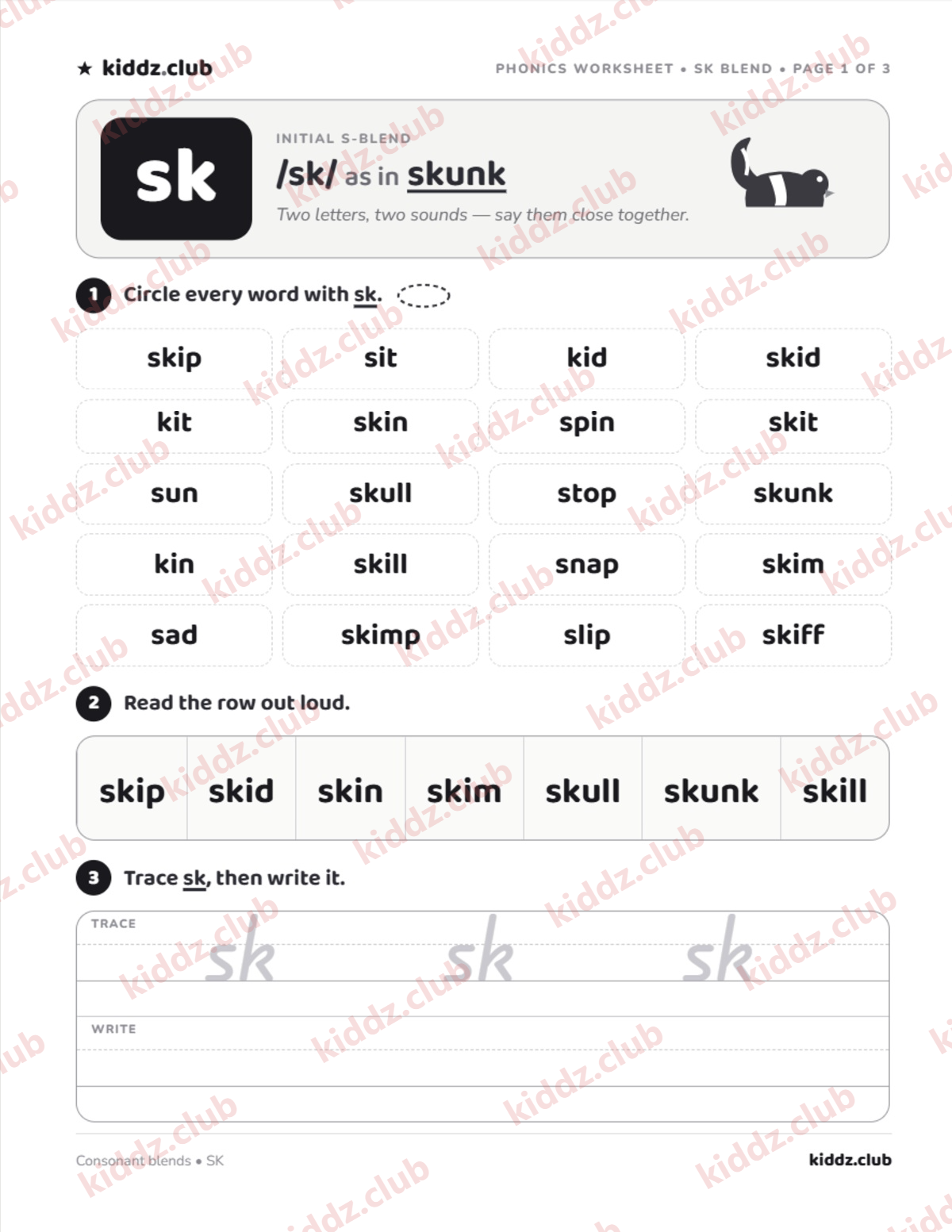
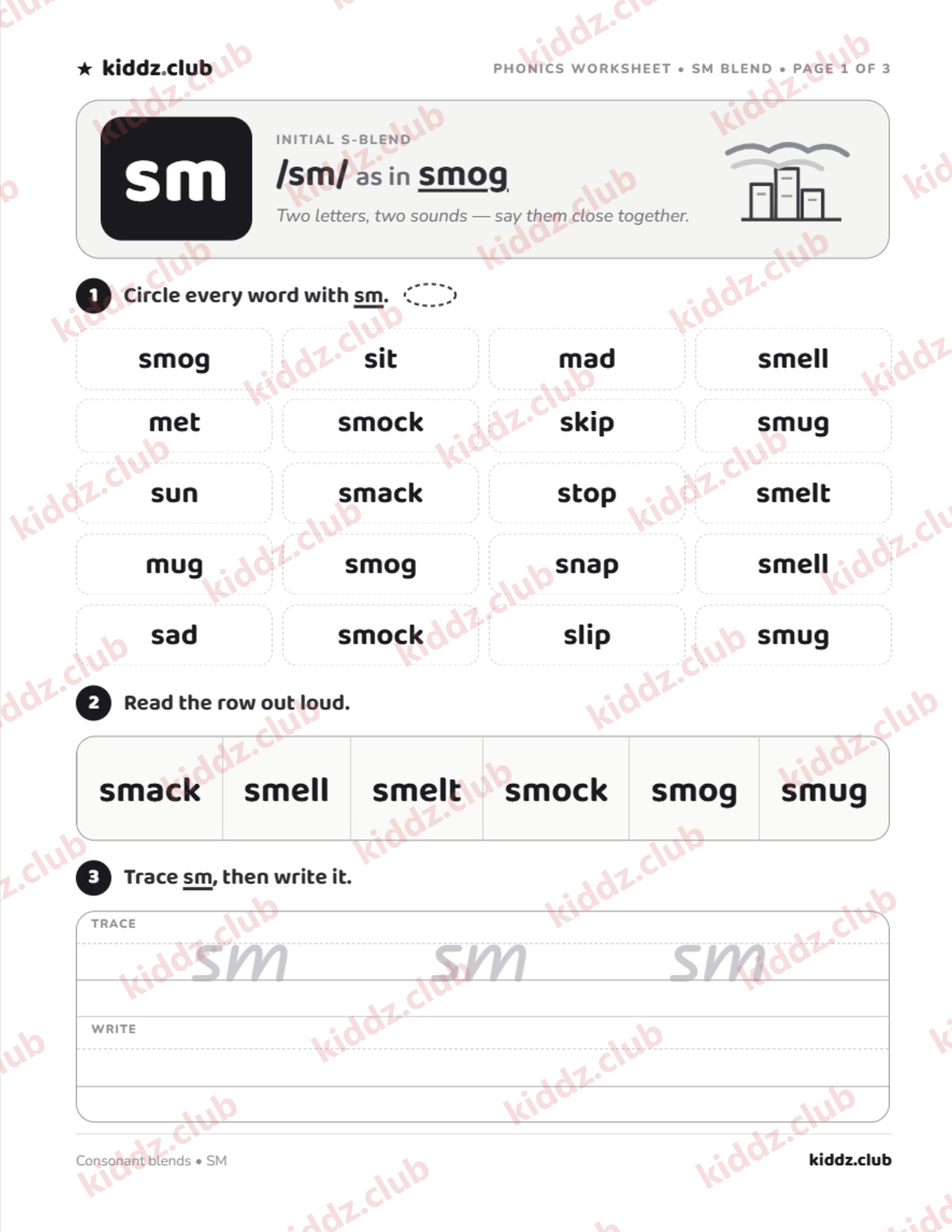
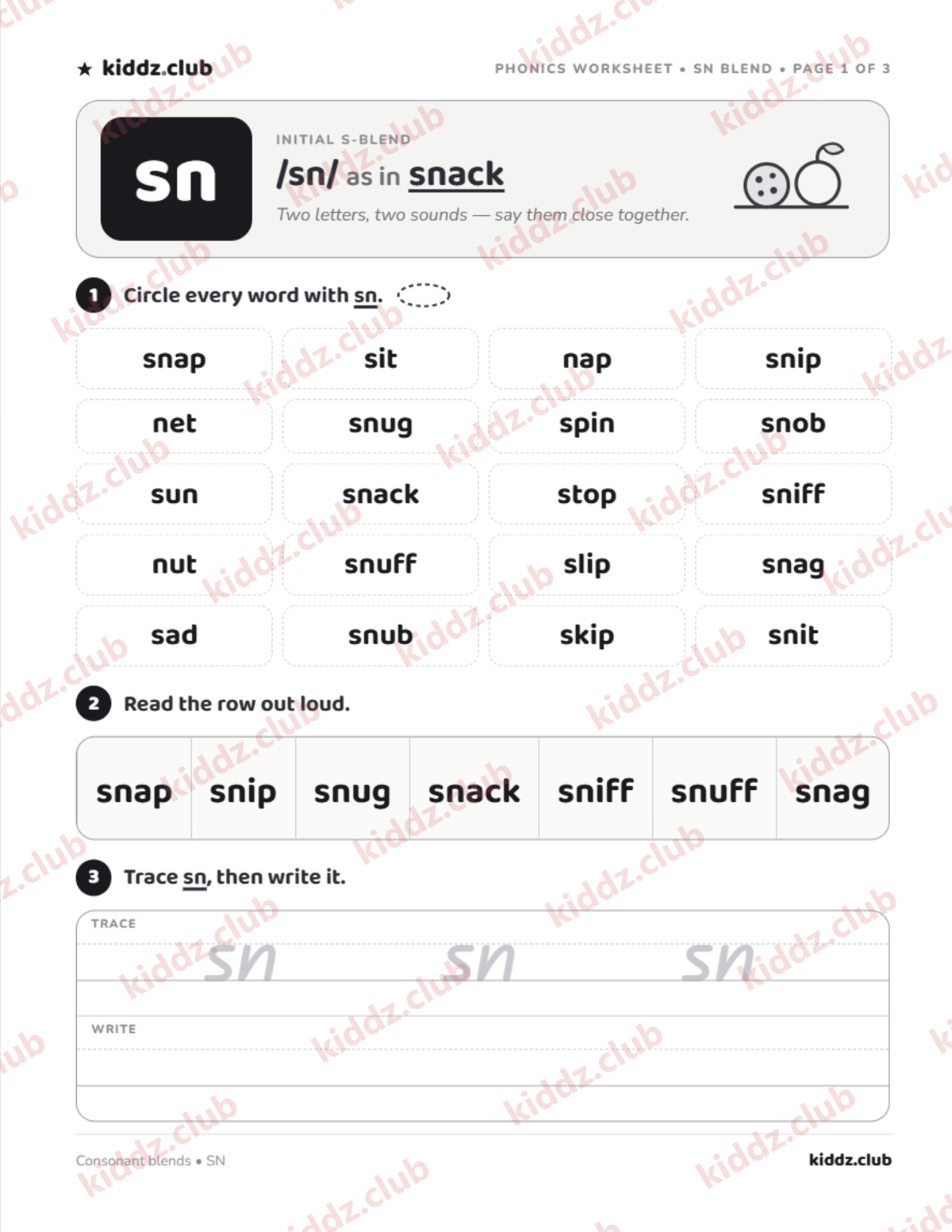
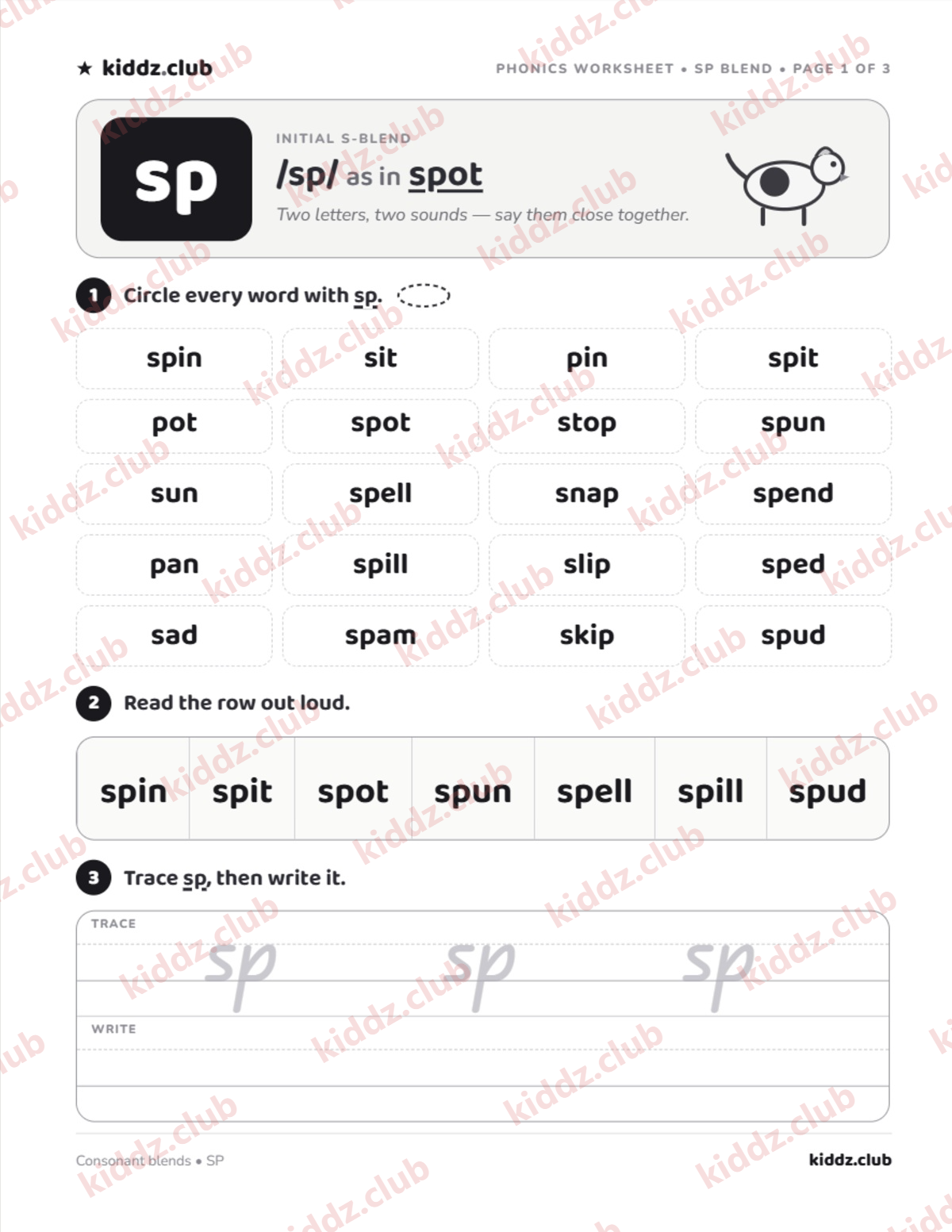
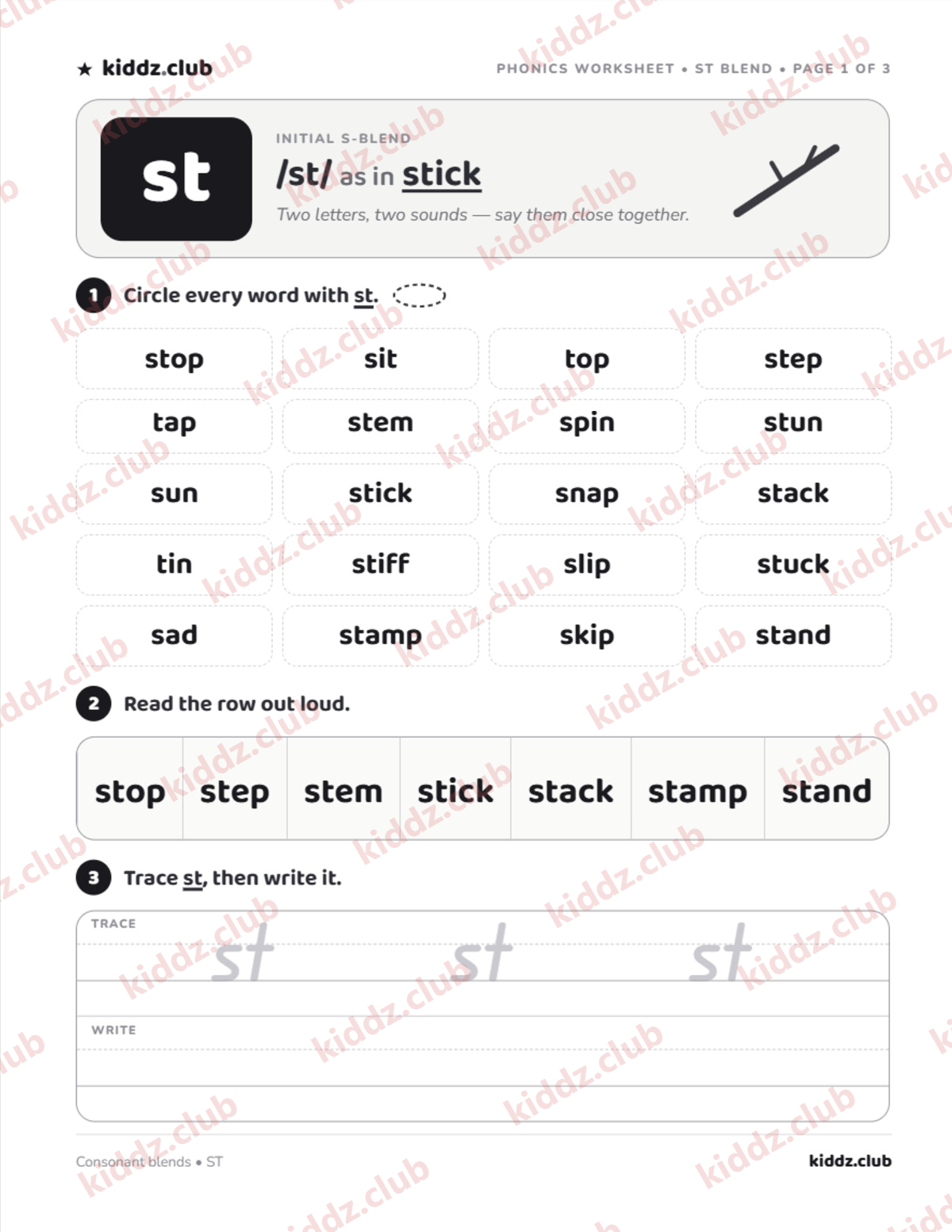
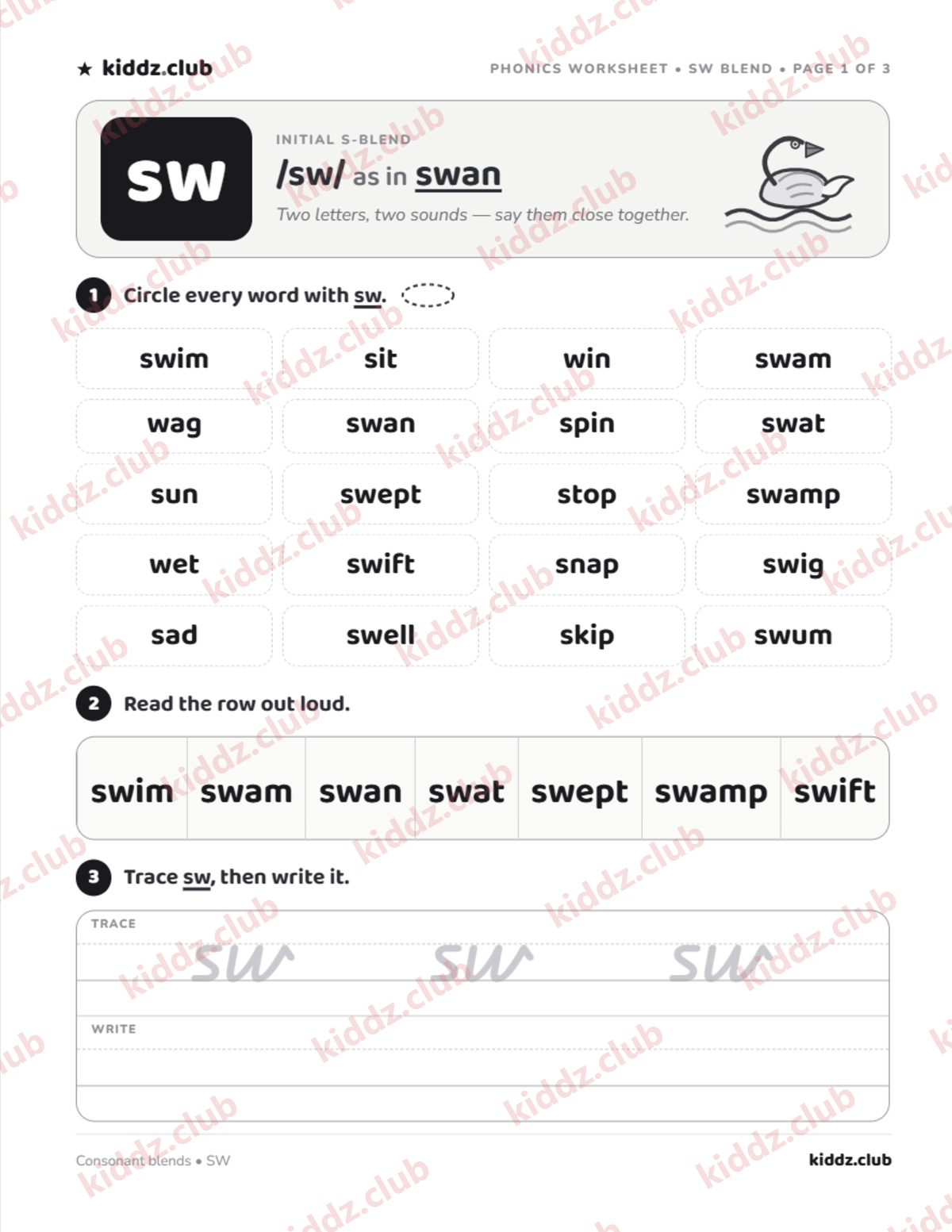
What's on each worksheet
Every initial blend worksheet runs three pages with the same six activities:
Activity 1 — Circle the blend words. A grid of twenty words; the child circles every word that starts with the blend and skips the near-misses.
Activity 2 — Fluency row. Seven blend words in a row, read out loud.
Activity 3 — Trace and write. Trace the blend, then write it from scratch on the line below.
Activity 4 — Word-to-picture match. Draw a line from each blend word to its picture.
Activity 5 — Sentence completion. Write the missing blend word into four sentences, choosing from a small word bank.
Activity 6 — The blend maze. A full page of its own: walk from START to FINISH, stepping only on words that start with the blend and skipping every other word.
How to teach initial blends
Most kindergarten and Year 1 programs teach blends after CVC words are solid. A reasonable order:
- L-blends first. They're often the easiest because the /l/ sound is stretchy.
- R-blends next. Many kids develop the /r/ sound late, so don't push if your child says "wabbit" instead of "rabbit" — that's speech, not phonics.
- S-blends last. Including the everyday workhorses like st (stop, stick) and sp (spin, spot).
The teaching technique: stretch then merge. fff-rrr-og... fff-rrr-og... frog. Slow at first, then faster, until the two sounds merge into one blend.
For overall context on blends, see Phonics blends worksheets.
When to use these worksheets
Use these worksheets if:
- Your child reads CVC words (cat, sun, big) confidently
- They've met some blends in their reading
- They're 5-7 years old
Skip these worksheets if:
- Your child is still learning individual letter sounds — start with the Magic 7 set
- They read multi-syllable words easily — move on to Phase 5 work
Related resources
Part of the free phonics worksheets library.
Companion materials:
- Final consonant blend worksheets — the blends at the END of words
- Phonics blends worksheets — overview of all 30 blends
- Ready for digraphs? Consonant digraph phonics worksheets — sh, ch, th, ng, and ck
Earlier stage:
Common questions
What's the difference between an initial and a final blend?
An initial blend is at the start of a word: stop, blue, frog. A final blend is at the end of a word: hand, lamp, nest. They use the same letters but appear in different positions — and are taught as separate skills. That's why st and sk each get two different sheets: one for each position.
What's the blend maze on page 3?
Page 3 of every sheet is a full-page word maze. The child starts at START and moves one square at a time — up, down, left, or right — stepping only on squares whose word starts with the sheet's blend, and skipping every other word. On the st sheet that means stepping on stop and stuck but never snap or slip. Telling the true blend from a near-miss is exactly the sound discrimination the rest of the sheet drills — the maze turns it into a game.
Does my child need all 20 sheets?
Probably not. Most kids generalize after working through a handful of each family group — a couple of L-blends, a couple of R-blends, a couple of S-blends. The full 20 is for systematic teaching, not survival.
Are these worksheets really free?
Yes. All 20 are free for personal, classroom, and tutor use.
Ready for More Than Worksheets?
Picture This! teaches visualization step-by-step so children can genuinely understand—and enjoy—what they read.