
Phonics games worksheets — free reading bingo
A free printable phonics bingo card with 25 short reading-related activities, each one a small phonics game your child can do in five minutes or less. Designed to live on the fridge for a month and turn daily reading practice into something a kid actually wants to do.
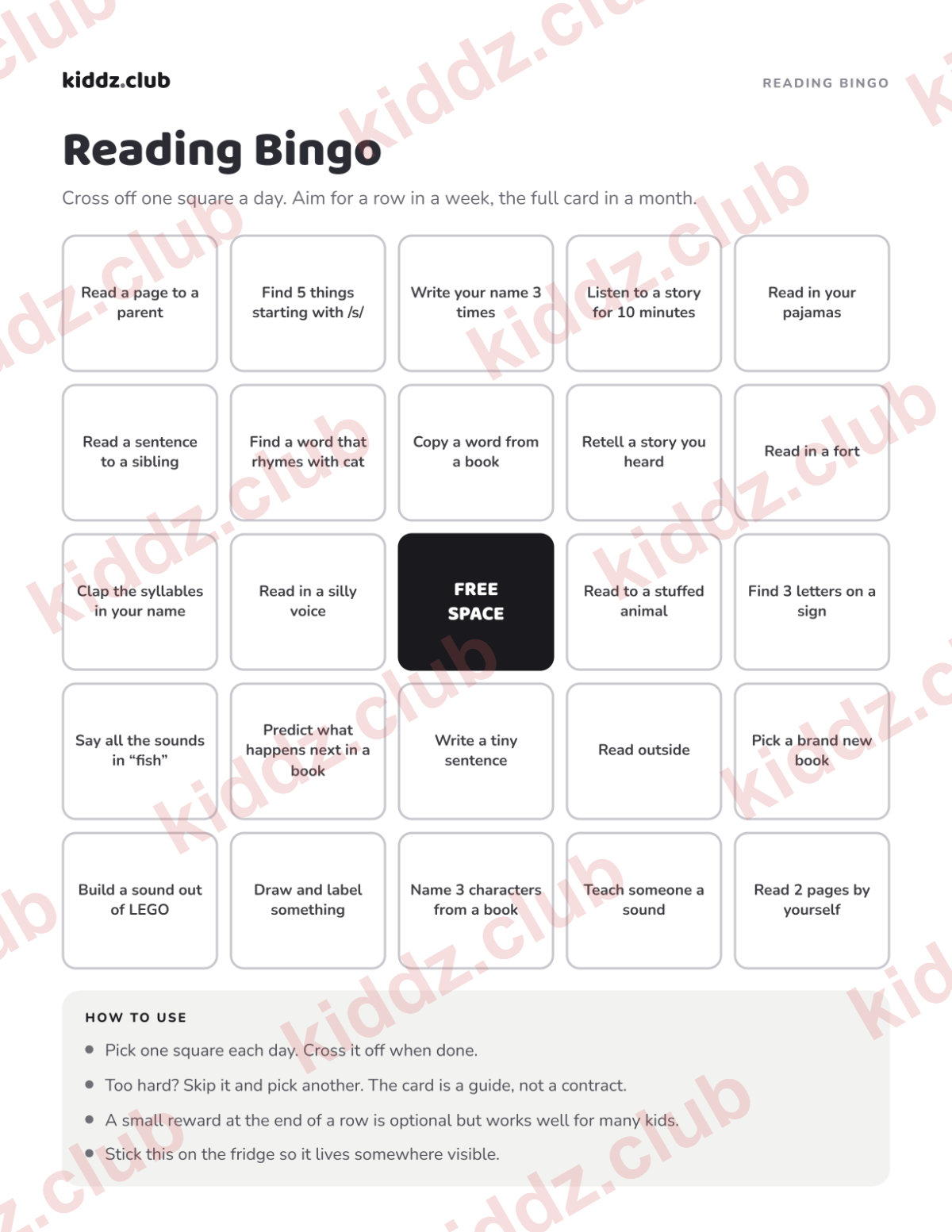
What's on the card
A 5×5 grid of 25 mini-activities, mixing phonics practice, oral language, fine motor, and just-for-fun reading-adjacent things. A few examples:
- Read a page of any book
- Find five things that start with /s/
- Write your name without help
- Make a word with magnetic letters
- Build a letter shape with playdough
- Read three road signs on a walk
- Tell a story about your day
- Listen to someone read for 10 minutes
- Spot a word that starts with the same sound as your name
- Sound out a word you've never seen before
Plus 15 more. Enough variety that no two days feel the same.
The goal is broad reading exposure, not narrow drill. Every square is a small win that takes minutes.
How to use it
The bingo card is designed to be flexible. There are several ways families have used it:
As a month of daily practice. One square per day. Color in or check off each square as the child does it. The kid finishes the month with a fully-colored card and a real sense of accomplishment.
As a fridge poster, with weekly mini-goals. Aim to complete a row or column each week. Whichever activities the child finds easy go first; harder ones get spread across the month.
As a road-trip or holiday-week game. Print one for each kid. Whoever finishes the most squares by the end of the trip wins something small.
As a reward chart substitute. Replace the "good behavior sticker chart" with reading activities. Same satisfaction, different content.
There's no single right way — the card works because each activity is small enough that something on it is doable on any given day.
Why this works better than worksheet drills
Most phonics worksheets ask the child to do one specific thing — circle the matching sound, fill in the blanks, trace the letter. That's useful, but it's a narrow band of practice. A bingo card with 25 different activities gives the child:
Variety without effort. No one square is hard. Together, they cover dozens of small reading skills.
Choice. The kid picks which square to do today. That sense of agency makes the activity feel optional, which means they're more likely to actually do it.
A clear sense of progress. A bingo card with 12 squares filled in is visibly different from one with 4 squares filled in. Kids see their own progress.
Reading practice that doesn't look like work. "Tell a story about your day" is reading-readiness work, but it doesn't feel like a worksheet. That changes how the child shows up.
The combined effect is what we're after with kindergarten phonics: lots of small, varied, low-pressure reading exposure, every day.
What age this is for
The card works for ages 4-7, with some squares better suited to different ages:
Ages 4-5: Most squares involve oral language, listening, finding sounds, and pre-writing. A few involve early reading.
Ages 5-6: All squares work. The reading-focused ones (read a page, sound out a new word) become possible.
Ages 6-7: All squares work, but kids may find the easier ones too easy. Skip those, or add your own variations on a printout.
If your child is significantly past 7 or significantly under 4, this card probably isn't the right fit.
Tips for actually using it
A few things parents have learned from using this card:
Put it somewhere visible. Fridge, bedroom door, or the wall above their desk. Out of sight, out of mind.
Don't force a square. If the child looks at the card and doesn't want to do anything today, skip it. Tomorrow's another day.
Color in completed squares with the child. That little ritual at the end of each square is part of the satisfaction. Don't skip it.
Aim for a row, not perfection. A row of 5 squares feels like a real achievement. Don't worry about completing the whole card.
Print a fresh card each month. It's free. Treat each new card as a new month, with a clean slate.
When this isn't the right tool
The bingo card is a broad practice tool. If your child needs specific structured phonics teaching — they're stuck on blending, can't recognize letters, can't read CVC words — a bingo card alone won't get them there. Pair it with structured tools:
- Magic 7 Phonics Flashcards for letter-sound recognition
- Magic 7 Activity Pack for sustained focused practice
- CVC Word Pack for word-level practice
The bingo card is the daily habit layer on top of structured practice. Not a substitute for it.
Related resources
This printable is part of the free phonics worksheets library, specifically the kindergarten phonics worksheets collection.
For the parent-facing background:
- The 5-minute reading routine that actually sticks
- How to read with a kid who hates reading
- How to teach phonics at home
Common questions
Is this really a "phonics game"?
Not in the strict sense — it's a reading-practice game that includes phonics. The squares cover broader reading-readiness skills (listening, oral language, fine motor) alongside phonics-specific ones (sound spotting, letter writing). The breadth is the point.
Can multiple kids use the same card?
Sort of. If each child colors in their squares with a different color, you can share a card across siblings. But it works better with one card per child — kids care about their progress.
What if my child finishes the card in two weeks?
Then they're more advanced than the card is designed for, or they're knocking off easy squares without doing the harder ones. Print another card and challenge them to complete the harder squares. Or move them on to one of the structured activity packs.
What if my child won't engage with the card at all?
A few possibilities. They might be too young (under 4). They might be tired of structured activities — try moving the card to a less prominent spot and not mentioning it. Or the format might not click for your kid; some kids prefer single sustained activities to bingo-style variety. Don't force it.
Is there a kindergarten-specific version?
Not yet. The current card is general for ages 4-7. A kindergarten-specific version is on the roadmap.
Are these worksheets really free?
Yes. Free for personal, classroom, and tutor use. Print as many copies as you need.
Ready for More Than Worksheets?
Picture This! teaches visualization step-by-step so children can genuinely understand—and enjoy—what they read.