
Letter I phonics worksheets — free printable activities
A free phonics worksheet for the letter I and the short /i/ sound — the second vowel in the s-a-t-p-i-n sequence. Part of the Magic 7 Activity Pack, which covers the seven foundational sounds children meet at the start of their reading journey.
Why letter I comes fifth
A second vowel changes everything. Until now every word your child could read had /a/ in the middle — sat, tap, pat. Short /i/ (as in insect, it, sit) opens an entire second word family: it, is, sit, pit, tip, sip, pip. Suddenly words come in pairs — sat/sit, tap/tip, pat/pit — which is fantastic blending practice.
Like /a/, short /i/ is stretchy (iiiii), which keeps blending easy. The sound is /i/ as in igloo, not the letter name "eye" — the long I sound comes much later, with magic-e.
What's on the Letter I page
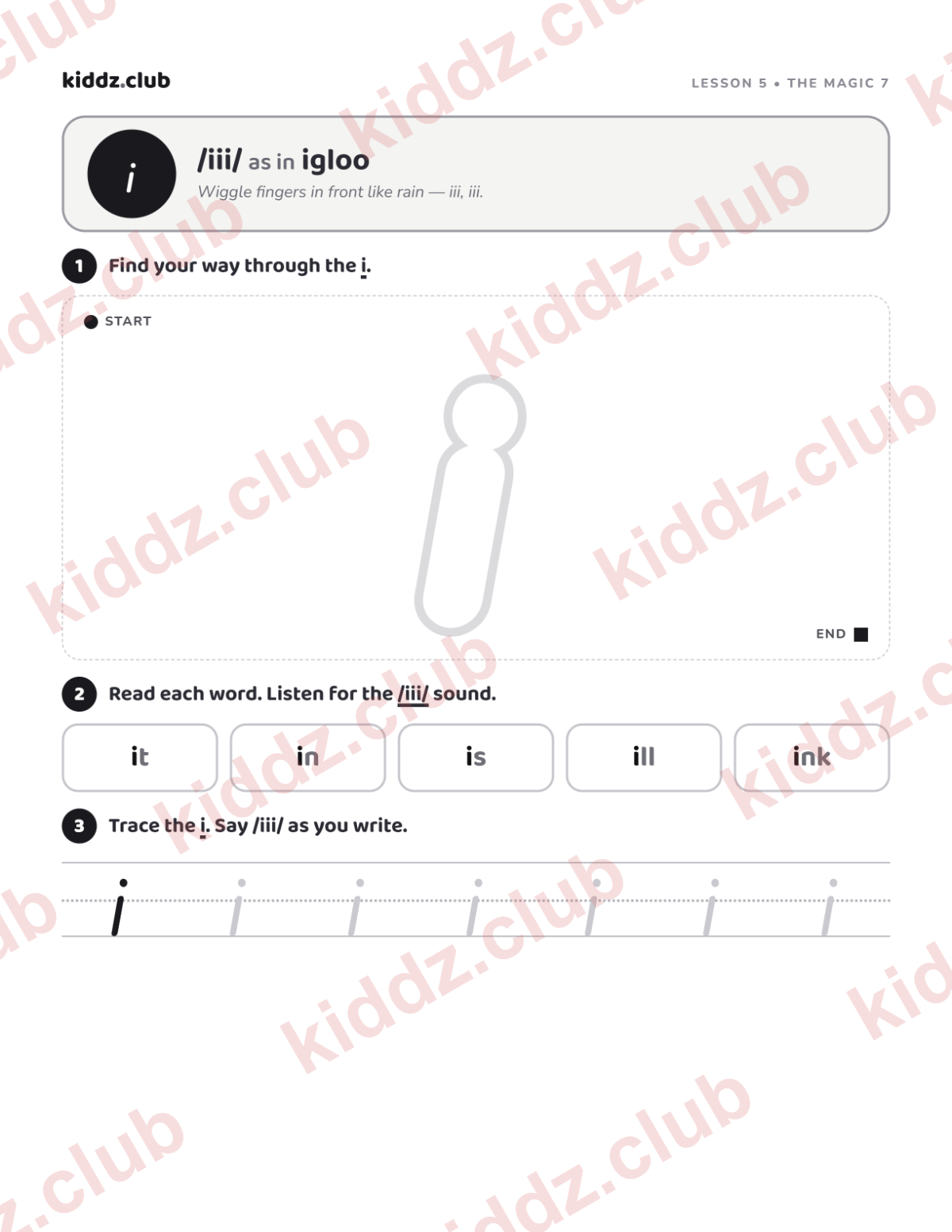
The Magic 7 Activity Pack covers seven sounds in one PDF. The Letter I lesson page has three activities:
Activity 1 — A letter-I-shaped maze. The letter I drawn as a maze with a START and END. Kids trace the path with a finger or pencil while saying /iii/.
Activity 2 — Find and circle. Small icons on the page (igloo, insect, and several distractors). The child circles every one that starts with /i/.
Activity 3 — Letter tracing. A model lowercase i on the left, six light-gray practice letters to trace while saying /iii/ aloud. (Don't forget the dot!)
How to teach the short /i/ sound
A simple five-minute approach:
- Show the letter. Point at i. Say /iii/ as in igloo — stretch it. Have your child copy.
- Use the action. "Wiggle your fingers like a tickly insect — i-i-i!"
- Find things that start with /i/. Igloo and insect in a picture book; "in" and "it" in speech.
- Play word pairs. Read sat then sit. tap then tip. Ask: "what changed?" Hearing the vowel switch is a big phonemic-awareness win.
- Stop while it's still fun.
What comes after I
N is next, adding in, an, nap, pin, tin, nip — and bringing the first little sentences within reach ("a pin is in a tin").
The pack includes all seven in order: s, a, t, p, i, n, m. One lesson page per sound, plus a blending page, first sentences, and a parent solution key.
When this worksheet is the right level
Use this worksheet if:
- Your child is 4-5 years old
- They know /s/, /a/, /t/ and /p/ (or are working through the Magic 7 in order)
- They can blend simple /a/ words like sat and tap
Skip this worksheet if:
- Your child can already read three-letter words confidently
- They've completed the Magic 7 set already — try the Short I worksheets or the CVC Word Pack next
Related resources
Part of the free phonics worksheets library. This page is linked from the preschool and pre-K hubs.
Companion materials for the letter I and the Magic 7 set:
- Letter P phonics worksheets — the sound before this one
- Letter N phonics worksheets — the sound after this one
- Magic 7 Phonics Flashcards — cut-out cards for each of the seven sounds
- Short I phonics worksheets — deeper /i/ practice for kindergarten
Common questions
What sound does I make?
In early phonics, I makes the short /i/ sound as in igloo and sit. The long "eye" sound (as in ice) comes much later. Teach short /i/ first.
My child confuses short /i/ and short /e/. Is that normal?
Very — they're the two closest vowel sounds in English (pin/pen). At this stage /e/ hasn't been introduced yet, so there's nothing to fix. When it arrives, minimal-pair games (pin or pen?) sort it out.
Why is the I worksheet part of a multi-letter pack?
Because I's job is making words with the letters around it. The first set (s, a, t, p, i, n, m) is taught together because the letters work together.
Are these worksheets really free?
Yes. Free for personal, classroom, and tutor use. Print as many copies as you like.
Ready for More Than Worksheets?
Picture This! teaches visualization step-by-step so children can genuinely understand—and enjoy—what they read.