
Short i phonics worksheets
The short i sound is /i/ — the vowel you hear in the middle of pig, sit and big. It's a high, short vowel that often gets confused with short e, because the two sounds sit very close to each other acoustically. This free printable gives focused practice on the /i/ sound in isolation before children tackle the contrast. Suitable for ages 4–6 who know most letter sounds and are beginning to blend CVC words.
One page. Find-and-circle, read-aloud and missing-vowel practice for short i.
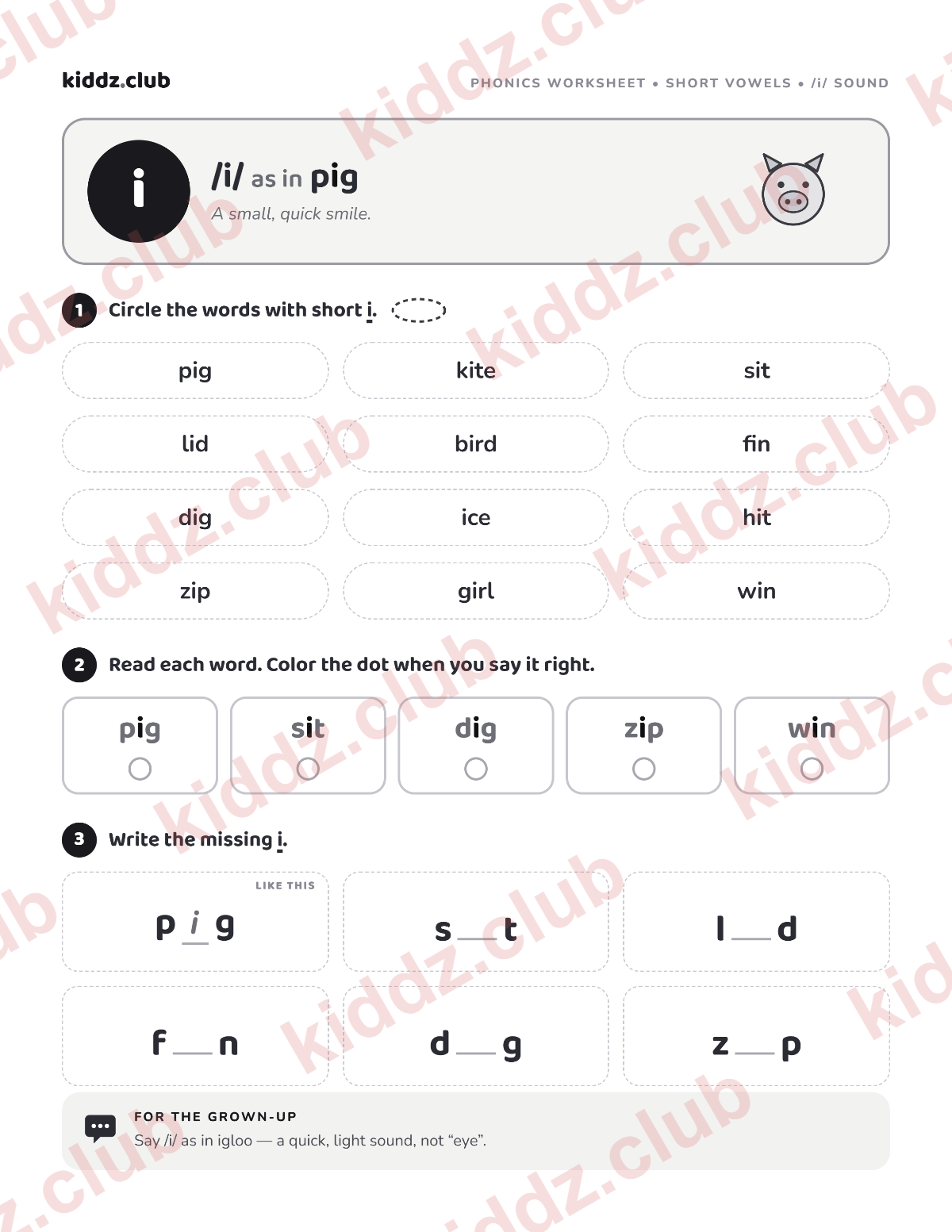
What's on the sheet
Activity 1 — Find and circle. A grid of words; the child circles the ones where the vowel makes the short /i/ sound (pig, sit, big, pin, bit, hip, lid, win) and leaves the distractors that use a different vowel.
Activity 2 — Read aloud. Five short i CVC words, each with a colorable dot beneath — the child reads the word and colors the dot to mark it done.
Activity 3 — Missing vowel. Short words with the vowel removed; the child writes the missing i to complete each word. Bridges reading to writing.
Parent note. A short tip on how to model the /i/ sound cleanly and how to handle the common i/e confusion.
How to teach the short i sound
Say it purely: /i/, not "eye." Spread the corners of your mouth slightly — just a hint of a smile — and keep the sound short and high. The tongue is high in the mouth. If you extend the sound it becomes long i ("eye"), which is a completely different phoneme.
The mouth cue: corners of the mouth pull slightly sideways, tongue high and forward. Compare with /e/ (mouth a little lower and wider) and /a/ (jaw dropped, mouth wide open). These physical contrasts are the most reliable cues for children who mix up the vowels.
Once the isolated sound is secure: find it in reading (tap under each letter, say /i/ when you hit the vowel), then write it — trace the letter, then write it in words.
When this is the right level
Use this if:
- Your child knows most letter sounds
- They're starting to blend CVC words (pig, sit, big)
- Ages 4–6
Skip this if:
- They're still learning first letter sounds — start with the Magic 7 set (s, a, t, p, i, n, m)
- They already read digraphs confidently — move on to long vowel worksheets
Related resources
- Short vowel worksheets hub — all five short vowels in one place
- Short a phonics worksheets — the /a/ sound in cat and hat
- Short e phonics worksheets — the /e/ sound in bed and hen (the most commonly confused pair with short i)
- Short o phonics worksheets — the /o/ sound in dog and hop
- Short u phonics worksheets — the /u/ sound in bug and sun
- CVC word pack — short vowel words to decode across all five vowels
- Alphabet phonics worksheets — all 26 letter sounds if any need firming up
- Long vowel phonics worksheets — the next step after short vowels are solid
Common questions
What is a short i word?
A short i word is one where i says /i/ — the vowel sound in pig, sit and big — not its name "eye." Common short i CVC words include pin, bit, hip, lid and win.
My child says "pig" as "peeg" — how do I help?
Model the pure /i/ sound in isolation: spread the corners of your mouth slightly, keep the sound short and high. Say pig slowly, tap out each sound p-i-g, and emphasise the middle vowel. Avoid extending it into "ee."
My child mixes up short e and short i — what should I do?
Short i (/i/ as in pig) and short e (/e/ as in bed) are the closest pair acoustically — the two most commonly confused vowels. Teach them on separate days before comparing them. When you do contrast them, use minimal pairs: bid/bed, tin/ten, pit/pet. Let your child feel the difference: /i/ is higher with the corners of the mouth spreading slightly, /e/ is lower and wider.
Are these worksheets free?
Yes — free for personal, classroom and homeschool use. Print as many copies as you need.
Ready for More Than Worksheets?
Picture This! teaches visualization step-by-step so children can genuinely understand—and enjoy—what they read.