
Short e phonics worksheets
The short e sound is /e/ — the vowel you hear in the middle of bed, hen and pet. It's one of the trickier short vowels because it sits acoustically close to short i, and children often swap the two. This free printable gives focused, targeted practice on the /e/ sound in isolation. Suitable for ages 4–6 who know most letter sounds and are beginning to blend CVC words.
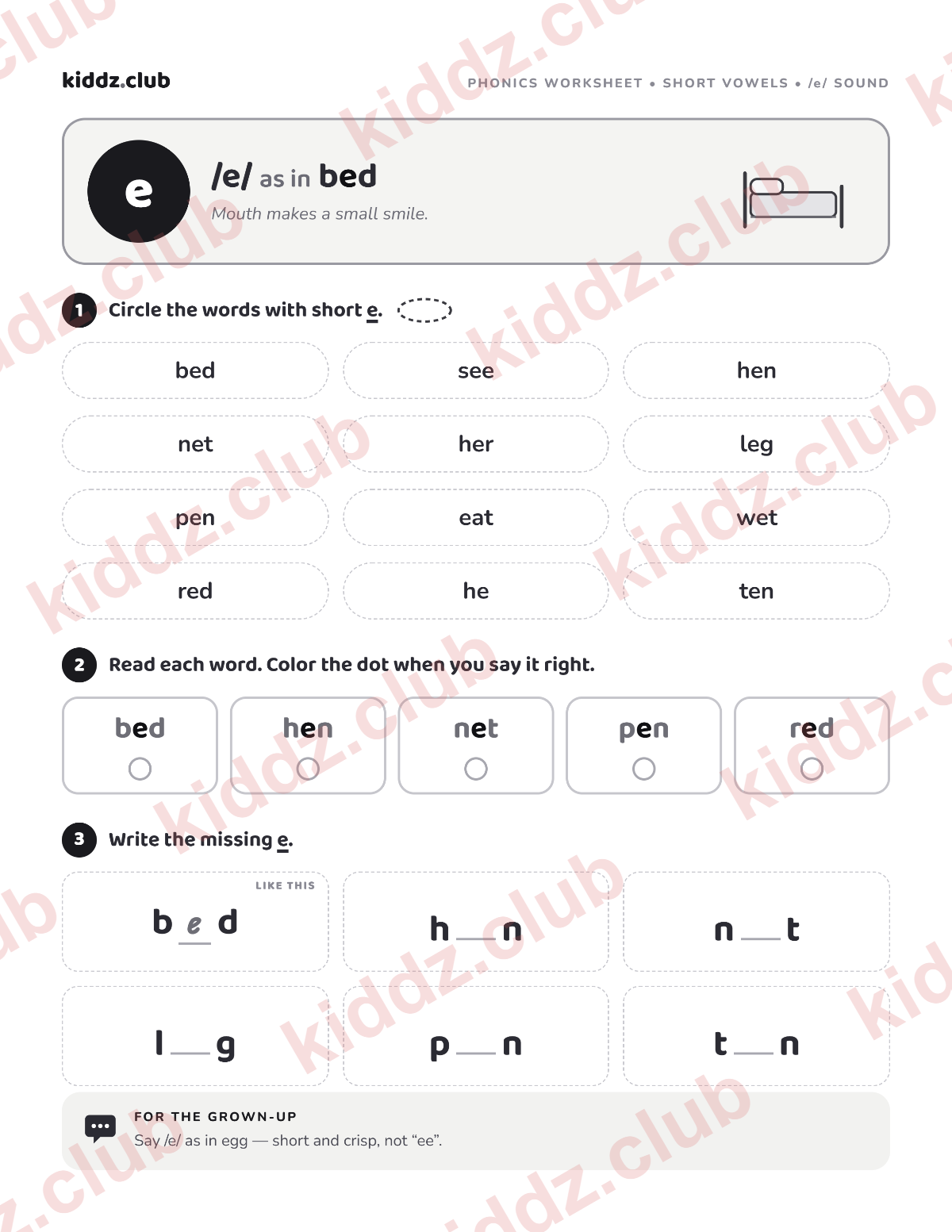
One page. Find-and-circle, read-aloud and missing-vowel practice for short e.
What's on the sheet
Activity 1 — Find and circle. A grid of words; the child circles the ones where the vowel makes the short /e/ sound (bed, hen, pet, red, wet, ten, leg, beg) and leaves the distractors that use a different vowel.
Activity 2 — Read aloud. Five short e CVC words, each with a colorable dot beneath — the child reads the word and colors the dot to mark it done.
Activity 3 — Missing vowel. Short words with the vowel removed; the child writes the missing e to complete each word. Bridges reading to writing.
Parent note. A short tip on how to model the /e/ sound cleanly and how to handle the common e/i confusion.
How to teach the short e sound
Say it purely: /e/, not "ee." The mouth is half-open, lips slightly apart, tongue mid-low — not stretched wide like /i/. Keep it short and flat. If you extend it, it creeps toward long e.
The mouth cue: mouth half-open, jaw slightly dropped, tongue in the middle of the mouth — lower than for /i/, higher than for /a/. This physical position is the most reliable cue for children who confuse e and i.
Once the isolated sound is secure: find it in reading (tap under each letter, say /e/ when you hit the vowel), then write it — trace the letter, then write it in words.
When this is the right level
Use this if:
- Your child knows most letter sounds
- They're starting to blend CVC words (bed, pet, hen)
- Ages 4–6
Skip this if:
- They're still learning first letter sounds — start with the Magic 7 set (s, a, t, p, i, n, m)
- They already read digraphs confidently — move on to long vowel worksheets
Related resources
- Short vowel worksheets hub — all five short vowels in one place
- Short a phonics worksheets — the /a/ sound in cat and hat
- Short i phonics worksheets — the /i/ sound in pig and sit (the most commonly confused pair with short e)
- Short o phonics worksheets — the /o/ sound in dog and hop
- Short u phonics worksheets — the /u/ sound in bug and sun
- CVC word pack — short vowel words to decode across all five vowels
- Alphabet phonics worksheets — all 26 letter sounds if any need firming up
- Long vowel phonics worksheets — the next step after short vowels are solid
Common questions
What is a short e word?
A short e word is one where e says /e/ — the vowel sound in bed, hen and pet — not its name "ee." Common short e CVC words include red, wet, ten, leg and beg.
My child says "bed" with "ee" — how do I help?
Model the pure /e/ sound: lips slightly apart, mouth half-open, short and flat — not stretched wide. Contrast it with long e: say "bed" and "bead" side by side and ask which one has the short sound in the middle.
My child mixes up short e and short i — what should I do?
Short e (/e/ as in bed) and short i (/i/ as in pig) are the closest pair acoustically — the two most commonly confused vowels. Teach them on separate days before comparing them. When you do contrast them, use minimal pairs: bed/bid, ten/tin, pet/pit. Let your child feel the difference: /e/ is lower and wider, /i/ is higher with the corners of the mouth spreading slightly.
Are these worksheets free?
Yes — free for personal, classroom and homeschool use. Print as many copies as you need.
Ready for More Than Worksheets?
Picture This! teaches visualization step-by-step so children can genuinely understand—and enjoy—what they read.