
Short vowel phonics worksheets
English has five short vowels: /a/ as in cat, /e/ as in bed, /i/ as in pig, /o/ as in dog, and /u/ as in bug. These are the sounds vowels make in short CVC (consonant-vowel-consonant) words — and they come before long vowels in every phonics sequence for a reason: mastering them unlocks hundreds of readable words from day one.
Each free printable below covers one vowel with three focused activities: find-and-circle, read-aloud, and missing-vowel. One page. One sound. Designed for ages 4–6 who know most letter sounds and are beginning to blend.
The five short vowel worksheets
Short a worksheet — /a/ as in cat
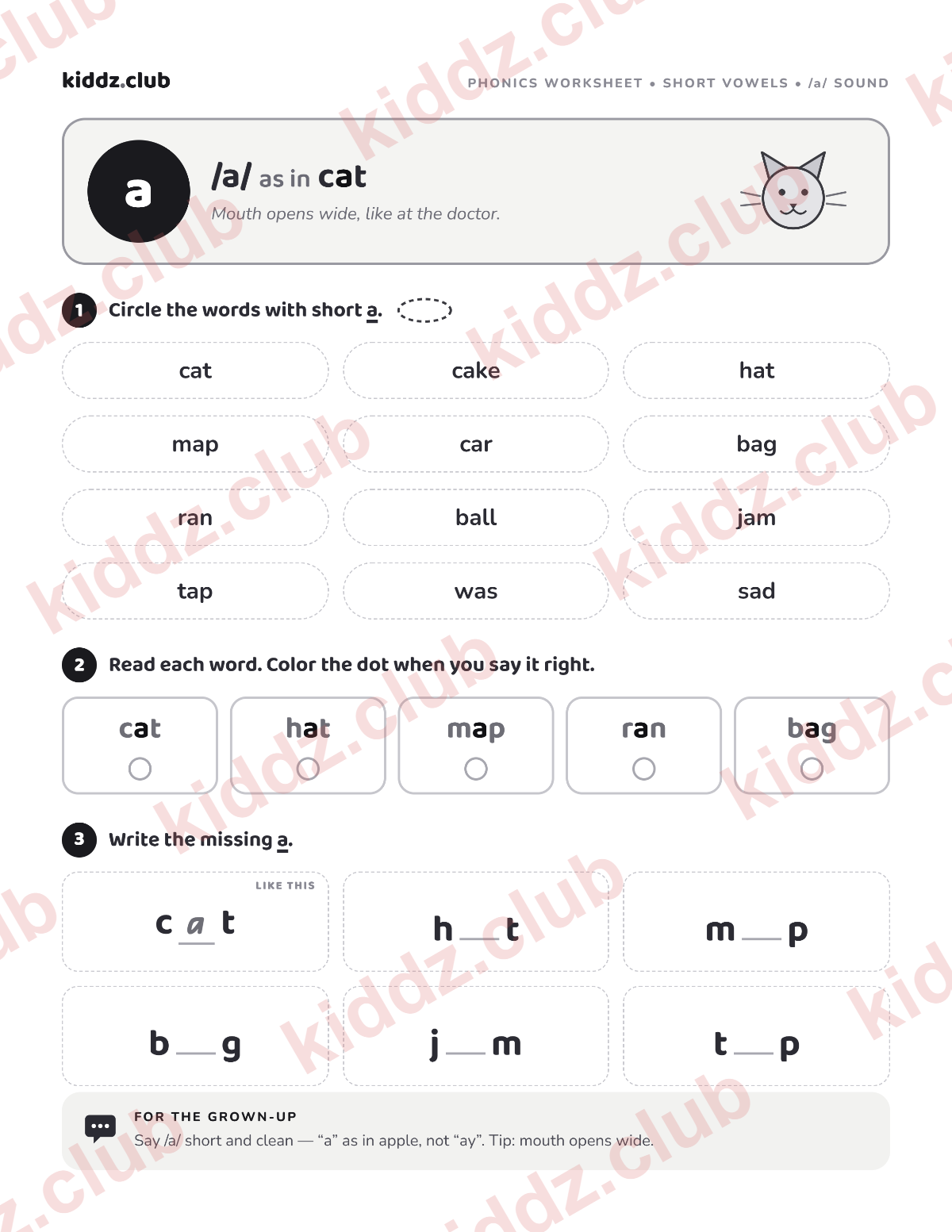
The wide-open jaw sound. Short a unlocks more beginner CVC words than any other vowel. Teach it first. Full short a page →
Short i worksheet — /i/ as in pig
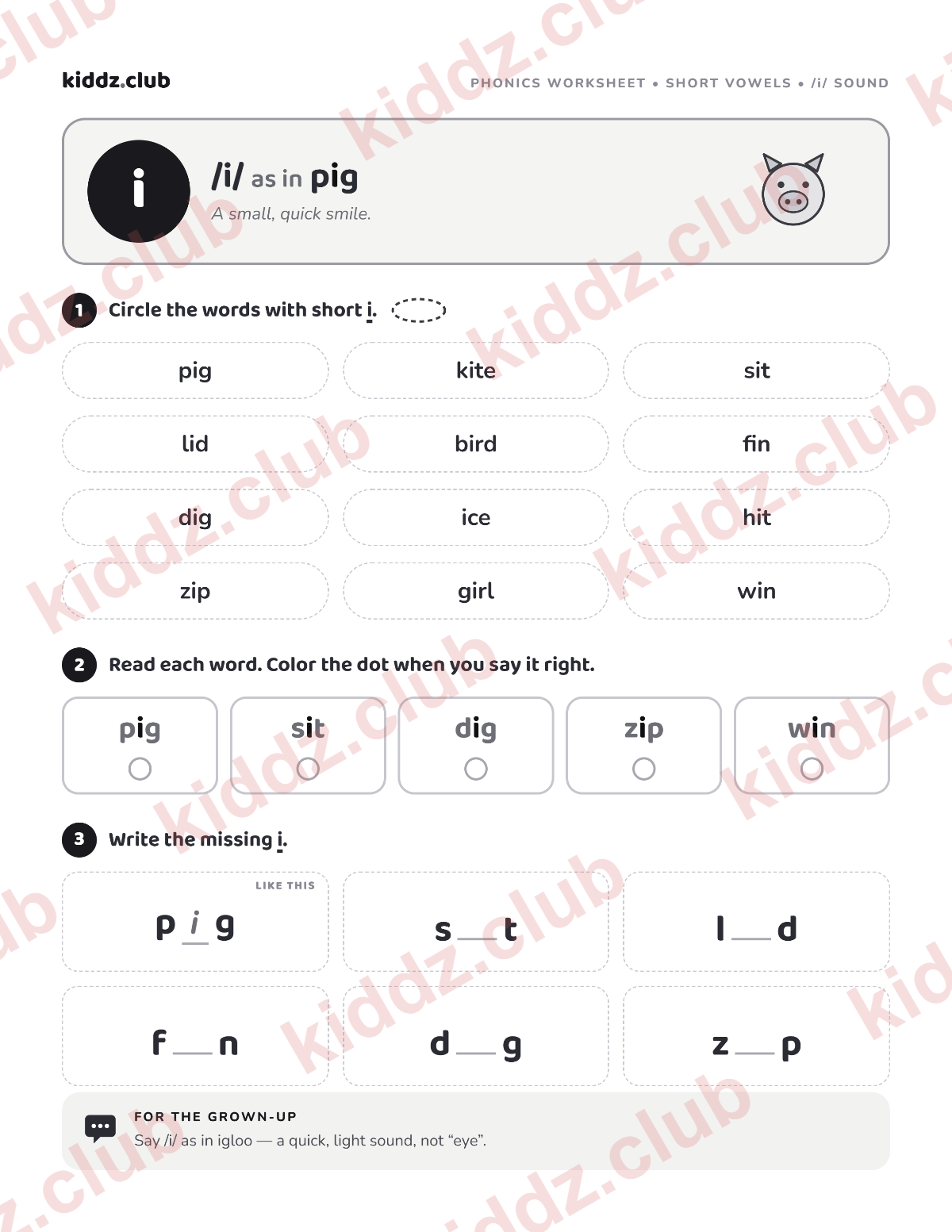
The high, corners-spread sound. Short i is taught second — before short e — to give the two acoustically similar vowels time to settle separately. Full short i page →
Short o worksheet — /o/ as in dog
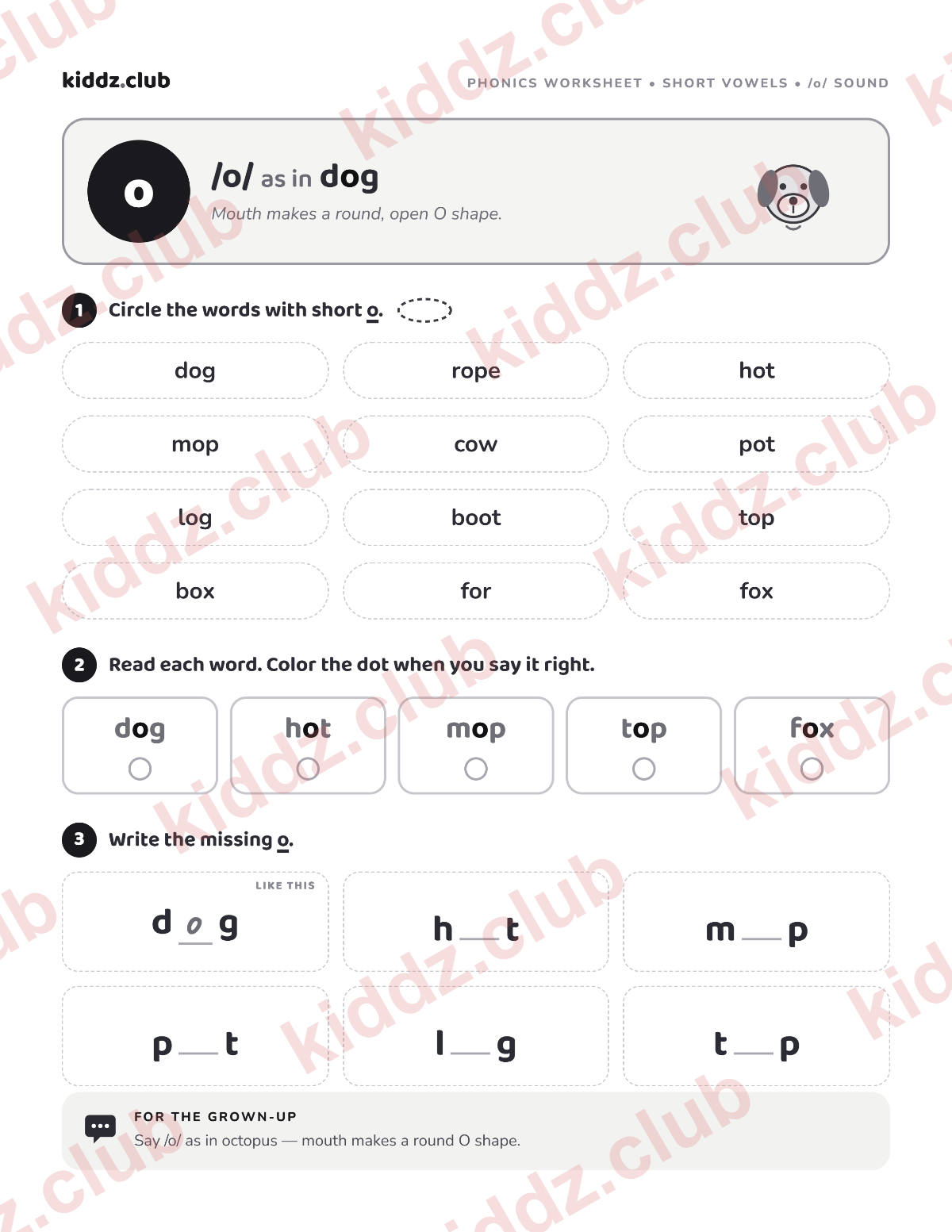
The round-lips sound. Short o is easy to distinguish from the others; children usually find it straightforward once /a/ and /i/ are solid. Full short o page →
Short u worksheet — /u/ as in bug
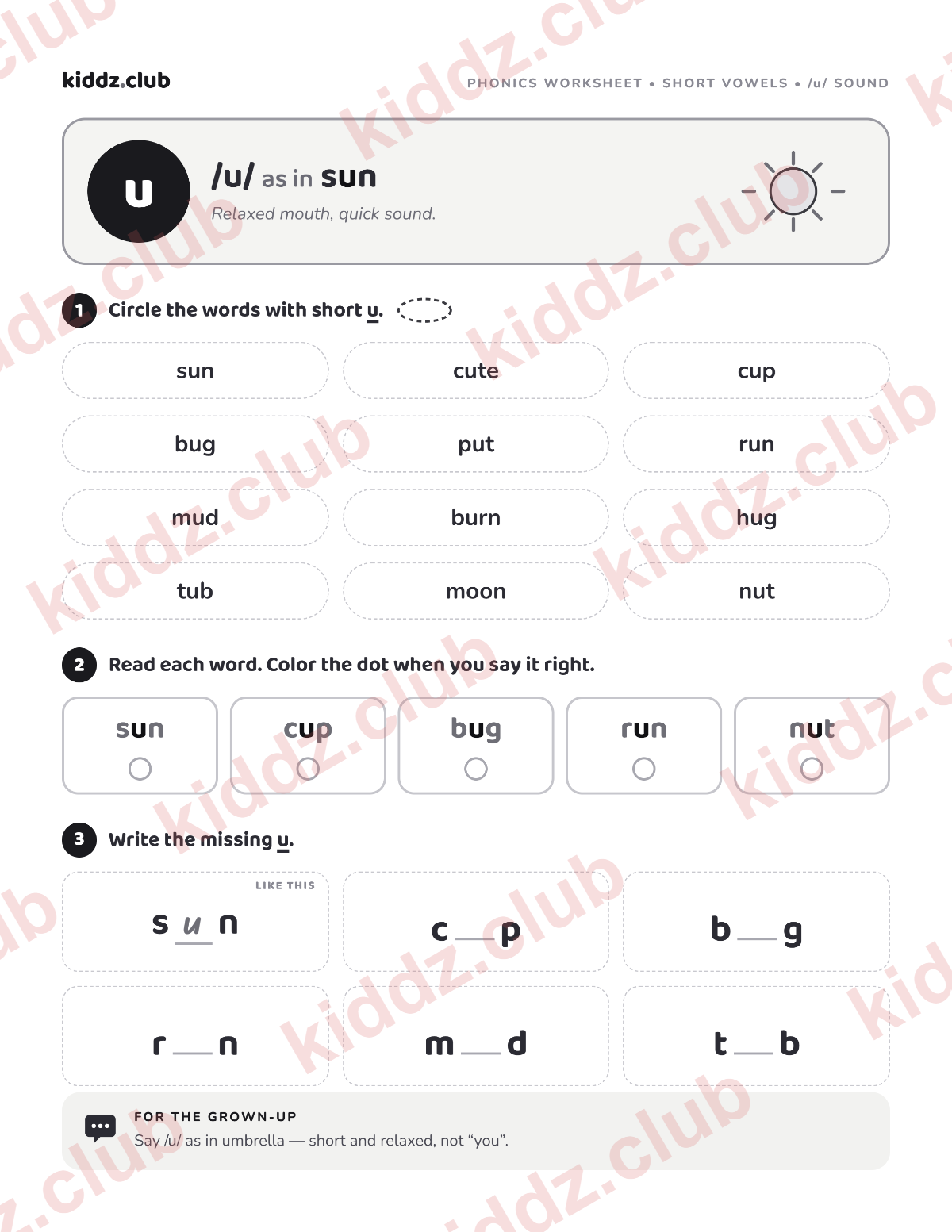
The relaxed central sound. Short u comes fourth — after a, i and o — so children have three solid reference points before adding a fourth vowel to the mix. Full short u page →
Short e worksheet — /e/ as in bed
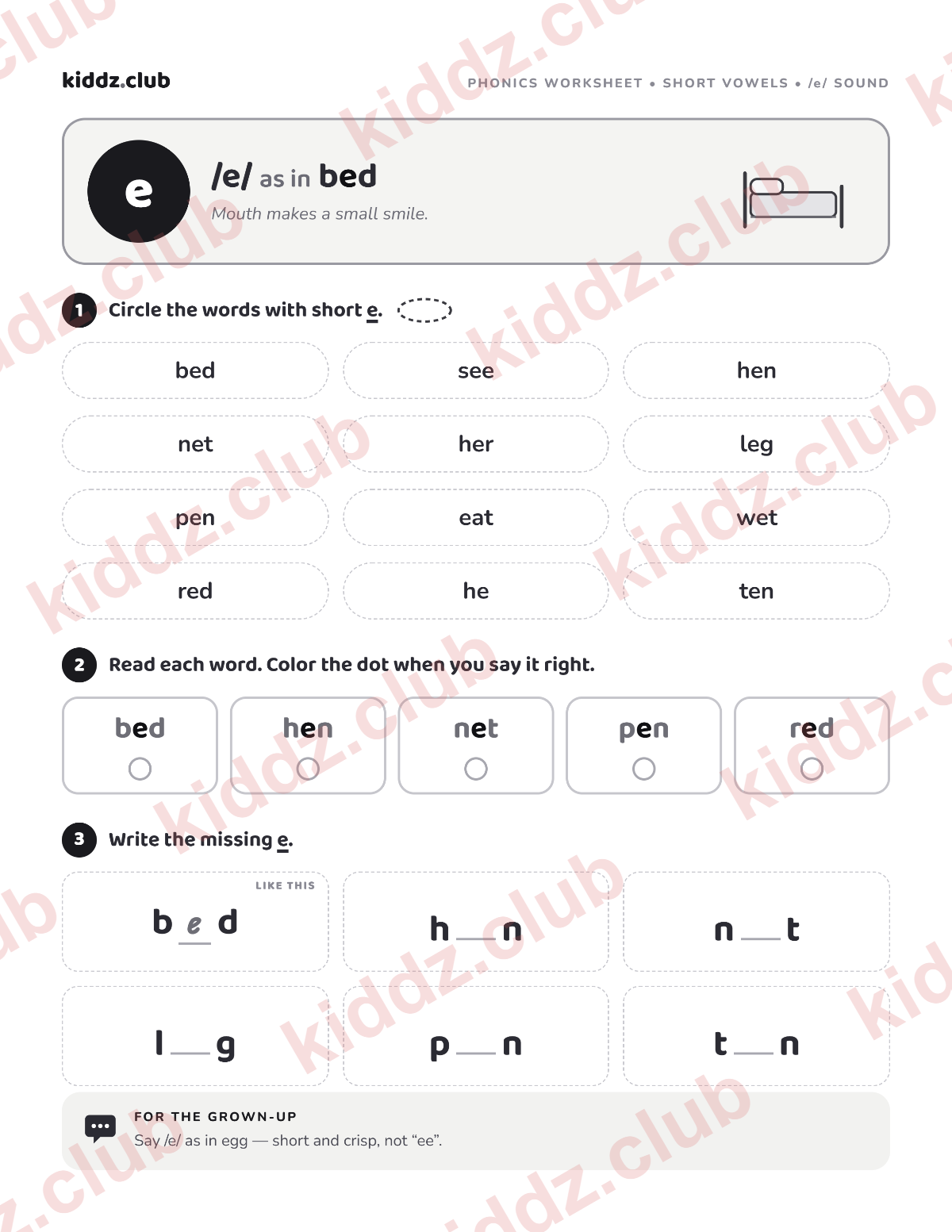
The half-open, flat sound. Short e comes last because it sits acoustically closest to short i. Teaching it after i is solid — with a deliberate gap between the two — reduces confusion. Full short e page →
How to teach short vowels — the order matters
The recommended order is: a → i → o → u → e. This isn't alphabetical — it's strategic. The key principle: keep the two hardest vowels to distinguish (e and i) as far apart as possible in the teaching sequence.
Short e and short i are acoustically the closest pair in English. If you teach them back-to-back, children frequently confuse them for months. By teaching short i second and short e last — with three other vowels in between — each one has time to become solid before the contrast is introduced.
This matches the Magic 7 philosophy of spacing confusable items: the Magic 7 starter set (s, a, t, p, i, n, m) uses the same spacing principle, putting confusable letter pairs as far apart in the teaching sequence as possible. Short vowels apply the same logic.
For each vowel, the sequence is:
- Isolate the sound. Say it purely in isolation — mouth cue, no letter name yet.
- Find it. Tap out CVC words and identify the middle sound.
- Read it. Blend CVC words containing the vowel.
- Write it. Fill in missing vowels, then write full words.
When to use these worksheets
Use these worksheets if:
- Your child knows most letter sounds
- They're beginning to blend CVC words
- Ages 4–6
Skip these worksheets if:
- Your child is still learning individual letter sounds — start with the Magic 7 set (the seven sounds that unlock the most words: s, a, t, p, i, n, m)
- Your child reads CVC words confidently and is meeting digraphs or magic e in their books — move to digraph worksheets or long vowel worksheets
Related resources
- Beginning sounds worksheets — the step before short vowels: hearing where a word starts, all picture-based
- CVC word pack — short vowel words to decode across all five vowels once each sound is known
- Long vowel phonics worksheets — the next step after short vowels are solid (magic e, vowel digraphs)
Common questions
Which short vowel should I teach first?
Teach short a first — it unlocks the most CVC words immediately (cat, sat, map, ran). Then short i, short o, short u, and short e last. This order spaces out the two most easily confused vowels (e and i), following the Magic 7 philosophy of separating similar items so each can solidify before the contrast is introduced.
Short vowels vs long vowels — which come first?
Short vowels always come first. They unlock CVC words (cat, bed, pig, dog, bug) — the foundation of early reading. Long vowels (magic e, vowel digraphs like ai/ay, ee/ea) come later, once CVC reading is solid.
How long until my child knows all five short vowels?
Most children working through the five vowels one at a time — a few days of focused practice per vowel — can read all five CVC vowel sounds within three to six weeks. The e/i pair usually needs the most time. Revisiting over several weeks through varied practice (reading, writing, games) consolidates what the worksheets introduce.
Ready for More Than Worksheets?
Picture This! teaches visualization step-by-step so children can genuinely understand—and enjoy—what they read.