
NG phonics worksheets
ng makes the humming sound at the end of ring, king and song. Unlike the other digraphs, it lives at the end of words — which makes it a great listening exercise. This free printable helps children spot it, read it and write it.
One page. Find-and-circle, read-aloud and tracing for the ng sound.
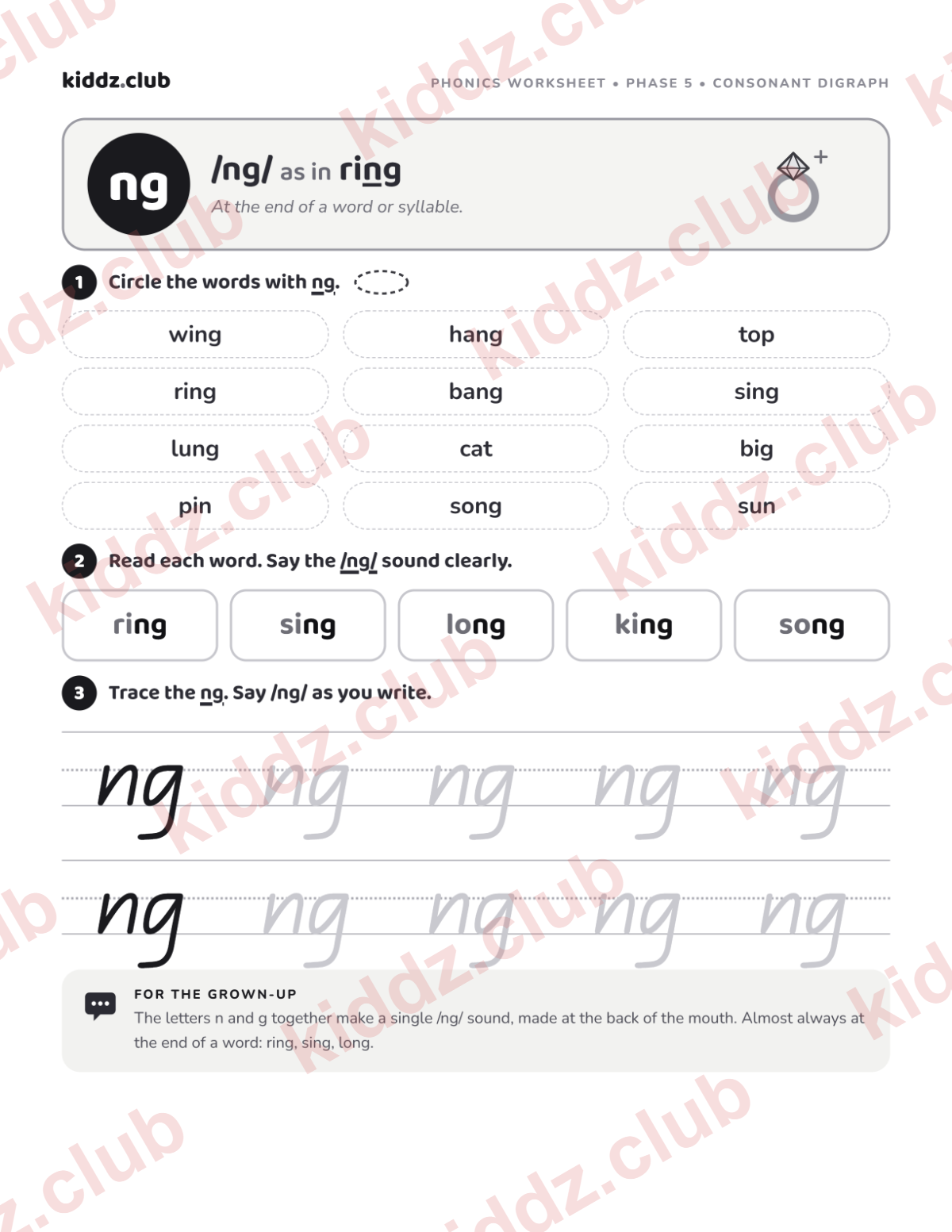
What's on the sheet
Activity 1 — Find and circle. Twelve words in a grid; the child circles the words containing ng (ring, sing, long, king, song, wing, bang, hang, lung) among look-alike distractors.
Activity 2 — Read aloud. Five featured ng words, each with a colorable dot beneath — the child reads each one and colors the dot.
Activity 3 — Trace. Six traces of ng across the page, the first solid, the rest light grey.
Parent note. A short tip on the /ng/ sound and its position in words.
How to teach the /ng/ sound
ng hums through the nose. The back of the tongue rises to close off the throat, and the air comes out through the nose — not the mouth. A fun way to show this:
- The nose trick. Hold your nose and try to say ring. The /ng/ at the end disappears! That shows children the sound lives in the nose.
- Always at the end. ng closes syllables — it never starts a word in English. Focus the practice on endings: ring, king, song, lung.
- Sing -ing words. Children often already know plenty of ng words from songs and rhymes — sing, ring, king. Tap into that familiarity.
When this is the right level
Use this if:
- Your child reads CVC words confidently
- They know their single letter sounds
- They're meeting digraphs in reading (ages 5–7)
Skip this if:
- They're still learning single letter sounds — start with the Magic 7 set
- They already read multi-syllable words — move on to long vowels
Related resources
- Consonant digraph worksheets — the full sh, ch, th, ng and ck hub
- TH phonics worksheets
- CK phonics worksheets
- CVC words worksheets
Common questions
Why is ng always at the end of words?
/ng/ never starts an English word — it only closes syllables: ring, singer, longer. That is why the sheet focuses entirely on word endings, and why ng is typically taught last among the digraphs.
Is "n + g" the same as ng?
No — ng is one nasal sound made at the back of the mouth, not the sound of n followed by g. If your child says rin-guh, model the hum: riiing. Hold your nose while saying it — the vibration disappears, which shows the sound goes through the nose.
Are these worksheets free?
Yes — free for personal, classroom and homeschool use.
Ready for More Than Worksheets?
Picture This! teaches visualization step-by-step so children can genuinely understand—and enjoy—what they read.