
TH phonics worksheets
th is the tongue-tickler — the only digraph where the tongue peeks out between the teeth: this, thin, bath. This free printable helps children spot it, read it and write it.
One page. Find-and-circle, read-aloud and tracing for the th sound.
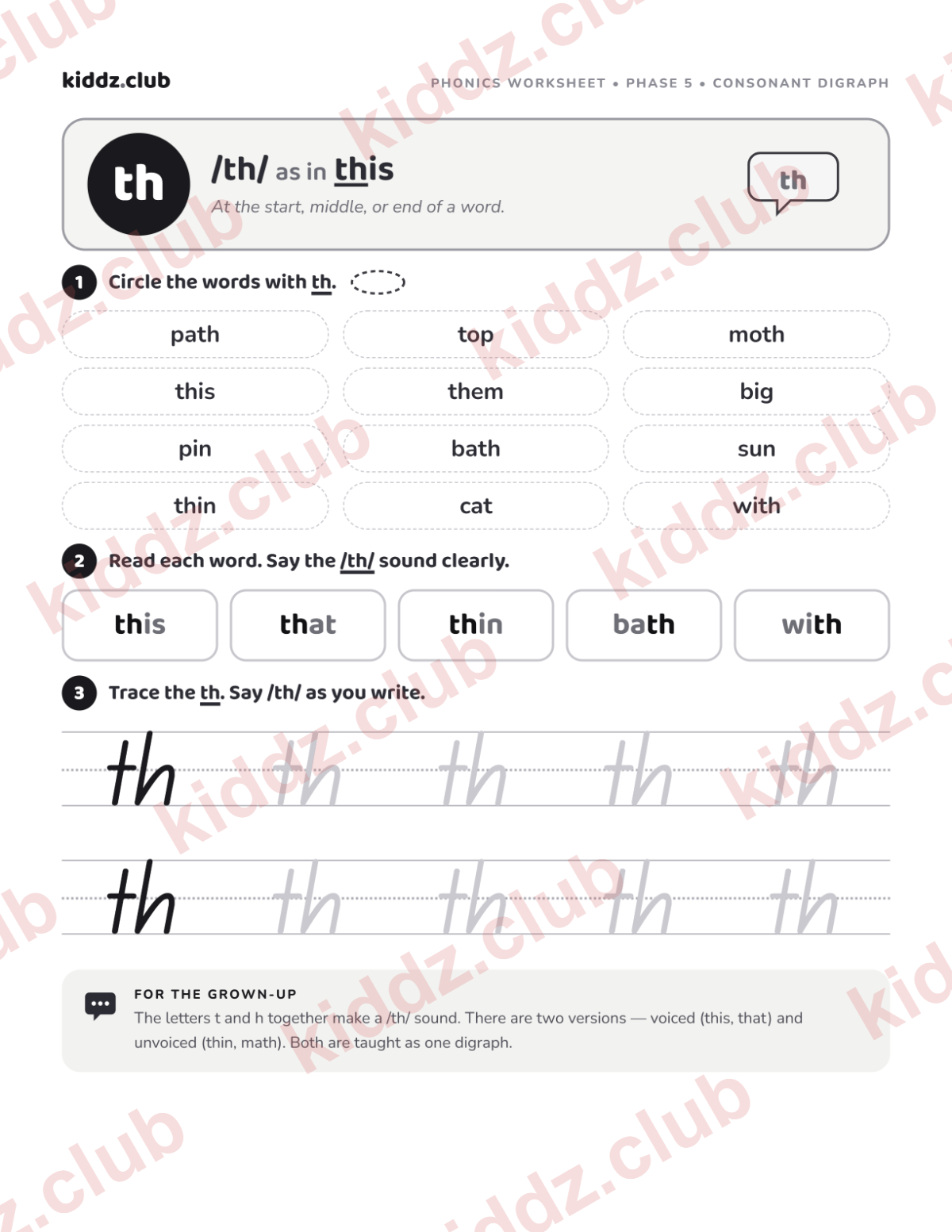
What's on the sheet
Activity 1 — Find and circle. Twelve words in a grid; the child circles the words containing th (this, that, thin, them, with, path, bath, math, moth) among look-alike distractors.
Activity 2 — Read aloud. Five featured th words, each with a colorable dot beneath — the child reads each one and colors the dot.
Activity 3 — Trace. Six traces of th across the page, the first solid, the rest light grey.
Parent note. A short tip on the tongue position for the /th/ sound.
How to teach the th sound
The physical cue is the whole trick: tongue gently between the teeth, then blow. That's all there is to it. Once children feel it, they remember it.
- Model it slowly. Show the tongue peeking between the teeth. Let them copy in a mirror — seeing their own tongue helps.
- Don't worry about the two sounds. th has a buzzy version (this, that) and a whispery version (thin, bath), but the mouth position is identical. Children pick up the difference naturally — teach them as one pattern.
- Find it at the start AND end of words. This starts with th; bath ends with it. Both patterns appear on the sheet.
When this is the right level
Use this if:
- Your child reads CVC words confidently
- They know their single letter sounds
- They're meeting digraphs in reading (ages 5–7)
Skip this if:
- They're still learning single letter sounds — start with the Magic 7 set
- They already read multi-syllable words — move on to long vowels
Related resources
- Consonant digraph worksheets — the full sh, ch, th, ng and ck hub
- SH phonics worksheets
- CH phonics worksheets
- NG phonics worksheets
- CVC words worksheets
Common questions
Why does th sound different in "the" and "thin"?
There's a buzzy (voiced) version — this, that, the — and a whispery (unvoiced) version — thin, math, path. Both use the exact same mouth shape: tongue gently between the teeth. The buzzy version adds voice. Children pick up the difference naturally without drilling it.
My child says "f" instead of "th" (fum for thumb)
Very common. Use a mirror: for th the tongue peeks between the teeth; for f the top teeth touch the bottom lip. Make it a game rather than a correction — practise in front of the mirror together.
Are these worksheets free?
Yes — free for personal, classroom and homeschool use.
Ready for More Than Worksheets?
Picture This! teaches visualization step-by-step so children can genuinely understand—and enjoy—what they read.