CK phonics worksheets
The ck spelling makes the /k/ sound — the same sound as c and k, but with its own job. ck turns up at the end of short words, right after a short vowel: back, duck, sock. This free printable helps children spot it, read it, and write it.
One page. Find-and-circle, read-aloud and tracing for the ck sound.
What's on the sheet
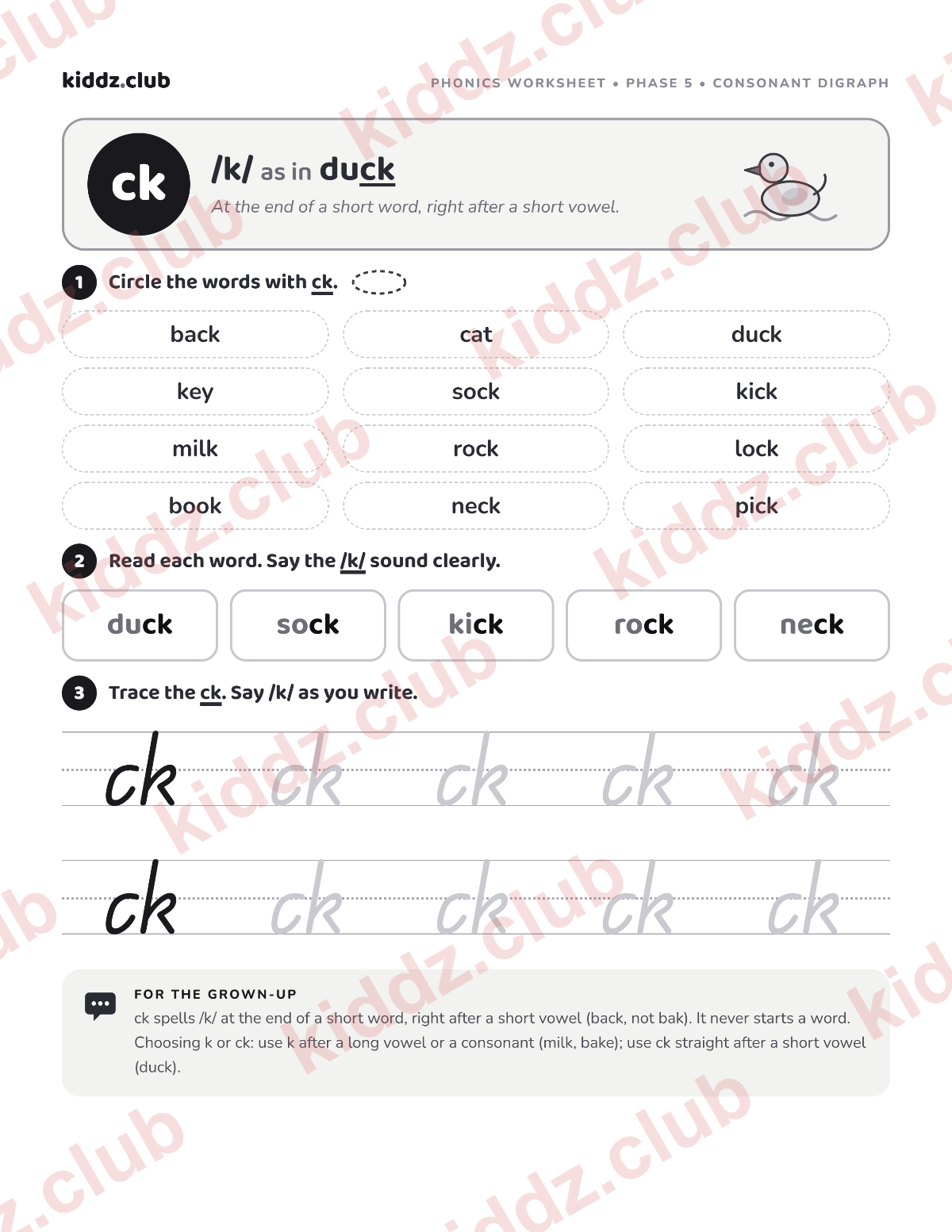
Activity 1 — Find and circle. Twelve words in a grid; the child circles the words containing ck (back, duck, sock, kick, rock, lock, neck, pick) among look-alike distractors that make /k/ another way (cat, key, milk, book).
Activity 2 — Read aloud. Five featured ck words, each with a colorable dot beneath — duck, sock, kick, rock, neck.
Activity 3 — Trace. Six traces of ck across the page, the first solid, the rest light grey.
Parent note. A short tip on the k-or-ck rule.
How to teach the ck spelling
ck spells /k/ only at the end of a short word, straight after a short vowel — back, not bak. It never starts a word. The quick rule: use ck right after a short vowel (duck, sock); use k after a long vowel or a consonant (milk, bake). Say it, find it in reading, then write it.
When this is the right level
Use this if:
- Your child reads CVC words confidently
- They know their single letter sounds
- They're meeting ck in reading (ages 5–7)
Skip this if:
- They're still learning single letter sounds — start with the Magic 7 set
- They already read multi-syllable words — move on to long vowels
Related resources
- Consonant digraph worksheets — the full sh, ch, th, ng and ck hub
- SH phonics worksheets
- CH phonics worksheets
- TH phonics worksheets
- NG phonics worksheets
- Phonics blends worksheets
- CVC words worksheets
Common questions
When do I use k and when do I use ck?
ck comes straight after a short vowel at the end of a short word (duck, back); k is used after a long vowel or a consonant (bake, milk).
My child writes "bak" instead of "back" — how do I help?
They've heard /k/ correctly but not learned the ck pattern. Show that short words ending in /k/ after a short vowel use ck; practise a few together (duck, sock, kick).
Are these worksheets really free?
Yes, free for personal, classroom and homeschool use.
Ready for More Than Worksheets?
Picture This! teaches visualization step-by-step so children can genuinely understand—and enjoy—what they read.