
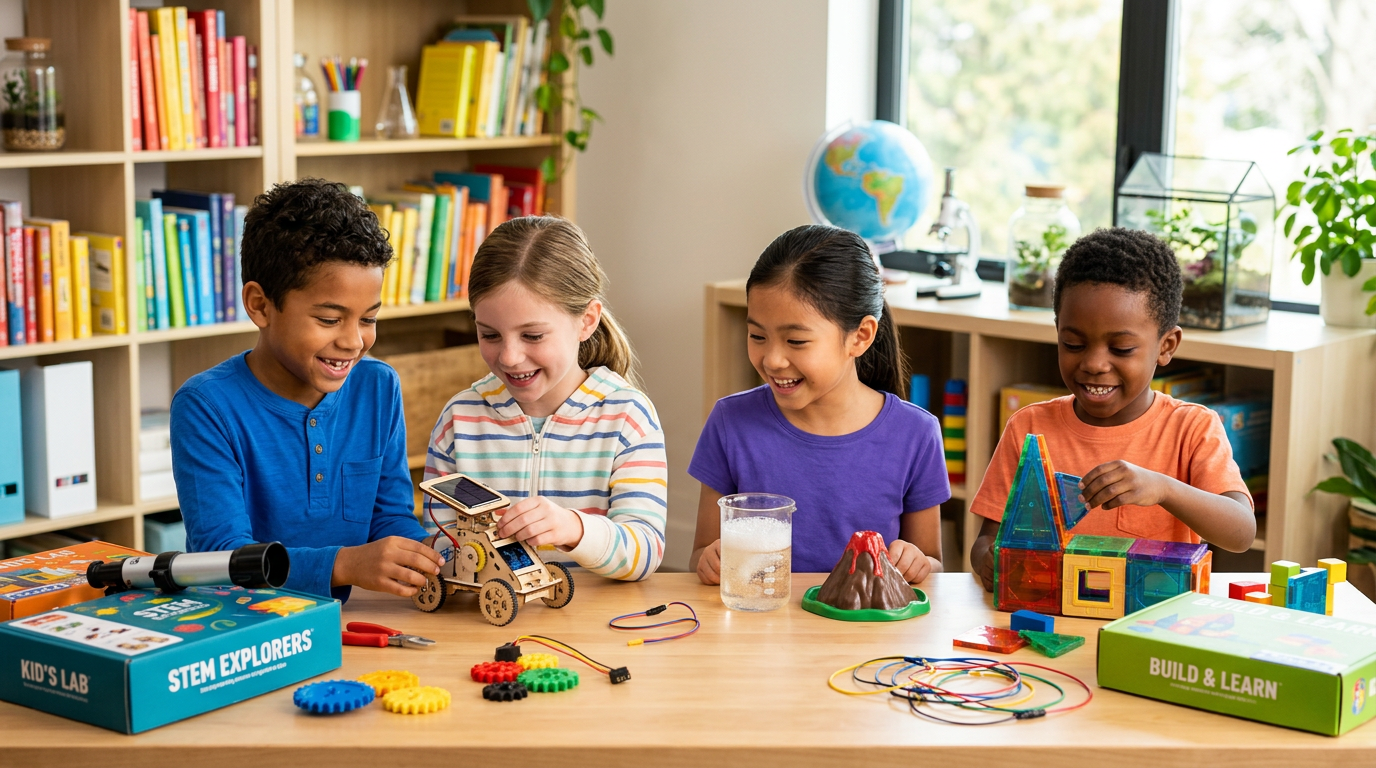
The Ultimate Guide to STEM Subscription Boxes for Curious Kids
In a world increasingly dominated by passive screen time, how do we ignite a genuine passion for science, technology, engineering, and math in our children? Dive deep into the pedagogy, the fun, and the finest STEM subscription kits available today.
The Shift from Passive Consumption to Active Creation
It is a familiar scene in modern households and classrooms: a child, mesmerized by the glow of a tablet, endlessly scrolling or watching brightly colored videos. While the digital age has brought unprecedented access to information, it has also cultivated an environment of passive consumption. But true learning—the kind that builds neural pathways, fosters resilience, and sparks lifelong passions—requires dirty hands, messy tables, and the occasional failed experiment.
This is where STEM (Science, Technology, Engineering, and Mathematics) subscription boxes enter the chat. These carefully curated monthly deliveries are much more than just toys in a cardboard box. They are Trojan horses for education. By disguising complex physical and chemical concepts as thrilling projects and "magic" tricks, these boxes transform living rooms and classrooms into vibrant laboratories.
Whether it is building a functioning air-pressure powered car, synthesizing disappearing ink like a secret agent, or coding a virtual pet that responds to touch, STEM kits offer a highly structured yet infinitely creative pathway to learning. In this comprehensive guide, we will break down exactly what to look for, review the top contenders on the market, and help you find the perfect match for your child or classroom.
How to Choose the Perfect Kit
Not all boxes are created equal. Use these four critical pillars to determine which subscription is the best fit for your family's needs and lifestyle.
Developmental Appropriateness
The most critical factor in choosing a box is matching it to your child's developmental stage—not just their chronological age. A box that is too easy will result in immediate boredom, while a box that is too complex will lead to frustration.
- Ages 3-5: Look for kits that focus on fine motor skills, sensory exploration, and cause-and-effect. Avoid anything with small, ingestible parts.
- Ages 6-9: This is the golden age of discovery. Look for kits that introduce basic scientific terminology, simple circuitry (like building motorized pets), and introductory coding concepts.
- Ages 10+: Pre-teens need genuine challenges. Look for real tools, complex hydraulics, deep-dive chemistry sets, and augmented reality integrations.
The Deep Dive: Top STEM Boxes Reviewed
MEL Science
Chemistry, Physics, VR/AR
MEL Science pairs incredibly high-quality physical experiments with an immersive Virtual Reality (VR) and Augmented Reality (AR) experience. The initial shipment includes a full chemistry starter lab with beakers, flasks, and a macro-lens cell phone holder.
Standout Experience
In the 'Chemistry for Spies' box, kids use copper sulfate to create invisible artwork, revealing their secret messages using ammonia carbonate. MEL also includes a VR headset, allowing kids to virtually interact with the molecular bonds they just manipulated.
KiwiCo
Engineering, Art, General STEM
The gold standard of subscription boxes. KiwiCo offers multiple lines that blend deep engineering concepts with beautiful, functional final products—like a wooden ukulele or a super-comfy rainbow cloud pillow.
Standout Experience
In the Eureka Crate (ages 14+), teens build a fully functioning wooden ukulele. For the younger crowd, projects like the rainbow cloud pillow teach color sorting and basic spatial reasoning while yielding a super comfy, highly-prized bedroom accessory.
The Curiosity Box
Quirky Science, Potions, Eco-friendly
A fantastic, eco-friendly option that utilizes biodegradable plastics. From building UV lava lamps to exploring the 'Splendid Space' box with VR glasses and rubber band planets, it's perfect for the slightly mad scientist in your house.
Standout Experience
The 'Potent Potions' kit has kids creating a DIY lava jar using baby oil, food coloring, and effervescent tablets. Alternatively, the 'Splendid Space' box comes with VR glasses and tasks kids with creating rubber band planetary systems.
Spangler Science Club
Accessible Science, Low Parent Supervision
Created by Steve Spangler, these kits focus on the 'wow' factor. They offer a $9.99 1-experiment tier and a $20 5-experiment tier. A major parent perk: the instruction cards are waterproof and highly durable for repeated use.
Standout Experience
They offer excellent tiered pricing ($9.99 for one experiment, or $20 for five). The 'Water Magic' box teaches polymer science by having kids use 'water gel powder' to make water magically vanish from a cup, alongside engineering perfectly square bubbles.
STEM Discovery Boxes
Hydraulics, Electronics, Physics
A heavy-hitter for older kids, every box delivers four unique projects and experiments. Kids get to physically build and test concepts involving hydraulics, electronics, and air-pressure powered cars.
Standout Experience
In a single box, a child might build an electric magnet swing, assemble a functioning air-pressure powered car, and explore the chemistry of powered marbles. It is deeply hands-on engineering work.
Amazon STEM Toy Club
Robotics, Building, Tech
Curated by toy experts, this box sends highly rated STEM kits. A standout for the 5-7 age group is the robotic pet kits, which act like motorized Legos, allowing kids to build walking dogs, whales, and birds.
Standout Experience
A massive hit in the 5-7 age tier are the robotic pet building kits. Operating somewhat like Legos with internal motors, kids can assemble and connect pieces to build a dog, bird, or whale that actually walks across the table.
Compare at a Glance
Quickly find the right box for your child's age group.
| Brand | Best Age | Core Focus | Price |
|---|---|---|---|
| MEL Science | 5-16+ | Chemistry, Physics, VR/AR | From $20.90/mo |
| KiwiCo | 0-16+ | Engineering, Art, General STEM | From $18.50/mo |
| Spangler Science Club | 5-12 | Accessible Science, Low Parent Supervision | From $9.99/mo |
| The Curiosity Box | 7-14 | Quirky Science, Potions, Eco-friendly | From $22.00/mo |
| STEM Discovery Boxes | 7-Teen | Hydraulics, Electronics, Physics | Varies (3, 6, 12 mo) |
| Amazon STEM Toy Club | 3-13 (Tiered) | Robotics, Building, Tech | From $19.99/mo |
| Club SciKidz | 7-12 | Traditional Lab Experience, Robotics | From $34.95/mo |
| Bitsbox | 6-12 | Coding, App Development | From $16.95/mo |
Educator's Corner: STEM in the Classroom
Are you a teacher looking to incorporate more hands-on science without spending your weekend sourcing copper tape and button batteries? Several subscription box companies have pivoted to support classroom environments directly.
Spotlight: Curiosity Box "STEM Day in a Box"
Designed specifically for Key Stage 2 / Elementary classrooms, this kit provides everything a teacher needs to run a full day of science. It includes presentation materials, videos to launch the topic, and a schedule that incorporates standard math and literacy slots.
- Group Kits: Pre-packaged materials like funky copper tape and batteries for the "Electric Artwork" circuit building project.
- Teacher Packs: Curriculum alignment checklists and a guide containing "Answers to common questions kids will ask".
- Classroom Prizes: Tubs of super-light "air putty" to reward successful team builds or creative designs.
- Take-Homes: Aspirational STEM paper fortune tellers (e.g., "You're a coding rockstar!") for kids to take home.
It essentially turns any general educator into a specialized science teacher for the day, deeply engaging students through collaborative, physical problem-solving.
Frequently Asked Questions
Generally, yes. If you were to purchase the raw materials (beakers, specific chemicals, laser-cut wood, motors) independently, you would often spend more than the $20-$30 monthly fee. Furthermore, you are paying for the curriculum design, the tested instructions, and the convenience of having everything arrive at your door.
It depends heavily on the box. Chemistry sets (like MEL Science or Spangler) are great for sharing, as siblings can take turns mixing and measuring. Engineering build kits (like KiwiCo) are much harder to share, as there is usually only one final product being built. If you have siblings close in age, consider alternating who is the 'Lead Scientist' each month.
That is exactly what these boxes are for! Many children reject 'science' because they associate it with dry textbooks. When science is disguised as making galaxy slime, building a functioning robot pet, or creating an app that makes a troll burp (via Bitsbox), the resistance completely disappears.
Most are entirely screen-free, focusing heavily on tactile, physical world interactions. However, a few use screens to enhance the learning. MEL Science uses a smartphone/VR headset for its immersive molecule viewing, and Bitsbox inherently requires a computer or tablet because it teaches actual computer programming.
Ready to Ignite Their Curiosity?
The best way to predict the future is to invent it. By providing your kids with the tools to build, fail, iterate, and succeed, you aren't just giving them a toy—you are building their creative confidence.
Teach your child to read effectively today.Help Your Child Fall in Love with Reading
Picture This! teaches visualization step-by-step so children can genuinely understand—and enjoy—what they read.
Related Articles



Sources & References
- MEL Science: Fun Science Kits & Experiments for Kids
- Monthly Science Kits & STEM Subscription Boxes - KiwiCo
- Bitsbox Store
- The Curiosity Box – The Subscription for Thinkers
- CrunchLabs: Where kids & adults learn to Think like Engineers
- KiwiCo STEM Science Kits - Edison Awards
- The Best Educational Subscription Boxes for Kids in 2026 | MSA
- STEM Subscription Boxes for Kids & Teens - Cratejoy
- Freebies and Opportunities for Science and STEM Teachers, December 2, 2025 | NSTA