Phonics letter Z worksheet — free printable
A free, printable phonics worksheet for the letter Z and the /z/ sound. One page of reading, find-and-circle, and tracing — the same focused format as every other letter in the series.
What's on the sheet
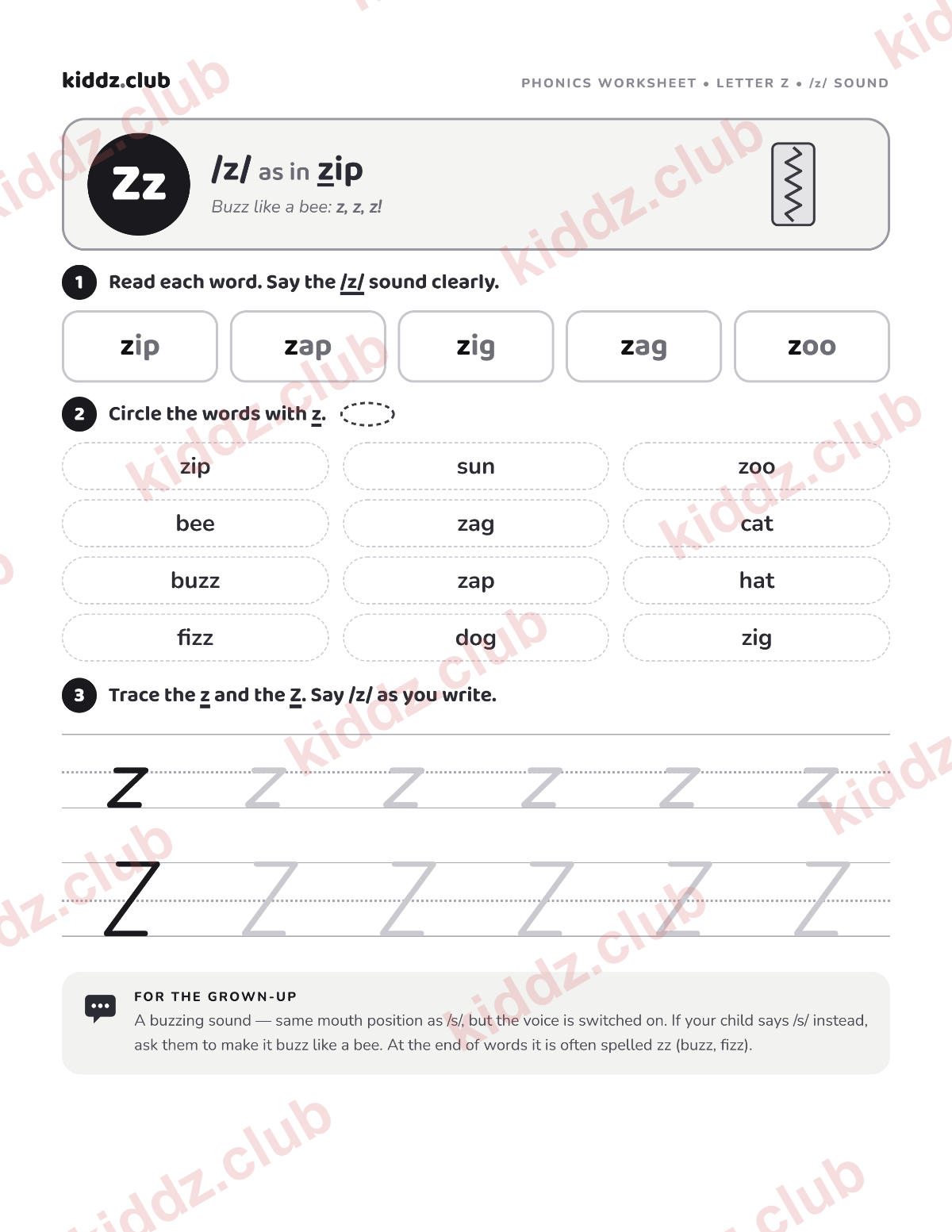
Each activity targets the /z/ sound in a different way:
Activity 1 — Read each word. Five short words featuring the /z/ sound, each with a colorable dot beneath — say the word, color the dot.
Activity 2 — Find and circle. Twelve words shown in a grid; the child circles the words containing the letter Z among look-alike distractors.
Activity 3 — Trace lowercase and uppercase. Four traces of lowercase z, then four traces of uppercase Z. The first of each is a solid model.
Parent note. A small note explaining the /z/ sound — including the voiced/unvoiced contrast with /s/ and tips for helping children feel the difference.
About the letter Z
Z is one of the last letters most kindergartners learn — partly because it's at the end of the alphabet, partly because it appears in fewer English words than common letters like S or T.
The /z/ sound is voiced — your throat vibrates when you say it. Place a finger on your throat while saying zzzzz and you'll feel the buzz. Compare with /s/ (no buzz) to hear the difference: /sss/ and /zzz/ are made the same way in the mouth, just one has voice and the other doesn't.
Z is sometimes confused with S in early writing because both make sustained, sibilant sounds. The distinction is voicing — and the way to teach it is by feel, not just by listening.
How to use this worksheet
A few small things that make this sheet work harder:
Say the sound, not the letter name. When you point at the z, say /zzz/ — not "zee." This applies to every phonics worksheet but is worth repeating with each new letter.
Use the bee mnemonic. "Z buzzes like a bee — zzzz, zzzz." The buzzing action helps kids feel the voicing.
Read the words aloud together. Each of the five reading words has a clear /z/ sound. Take turns reading them so your child hears them in context.
Don't expect mastery in one sitting. Most kids need to see a new letter several times over a week before it sticks. This worksheet is for one of those sittings, not all of them.
When this worksheet is the right level
Use this worksheet if:
- Your child has met most of the alphabet (typical for kindergarten by spring)
- They can read simple CVC words but haven't yet learned z
- They're 4–7 years old
Skip this worksheet if:
- Your child is just starting phonics — focus on the Magic 7 sounds first
- They already read words with z confidently — move on to digraphs and Phase 5 work
Related resources
Part of the free phonics worksheets library — specifically the kindergarten phonics worksheets collection and the full alphabet series.
You may also want:
- Letter S phonics worksheet — the other common voicing-pair letter
- CVC word pack — for when your child can read words with z
- Magic 7 phonics flashcards — earlier-stage sounds
For the parent-facing background:
Common questions
What sound does z make?
Z makes a /z/ sound — voiced and continuous (you can hold it: zzzz). It's the voiced counterpart of /s/. Listen for the buzzing quality in words like zoo, buzz, zigzag, jazz.
When should I teach the letter Z?
Most kindergarten programs teach Z in spring of the kindergarten year, after the foundational letters (S, A, T, P, I, N, M and the next group) are solid. It's part of the "last letters" group along with Q and X.
Why is Z taught later than other letters?
Two reasons. First, Z appears in fewer English words than common letters, so kids don't need it as early. Second, it's positioned at the end of the alphabet, which influences the order most curricula follow. There's no developmental reason to wait, though — kids can learn Z perfectly well at any time.
Should I teach Z before or after S?
After. S is much more common in early reading (it appears in the Magic 7 set). Z comes later, and the contrast with S — same mouth position, different voicing — is easier to teach once S is already solid.
Is this worksheet really free?
Yes. Free for personal, classroom, and tutor use. Print as many copies as you need.
Ready for More Than Worksheets?
Picture This! teaches visualization step-by-step so children can genuinely understand—and enjoy—what they read.