
AU and AW phonics worksheets
au and aw both spell the /aw/ sound — sauce, saw. The rule is short and useful: au never ends a word; aw can — and it likes to sit before n and l (yawn, crawl). This free five-page pack teaches the sound, the rule, and ends with a maze.
One 5-page activity pack: find-and-circle, word sort, missing letters, a decodable story and a phonics maze.
What's in the pack
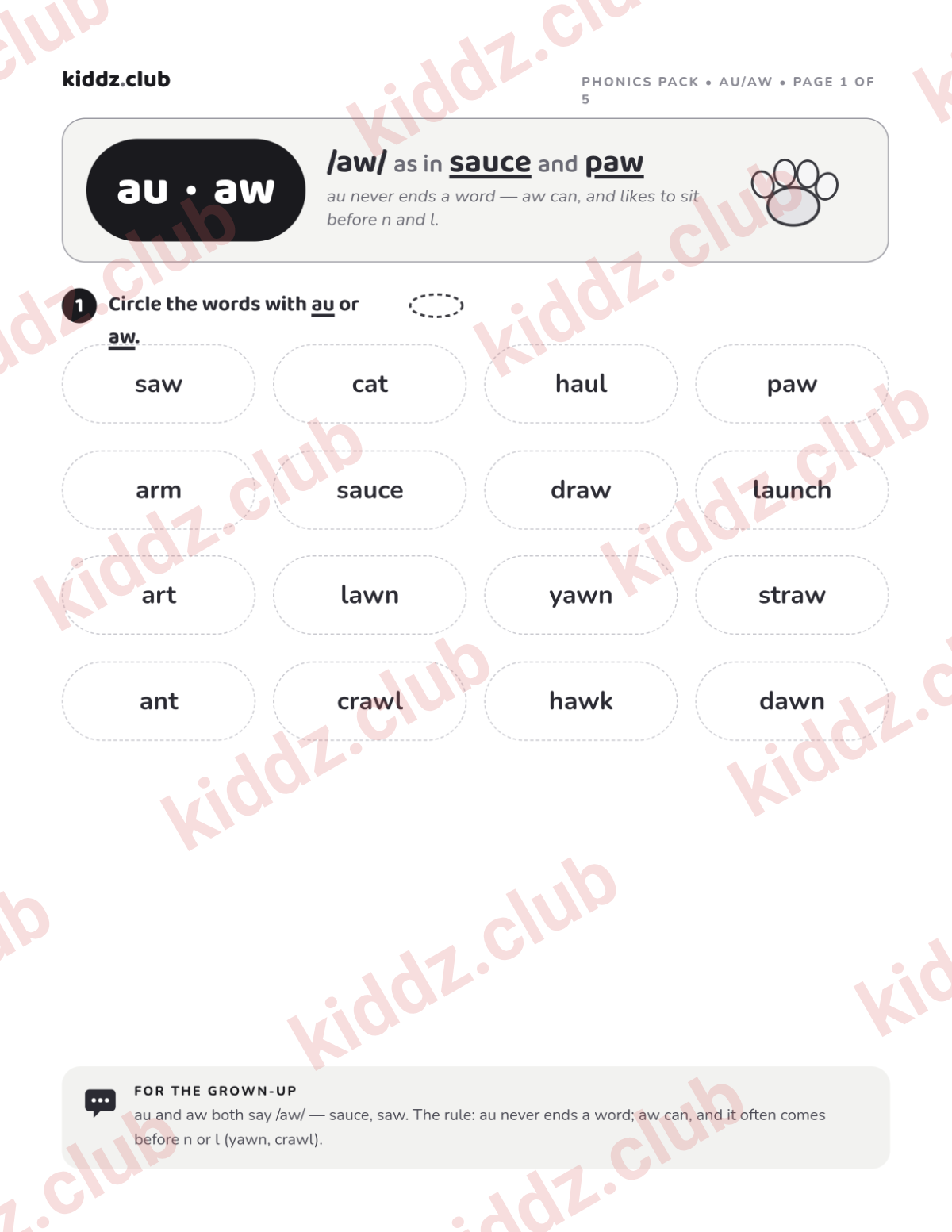
Page 1 — Find and circle. Sixteen words; circle the ones with au or aw.
Page 2 — Word sort. au or aw columns, with the rule as the tip.
Page 3 — Write the missing team. Eight words, first completed as the example.
Page 4 — Read the story. A hawk, a lawn, and straw for the nest — with the star tracker.
Page 5 — Maze time. Help the hawk carry the straw to the nest, stepping only on stones with the /aw/ sound. (You'll need: a pencil.)
How to teach au and aw
Give the rule, then let the sort prove it: au never ends a word (sauce, haul, launch); aw can end one (saw, draw, straw) and often comes before n or l (lawn, yawn, crawl).
The find-and-circle's tricky words (cat, arm, art, ant) share letters but not the sound — listening beats letter-spotting.
When this is the right level
Use this if:
- Your child reads CVC, digraph and magic-e words confidently
- Ages 6–8
Skip this if:
- They're still working on short vowels or digraphs — start with the short vowel worksheets or digraph worksheets
- They're already reading multi-syllable words fluently
Related resources
- Vowel team worksheets hub — all the vowel team packs in one place
- OI and OY phonics worksheets — the /oi/ sound in coin and boy
- OO phonics worksheets — one spelling, two sounds
- OA and OW phonics worksheets — the long o teams in boat and snow
- Long vowel worksheets — single sheets across all the long vowel spellings
Common questions
When do I write au and when aw?
au never ends a word; aw can — and it likes the spots before n and l (yawn, crawl). Inside a word before other letters, it's usually au (sauce, launch).
Why is "author" in the sort?
It shows au living mid-word. It's a longer word, but the au chunk is the only part being tested — reading it whole is a bonus, not a requirement.
What do I need for the maze?
A pencil, and ears: say each word out loud to find the path.
Are these worksheets free?
Yes — free for personal, classroom and homeschool use. Print as many copies as you need.
Ready for More Than Worksheets?
Picture This! teaches visualization step-by-step so children can genuinely understand—and enjoy—what they read.