
Beginning Sounds Worksheets
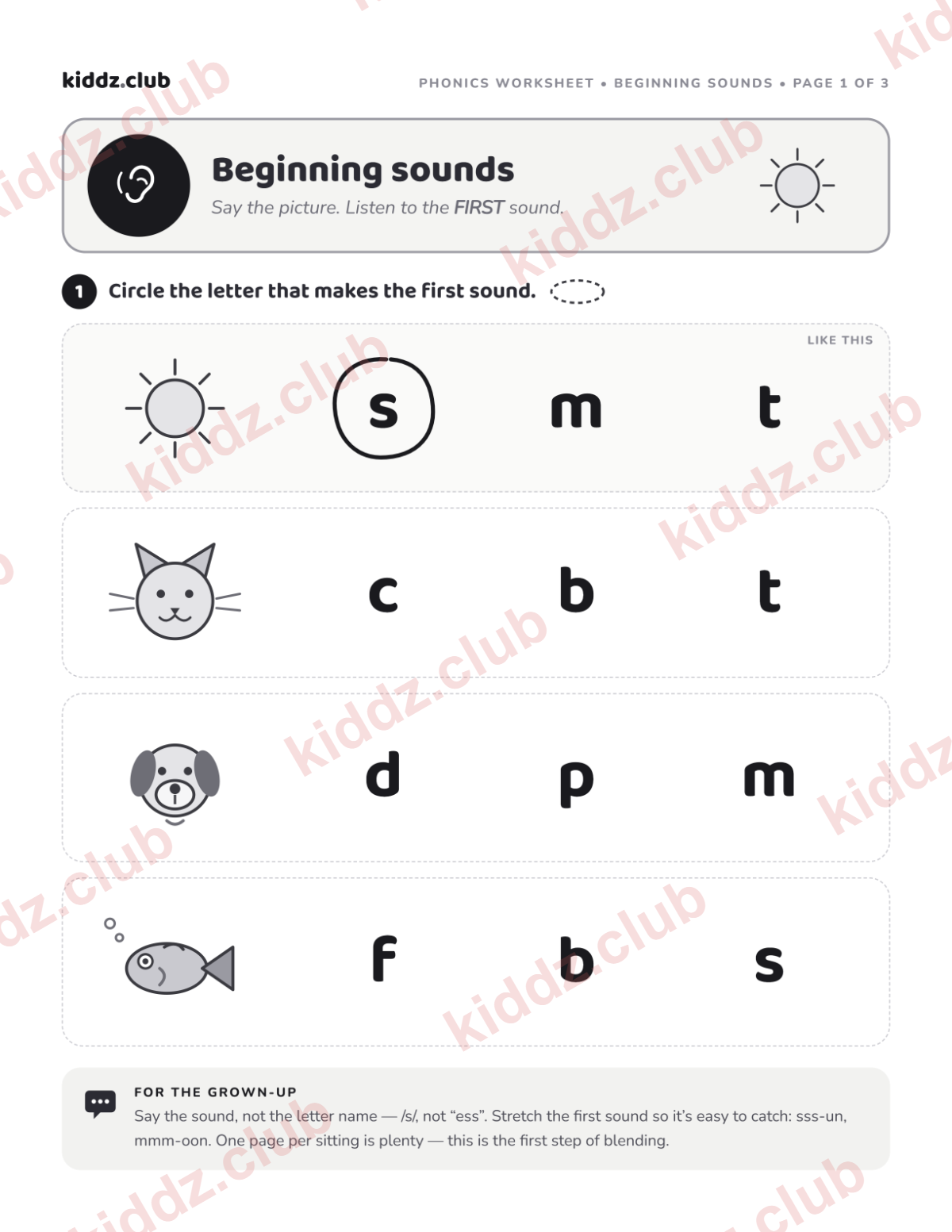
Hearing the first sound in a word — that cat starts with /k/ and sun starts with /s/ — is the very first step of reading. This free 3-page pack builds that skill in the right order: circle the letter, spot the sounds, then write the first letter yourself. Every picture is colorable line art, and each page carries a grown-up tip so you know exactly what to say.
These beginning sounds worksheets (sometimes called initial sounds worksheets) suit preschool through kindergarten — find more pre-reading practice on our preschool phonics worksheets and pre-K phonics worksheets pages.
What's in the pack
- Circle the first sound — say the picture, circle the letter (multiple choice, the gentlest start)
- Sound spotting — circle every picture that starts with /m/
- Write the first letter — with a worked example to copy
How to teach beginning sounds
- Say the sound, not the letter name. /s/, not "ess." Letter names don't blend into words; sounds do.
- Stretch the word's start. sss-un, mmm-oon — exaggerating the first sound makes it easy to catch.
- Play it away from the page too. "I spy something that starts with /m/" in the kitchen is the same exercise. Oral first, page second.
Get the preschool starter bundle by email
Pop your email in and we'll send this beginning sounds pack plus the Magic 7 Flashcards and Activity Pack straight to your inbox — ready to print.
No spam, ever. Your printables arrive either way.
Related resources
- Magic 7 phonics flashcards — the first seven letter sounds (s, a, t, p, i, n, m)
- Preschool phonics worksheets — the full preschool pathway
- Pre-K phonics worksheets — letter recognition for ages 3–4
- Alphabet worksheets — one worksheet per letter, A to Z
- CVC worksheets — first blended words
Common questions
What are beginning sounds?
The first sound you hear in a spoken word — /s/ in sun, /m/ in moon. Isolating that first sound is the earliest phonemic-awareness skill and the doorway to blending and reading. Children practice it entirely by ear; the letters come along for the ride.
Should I say the letter name or the sound?
The sound. Say /s/ (sss), not "ess" — sounds are what build words. Stretch the first sound so it's easy to catch: sss-un, mmm-oon. Letter names can wait.
My child wrote k instead of c for cat. Is that wrong?
It's phonetically perfect — c and k make the same sound, and hearing /k/ correctly is the actual skill this pack teaches. Celebrate it, mention casually that cat happens to use the letter c, and move on. Spelling rules come much later.
What age is this for?
Typically 3½–5. If your child can chat comfortably and enjoys rhymes, they're ready to try page 1. If it's a struggle, shelve it for a few weeks — readiness arrives on its own.
What comes after beginning sounds?
Letter-sound flashcards (start with our Magic 7: s, a, t, p, i, n, m) and then first blended words. Beginning sounds + a handful of letters is everything a child needs to read their first word.
Ready for More Than Worksheets?
Picture This! teaches visualization step-by-step so children can genuinely understand—and enjoy—what they read.