
EE and EA phonics worksheets
ee and ea both spell the long e sound — see, sea. Here's the honest truth: there's no rule for which word uses which. Children learn these by meeting them often — which is exactly what this free five-page pack is built for.
One 5-page activity pack: find-and-circle, word sort, missing letters, a decodable story and a roll-and-read game.
What's in the pack
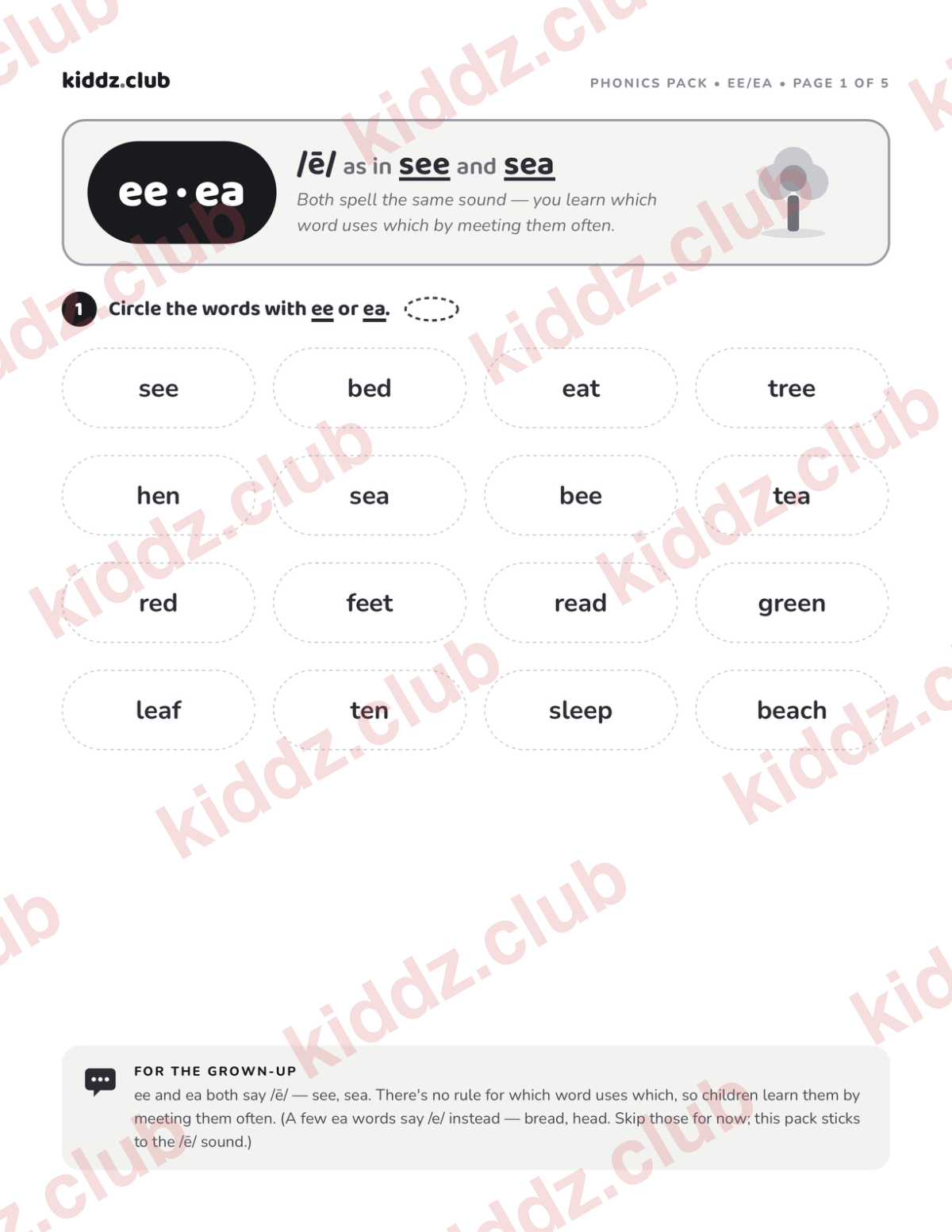
Page 1 — Find and circle. Sixteen words; circle the ones with ee or ea (see, eat, tree, sea, bee, tea, feet, read, green, leaf, sleep, beach). The other words (bed, hen, red, ten) are there on purpose — they contain similar letters but not the team.
Page 2 — Word sort. Write each word from the word bank (see, eat, tree, sea, feet, read, green, leaf, three, dream, sheep, clean) into the right column — ee in one, ea in the other.
Page 3 — Write the missing team. Eight words with the vowel team missing — tree is completed as an example, then sea, feet, read, green, leaf, sleep, beach. Say the word out loud first, then decide which team spells it.
Page 4 — Read the story. A short decodable green-tree story using the pack's words, with a "read it three times — colour a star each time" tracker.
Page 5 — Roll and read. A dice game with 24 mixed ee/ea words — roll, read a word from that column, cross it out. Two players: first to clear a column wins. (You'll need one die.)
How to teach ee and ea
There's no rule to teach here — so teach honestly: "both teams say /ee/; we learn which word uses which by reading them lots." Children accept that far more readily than a rule that keeps breaking.
Volume and repetition are the method. The pack's five different activities are five different meetings with the same words — circle them, sort them, write them, read them in a story, then race through them in a game. By the fifth meeting, tree just looks right with ee and sea just looks right with ea.
Note for parents: a few ea words say /e/ instead (bread, head). They're deliberately left out of this pack — they're taught later as their own pattern, so nothing here contradicts what your child is learning.
When this is the right level
Use this if:
- Your child reads CVC, digraph and magic-e words confidently
- Ages 6–8
Skip this if:
- They're still working on short vowels or digraphs — start with the short vowel worksheets or digraph worksheets
- They're already reading multi-syllable words fluently
Related resources
- Vowel team worksheets hub — all the vowel team packs in one place
- AI and AY phonics worksheets — the long a teams in rain and play
- OA and OW phonics worksheets — the long o teams in boat and snow
- Long vowel worksheets — single sheets across all the long vowel spellings
- Magic-e worksheets — the first way English spells the long vowels
Common questions
Is there a rule for ee vs ea?
No reliable one — and pretending there is confuses children. Frequency and exposure build the memory of which word uses which spelling, which is exactly what this pack provides.
What about words like "bread" and "head"?
That's ea making a different sound (/e/). It's a separate pattern taught later; this pack sticks to the /ee/ sound so nothing contradicts.
Should I teach ee/ea before or after ai/ay?
After ai/ay works well — start with the team that has a rule, then introduce the idea that some teams are learned by sight of the word.
Are these worksheets free?
Yes — free for personal, classroom and homeschool use. Print as many copies as you need.
Ready for More Than Worksheets?
Picture This! teaches visualization step-by-step so children can genuinely understand—and enjoy—what they read.