
Free 1st grade phonics worksheets
Printable phonics worksheets for 1st grade children (ages 6-7) — covering the patterns children need to move from sounding out simple words to reading independently. Every worksheet on this page is free, designed by phonics teachers, and ready to print at home or in the classroom.
The materials follow the synthetic phonics approach used in most modern 1st grade programs (Letters and Sounds, Jolly Phonics, Read Write Inc., and similar). They build directly on the sounds learned in kindergarten, moving into two-letter patterns, the silent e rule, and longer vowel spellings.
Not there yet? If your child is still working on basic letter sounds and three-letter words, start with the kindergarten phonics worksheets first — these 1st grade materials assume that foundation is in place.
Quick navigation
The 1st grade pathway — how the skills build on each other
Consonant digraphs — sh, ch, th, ng, ck
Consonant blends — 30 worksheets covering every common blend
Magic e — the silent e rule that changes how a vowel sounds
Long vowel spellings — ai/ay, ee/ea, oa/ow, oo, igh
Vowel team activity packs — five-page packs for ai/ay, ee/ea, oa/ow
R-controlled vowels — ar, or, ur, ir, er
The 1st grade phonics pathway
1st grade phonics moves in a clear direction: from single-letter sounds (kindergarten) toward multi-letter patterns where two or more letters work together. Here's how the skills stack up:
- Consonant digraphs — two consonants that make one new sound: sh, ch, th, ng, ck. These come first because they appear in simple words children are already reading.
- Consonant blends — two consonants where both sounds are heard: stop, frog, blend. Taught alongside digraphs or just after, in family groups.
- Magic e — a silent e that changes the earlier vowel: cap → cape, kit → kite. Unlocks hundreds of common words at once.
- Long vowel spellings — the same long vowel sound spelled different ways: ai/ay, ee/ea, oa/ow, oo, igh. Phase 5 territory — start with the vowel team activity packs.
- R-controlled vowels — a vowel followed by r that makes a new sound: ar, or, ur/ir/er. Essential for reading everyday words like car, fork, bird.
You don't need to complete each group before starting the next. Children often learn two or three patterns at once, especially once reading is flowing. Follow your child's school sequence if they have one.
Consonant digraph worksheets
A consonant digraph is two consonants that together make one new sound — not the individual sounds of the two letters. The sh in ship isn't /s/ + /h/; it's a completely new sound. Children need to recognize and memorize these as units.
Five free worksheets, one per digraph, each with three activities (find-and-circle, read aloud, and tracing):
- SH worksheet — ship, shop, wish, dash. The shushing sound; teach this one first.
- CH worksheet — chip, chin, much, bench. The train-chugging sound.
- TH worksheet — this, thin, with, bath. The tongue-between-teeth sound.
- NG worksheet — ring, sing, long, bang. The humming end-of-word sound.
- CK worksheet — duck, clock, stick, black. The /k/ sound after a short vowel.
All five are also available together on the consonant digraph phonics worksheets page, with teaching notes on how digraphs differ from blends.
Consonant blend worksheets
A consonant blend is two consonants where you can hear both sounds. Stop has /s/ and /t/, both audible. This is different from a digraph, where the two letters make one new sound.
Thirty free worksheets — 20 initial blends (word-starting) and 10 final blends (word-ending):
- L-blends: bl, cl, fl, gl, pl, sl
- R-blends: br, cr, dr, fr, gr, pr, tr
- S-blends: sc, sk, sm, sn, sp, st, sw
- Final blends: nd, nk, nt, mp, st, sk, lt, ft, lk, lp
See the phonics blends worksheets page for all 30, organized by blend family, with teaching notes on the stretch-then-blend technique.
Initial and final blends also have their own dedicated pages with download buttons and teaching notes:
Magic e worksheets
The magic e rule — also called split digraph or CVCe pattern — is where a silent e at the end of a word changes the earlier vowel. Compare:
- cap → cape (short a → long a)
- kit → kite (short i → long i)
- hop → hope (short o → long o)
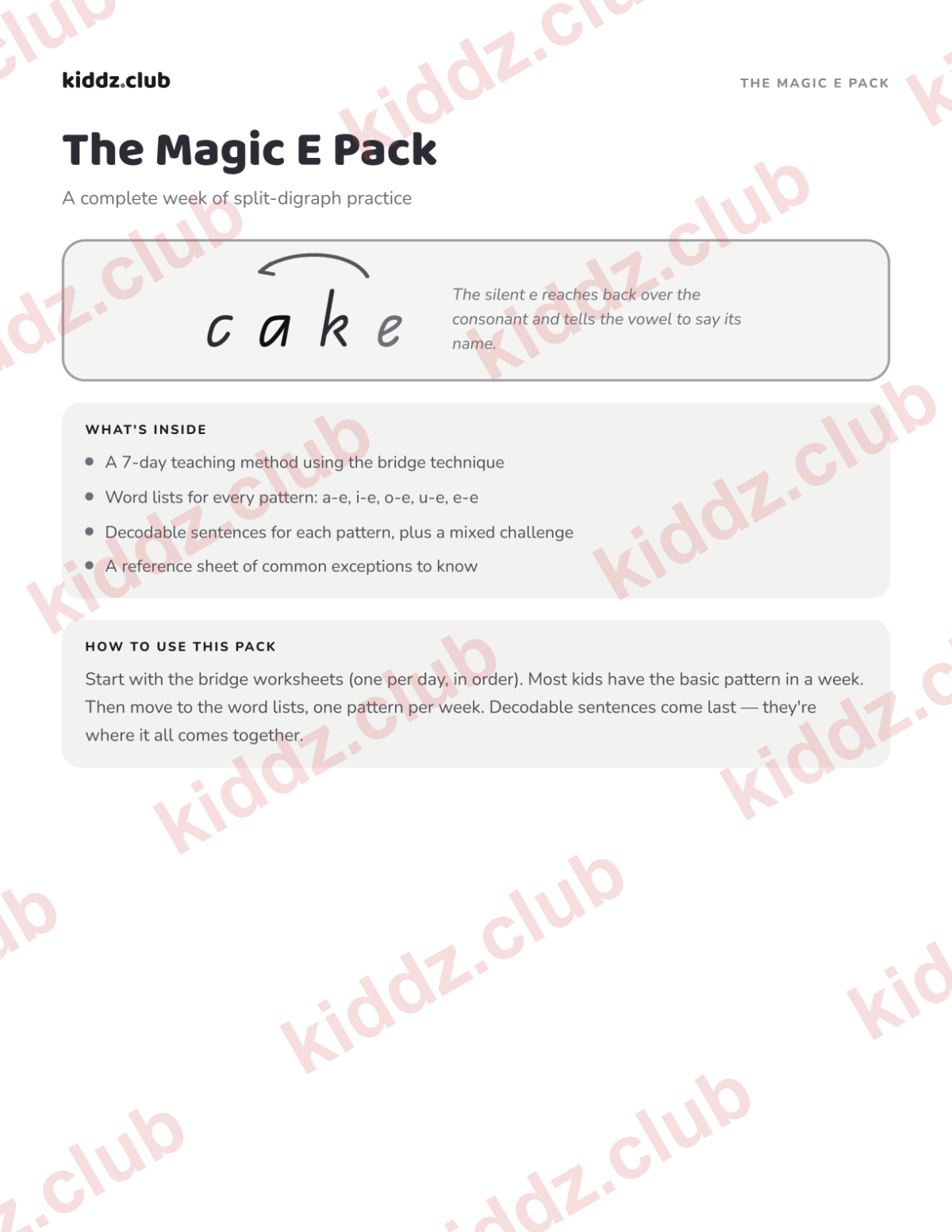
The Magic E Pack is a free 20-page printable covering all five patterns (a-e, i-e, o-e, u-e, e-e). It uses the bridge method — a visual curved arrow from the silent e back to the earlier vowel — which helps children see the relationship rather than just memorizing a rule. Includes:
- 7 sequential bridge-method lessons
- Full word lists for each pattern
- Decodable sentences
- A parent reference for common exceptions (have, give, come)
Most children work through the pack in 7-14 days, one lesson per session.
Long vowel spelling worksheets
Once magic e is solid, the next territory is the vowel team spellings — the same long vowel sounds written with two letters in the middle of a word.
Eight free worksheets, one per vowel team, from the long vowel phonics worksheets page:
- AI — rain, train, paint (long /ay/ in the middle of a word)
- AY — play, day, stay (long /ay/ at the end of a word)
- EE — tree, feet, sheep
- EA — beach, leaf, sea
- OA — boat, road, coat (long /oa/ in the middle)
- OW — snow, blow, grow (long /oa/ at the end)
- OO — moon, food, pool (the long version)
- IGH — light, night, right
The positional rules are the key teaching tool here: ai in the middle, ay at the end — oa in the middle, ow at the end. These give children a reasoning process when they're unsure which spelling to use.
More vowel team spellings (ew/ue) — coming soon.
Vowel team activity packs
Beyond the single worksheets above, the six most common vowel team pairs each have a free five-page activity pack, each ending in a phonics game. The packs cover ai/ay (the team with a real position rule), ee/ea (learned by meeting the words often), oa/ow (including the tricky two sounds of ow), oo (one spelling, two sounds), oi/oy (the ai/ay rule reused) and au/aw (with a hawk-and-nest maze).
All six packs, with teaching notes and a recommended order, are on the vowel team phonics worksheets page.
R-controlled vowel worksheets
R-controlled vowels — sometimes called "bossy r" — are vowels followed by the letter r that make a new sound. The r changes how the vowel sounds:
- AR — car, star, park
- OR — fork, born, storm
- UR / IR / ER — all three make the same /er/ sound: turn, bird, her
Five free worksheets, one per pattern, from the r-controlled vowel worksheets page. Teaching tip: introduce ur, ir, and er together with the framing "three spellings, one sound" — this is less confusing than treating them as three separate patterns.
Interactive tools for 1st grade readers
Free tools to support practice beyond the printables:
- CVC Word Generator — tick which sounds your 1st grader knows and get a custom list of decodable words and sentences. Useful for building fluency with specific patterns before introducing the next one.
- Phonics Sound Player — tap any of the 44 English sounds to hear it pronounced correctly. Useful when a child isn't sure how a digraph or blend is supposed to sound.
- Reading Age Estimator — eight quick questions to find out where your 1st grader actually is in their reading development, plus one concrete thing to work on this week.
How 1st grade phonics actually works
A short practical guide for parents supporting a 1st grade reader.
The single biggest shift from kindergarten: in kindergarten, children learn that every letter has a sound. In 1st grade, they learn that letters work in teams — and the team's sound is often different from the sounds of the individual letters. SH doesn't sound like /s/ + /h/. IGH doesn't sound like /i/ + /g/ + /h/. The team has its own sound.
Show, don't just explain. For digraphs and vowel teams, the teaching technique that works is: point at the letters together, say the sound, find words that have it. "These two letters together always say /sh/. Watch — ship. Shell. Shout." Then repeat over a week.
For blends, stretch then merge. Say each sound slowly — fff-rrr-og — then say them faster until the word emerges. The child hears the individual sounds and the whole word at once.
For magic e, use the visual. A curved arrow from the silent e back to the earlier vowel (the bridge method) works better than the rule "the e is silent." Let them draw the arrow themselves until the pattern is automatic.
Ten to fifteen minutes a day. That's plenty. Short daily practice beats long weekly sessions, and a child who ends a session wanting more will be easier to engage tomorrow.
What comes after 1st grade phonics
Once the 1st grade patterns are solid — digraphs, blends, magic e, common vowel teams, r-controlled vowels — most children are ready to move into multi-syllable words, prefixes and suffixes, and the more complex vowel team spellings. That's 2nd grade territory and largely the world of vocabulary and reading fluency rather than phonics instruction.
Finished the first grade skills? Move on to the 2nd grade phonics worksheets — vowel teams, r-controlled vowels and review packs, organised in teaching order.
For parents of kindergartners approaching 1st grade material, see our kindergarten phonics worksheets for the foundational skills these materials build on.
Related articles for parents
- How to teach phonics at home
- What is a split digraph?
- How to teach magic e to a child who doesn't get it
- What to do when your child guesses instead of reading
- Why English spells the same sound so many ways
Get the 1st grade phonics bundle by email
Pop your email in and we'll send the Magic E Pack, the consonant digraph worksheets, and the long vowel worksheets straight to your inbox — ready to print.
No spam, ever. Your printables arrive either way.
Want the entire printables library?
Kiddz.club members can download every printable on the site as one zip — plus full access to the Picture This! reading program. Start with a free 7-day trial.
Common questions about 1st grade phonics worksheets
What phonics skills does a 1st grader need?
1st graders typically work through consonant digraphs (sh, ch, th, ng), consonant blends (st, bl, fr, nd), the magic e pattern (cake, kite, hope), long vowel spellings (ai, ay, ee, ea, oa, ow), and r-controlled vowels (ar, or, ur, ir, er). Most programs follow this order, though the exact sequence varies.
How is 1st grade phonics different from kindergarten phonics?
Kindergarten phonics focuses on individual letter sounds and three-letter CVC words (cat, sun, pig). 1st grade moves into multi-letter patterns — two letters that make one sound (digraphs), two consonants blended together (blends), and the silent e rule that changes a vowel's sound. The words get longer, and spelling gets more complex.
What order should I teach 1st grade phonics in?
A typical order: (1) consonant digraphs — sh, ch, th, ng; (2) consonant blends — l-blends, r-blends, s-blends, then final blends; (3) magic e — a-e, i-e, o-e, u-e; (4) long vowel teams — ai/ay, ee/ea, oa/ow, oo, igh; (5) r-controlled vowels — ar, or, ur/ir/er. Follow your child's school curriculum if they have one.
How long should a 1st grader spend on phonics each day?
Ten to fifteen minutes of focused phonics practice daily is plenty. That might be five minutes of reading new words, five minutes with a worksheet, and a few minutes re-reading something familiar. Shorter daily sessions beat longer weekly ones every time.
Are these worksheets aligned with my school's phonics program?
These materials follow synthetic phonics — compatible with Letters and Sounds, Jolly Phonics, Read Write Inc., Saxon, and most others. The exact teaching order varies between programs; use these worksheets in whatever order your school follows.
What if my 1st grader is still struggling with CVC words?
Go back. 1st grade phonics builds on CVC blending — if that isn't solid, the digraph and blend work will be frustrating. Spend two to four weeks on the kindergarten materials (Magic 7 sounds, CVC word pack, decodable sentences) before moving into 1st grade patterns. Most children who seem "behind" are just missing one or two foundational pieces.
Ready for More Than Worksheets?
Picture This! teaches visualization step-by-step so children can genuinely understand—and enjoy—what they read.